
Pine Wood Favor Basket with Handle
Wholesale pine wood favor basket with finger-joint corners, metal-reinforced wooden handle, and classic rectangular trug design, built for wedding favors, holiday gift hampers, and retail product display.
Key Features
- Solid pine construction with finger-joint corners — mechanical interlock that won't separate under load
- Sturdy swing-handle attached with metal screws and washers — comfortable one-handed carry
- Classic trug-style rectangular profile with slightly tapered sides for visual lightness
- Natural unfinished surface ready for staining, painting, or custom branding
- Available in medium and large sizes — fits favor bags, candles, small plants, and bottle sets
$0.68 - $3.40 / piece
Prices vary based on order quantity, dimensions, material selection, and logo printing method. Send an inquiry.
Specifications
- Wood Type
- Solid pine wood
- Dimensions
- Medium (26 x 15 x 12 cm), Large (29 x 20.5 x 16 cm)
- Design
- Open top rectangular basket with a fixed wooden handle
- Surface Finish
- Natural (sanded smooth)
- Usage
- Wedding favors, gift hampers, retail packaging, floral arrangements
- Customization
- Available for custom sizes, finishes, and engraved logos
Applications
Wedding favor distribution
A wooden basket on the gift table elevates favor presentation from 'help yourself from a cardboard box' to 'curated wedding detail.' Guests take a favor; the basket stays as a reusable display piece. The natural pine finish complements rustic, barn, garden, and boho wedding aesthetics.
Holiday gift hamper assembly
Fill with seasonal products — jams, chocolates, candles, mini wine bottles — and the basket becomes part of the gift. Unlike a wicker basket that can snag fabrics or shed fibers, the smooth wood surface is clean and splinter-free. The handle makes it carry-ready for hand-delivery or event pickup.
Retail product display and merchandising
On a store shelf or counter, wooden baskets organize loose products (soaps, sachets, seed packets, candy) into browsable displays. The tapered sides give visual access to contents from above, and the solid bottom means nothing falls through. At the end of the season, the baskets are durable enough to reuse for the next display.
Customization Options
Dimensions. Standard medium: approximately 25cm × 18cm × 12cm (L×W×H, excluding handle). Standard large: approximately 30cm × 22cm × 15cm. Custom dimensions available — the finger-joint jig adjusts to different board widths, so length and width changes don't require new tooling. Height changes are a simple board-width adjustment.
Wood Species. Pine is standard — best value for volume orders, takes stain and paint well. Paulownia: lighter weight (~280 kg/m³ versus pine at ~400 kg/m³), lower shipping cost per unit, but softer surface that dents more easily. Birch plywood: no knots, uniform appearance, excellent screw retention at handle attachment points.
Finish. Standard: natural unfinished — sanded smooth, ready for your own finishing or branding. Available: clear satin coat, custom stain (any tone), or opaque paint (any color). Distressed whitewash finish popular for farmhouse and shabby-chic retail aesthetics.
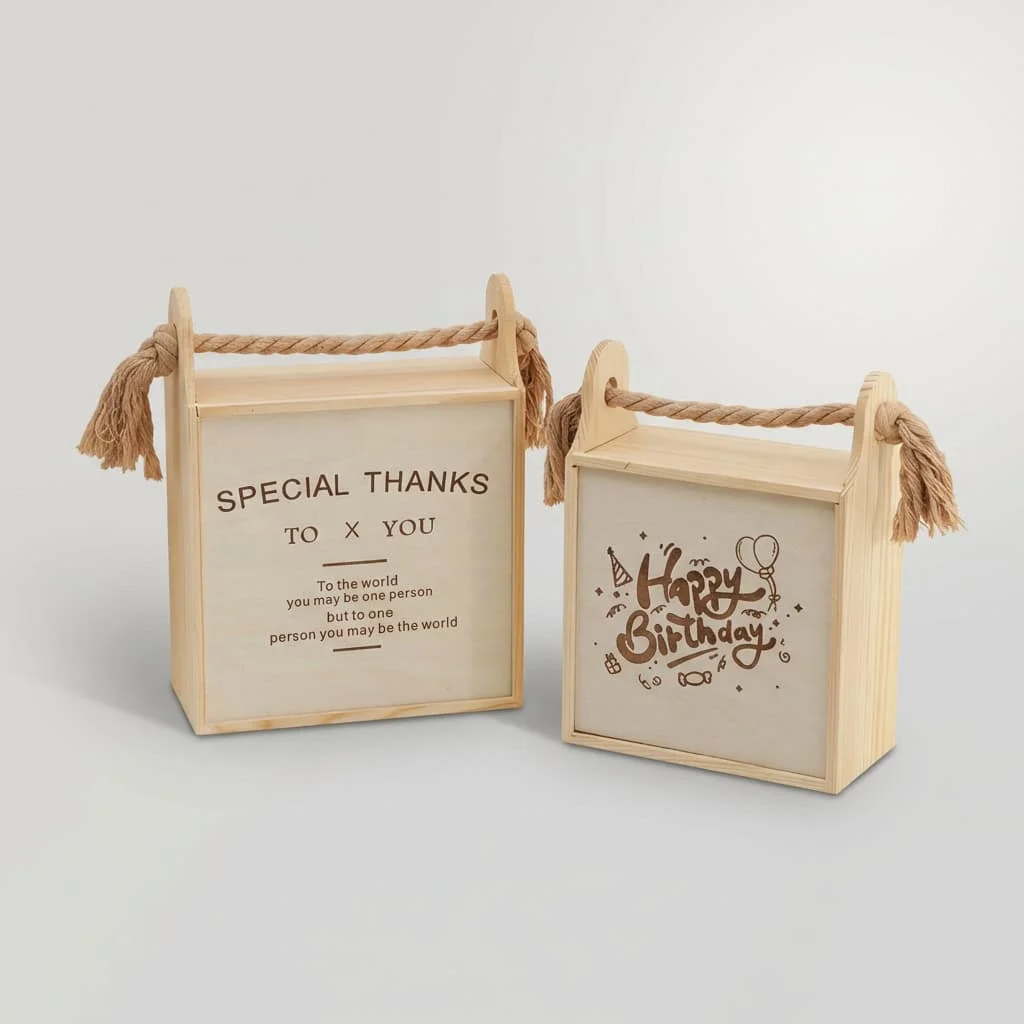
Branding. Laser engraving on the front face — dark, permanent mark. Screen printing on the side panel — full color, most visible. Hot stamp branding on the handle — subtle, discovered when lifted. Custom hang tags can be attached to the handle for removable branding.
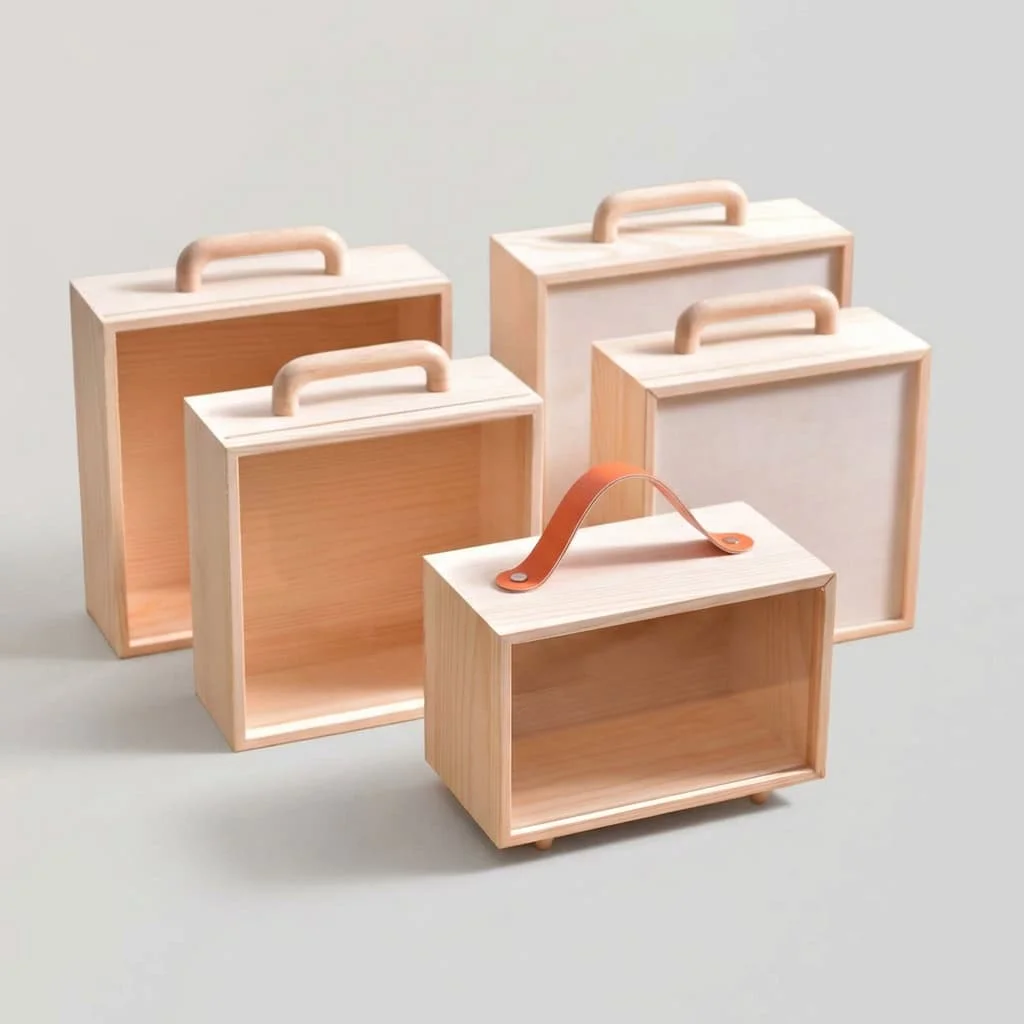
Handle Options. Standard: solid wood swing handle with metal hardware. Available: rope handle (nautical, rustic), leather-wrapped handle (premium touch), or no handle (open-top crate configuration).
Ready to get a recommendation?
Send us your requirements — we'll respond with material and production recommendations within 24–48 hours.
Why This Design Works
The trug shape has been working for centuries — here's why. A rectangular basket with slightly tapered sides and a central handle is one of the oldest woodworking forms because it solves several problems simultaneously: it's stable on a flat surface, it's carryable with one hand, the tapered sides mean stacked baskets nest partially for storage, and the open top gives immediate visual and physical access to contents. There's no lid to open, no latch to break — it's the simplest wooden container that fully works.
Finger joints at the corners do the real work. A butt joint with nails or staples will eventually work loose as the wood expands and contracts — and when it does, the corner opens up and small items fall through. Finger joints multiply the glue surface area by 3–4× versus a butt joint and add mechanical interlock. When a fully-loaded basket is lifted by the handle, the bottom corners take tension; finger joints transfer that load through alternating wood fingers rather than relying on glue alone.
Metal-reinforced handle attachment means the handle outlasts the basket. The wooden handle is attached to the side walls with metal screws passing through metal washers. This spreads the pull force across a larger area of the wood than a simple screw head alone. The washers prevent the screw from countersinking deeper into the soft pine over time — a common failure mode with unreinforced handle attachments where the screw gradually pulls through the wood with repeated use.
Manufacturing Considerations
Finger-joint fit tolerance is the #1 QC checkpoint. Finger joints are cut with an interlocking comb profile — if the fingers are too tight, the joint won't close fully without excessive clamping pressure, which can crack the wood. Too loose, and the glue gap is visible and structurally weak. The target finger-to-slot clearance is 0.1–0.15mm: tight enough that glue fills the gap, loose enough that the joint assembles without force. We check the first assembly from each jig setup and spot-check throughout the run — if finger fit changes, the tooling needs sharpening or replacement.
Pine knots near corner joints are a material yield issue. Pine boards have knots. If a knot lands within 15mm of a finger-joint cut, the finger can break off during machining or in use — the knot interrupts the grain continuity that gives the finger its strength. We grade boards before cutting and position knot-free sections at the joint ends. This reduces material yield (knotty sections become shorter boards or are rejected), which is part of why knot-free pine baskets cost more than knot-allowed ones.
Bottom panel attachment method matters for long-term durability. The solid wood bottom is rabbeted into a groove along all four side walls — the bottom panel sits in a recess, not just nailed on from underneath. This means the weight of the contents presses the bottom into its groove rather than pulling on fasteners. For heavy loads, we add a few small nails or staples through the bottom into the side walls as insurance, but the groove carries the primary load.
Have a technical concern about your use case? Our team can walk you through how we'd handle it for your project.
Start Your Project
Send us your design or reference images — we'll return with a pre-production sample for your approval.
Customization Services
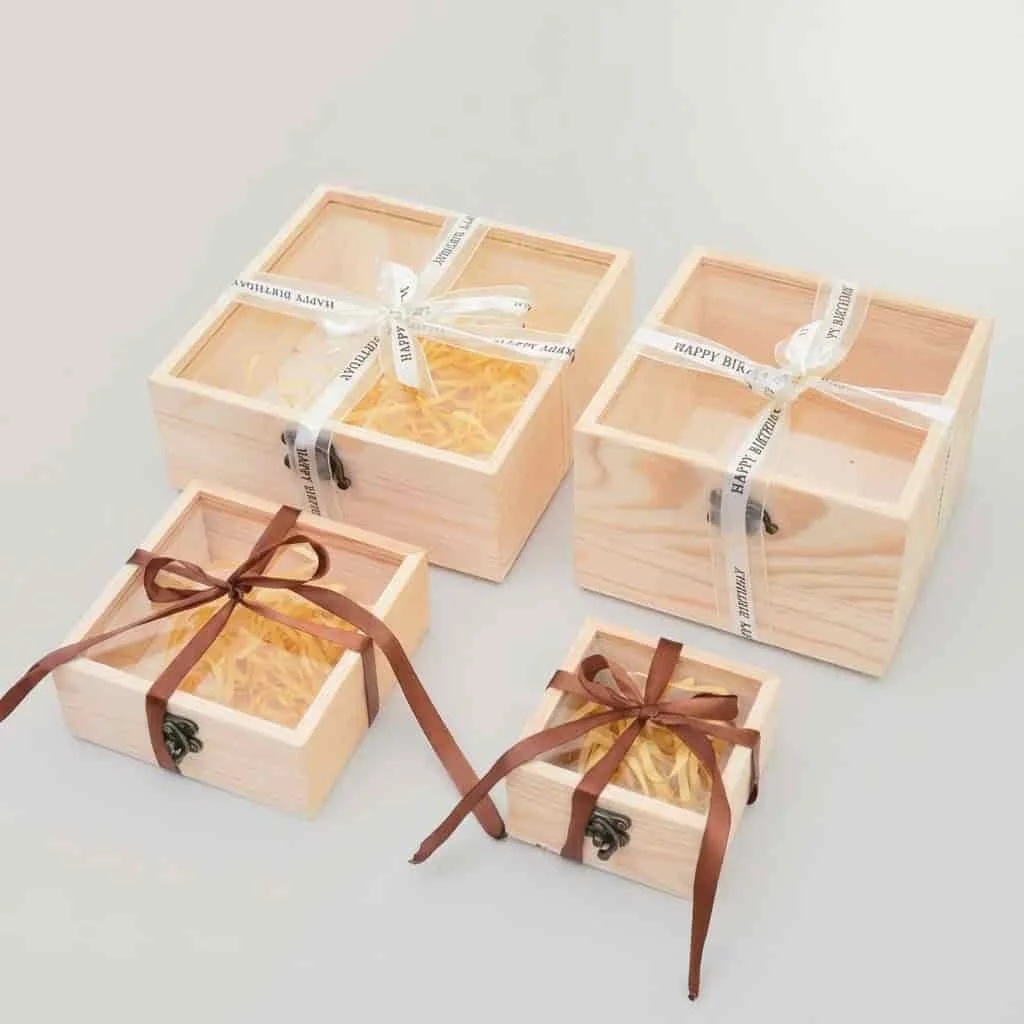
We provide complete customization options for wholesale buyers. Whether you need specific dimensions to fit your products, a stained finish, or custom logo engraving on the side panels, our team will manufacture the baskets to your exact specifications.
Frequently Asked Questions
Q: Can the basket hold bottles or heavier items?
Q: Does the unfinished pine need to be sealed before use?
Q: Can these baskets be nested for storage and shipping?
Q: What's the difference between this pine basket and a wicker basket for wedding favors?
Q: Can I get these baskets pre-filled with shredded paper or straw for retail display?
Send Us Your Requirements
Send your design, reference images, or product sample. We don't just quote a price — we respond with material recommendations, a feasibility assessment, and professional suggestions grounded in over 20 years of manufacturing experience. Expect a detailed response within 24–48 hours.
- Professional recommendations included
- Small MOQ & trial orders supported
- Worldwide shipping with export documentation