
Poplar Veneer Cake Box: Small Round, Square, and Oval Wooden Mousse and Cheese Packaging
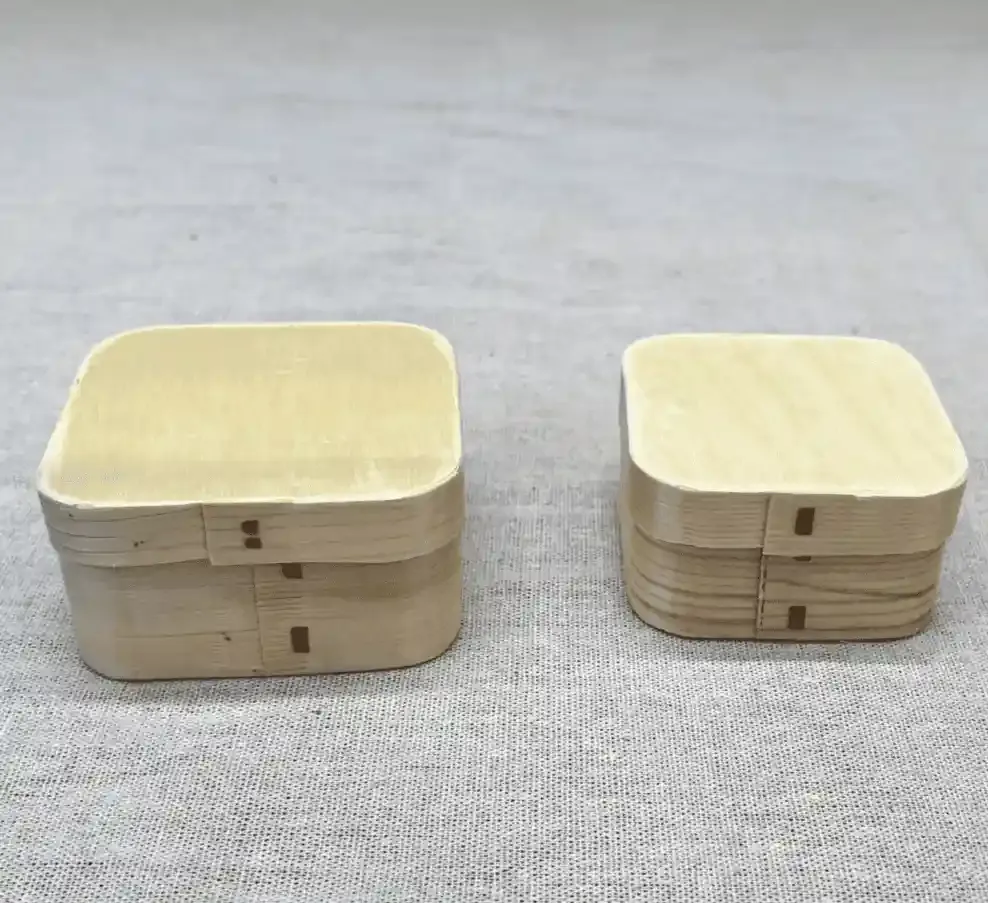
Miniature poplar wood veneer dessert container in round, square, and oval profiles, suitable for commercial bakeries, patisseries, and food packaging distributors.
Key Features
- Genuine poplar wood veneer — not particle board or MDF with wood-look laminate; the natural wood grain is visible and the container is fully biodegradable
- Three shape options — round (4.9×3.6 cm), square (4.8×3.5 cm), and oval (6.2×4.6×3.6 cm); each shape suits different dessert profiles and brand aesthetics
- Miniature single-serving format — sized for individual mousse cups, mini Basque cheesecakes, double-layer cheese, and petit fours; the container IS the portion guide
- Food-safe natural surface — no chemical coatings, no formaldehyde glues; the poplar veneer is formed with food-grade adhesive and arrives ready for direct food contact
- Hot-stamp-ready exterior — the smooth unfinished poplar surface accepts foil hot stamping with high contrast; no pre-treatment or sealing required before branding
$0.48 - $2.40 / piece
Prices vary based on order quantity, dimensions, material selection, and logo printing method. Send an inquiry.
Specifications
- Material
- Natural poplar wood veneer (1.0–1.5mm)
- Shapes
- Round, Square, Oval
- Oval
- 6.2 × 4.6 × 3.6 cm | Square: 4.8 × 3.5 cm | Round: 4.9 × 3.6 cm
- Surface Finish
- Natural, food-safe
- Application
- Mousse, cheese, mini cakes, bakery and patisserie packaging
- Customization
- Shape, dimensions, interior coating, branding, and lid options
Applications
Bakery and patisserie retail
Where individual desserts need packaging that matches the craftsmanship inside — a paper box says 'takeout'; a wooden veneer container says 'gift' and supports a higher retail price for the same mousse.
Hotel and catering dessert service
Where banquet desserts are pre-portioned into wooden containers for plated service or buffet presentation — the container becomes the serving vessel, reducing plating labor and creating a consistent visual across hundreds of covers.
Cheese and charcuterie packaging
Where artisan cheese producers and gourmet food brands package individual portions — the breathable wood veneer regulates humidity better than plastic, preventing the surface sweat that plastic-wrapped cheese develops.
Customization Options
Shape and dimensions: Round, square, and oval are standard in the miniature sizes listed. Custom shapes — hexagonal, rectangular, or custom silhouette — require new forming molds. Custom dimensions within ±20% of standard sizes are achievable without new tooling. Large-format versions (for full-size cheesecakes or whole cheese wheels) are a separate product requiring mold development.
Wood species: Poplar veneer is standard — light color, fine grain, excellent formability for bent-wood construction, and food-safe. Birch veneer for a slightly darker, harder option with finer grain. Pine veneer for a more rustic, knotty look — less uniform but popular for farmhouse-style bakeries. Veneer thickness is typically 1.0–1.5mm — thick enough to hold its shape, thin enough to bend without cracking.
Interior finish: Natural unfinished is standard — food-safe and allows the dessert to breathe. Optional: food-grade wax coating for moisture resistance (recommended for high-moisture desserts like mousse that will sit in the container for more than 4 hours). Parchment paper liner — adds a barrier layer and a rustic bakery look. Custom-printed liners with your brand pattern.
Exterior branding: Hot foil stamping is the most popular and cost-effective — gold, silver, copper, or black foil on the natural poplar surface produces sharp, durable branding. Laser engraving for a subtler, debossed mark. Custom labels or belly bands. Direct printing on the wood surface via silk screen for multicolor logos.
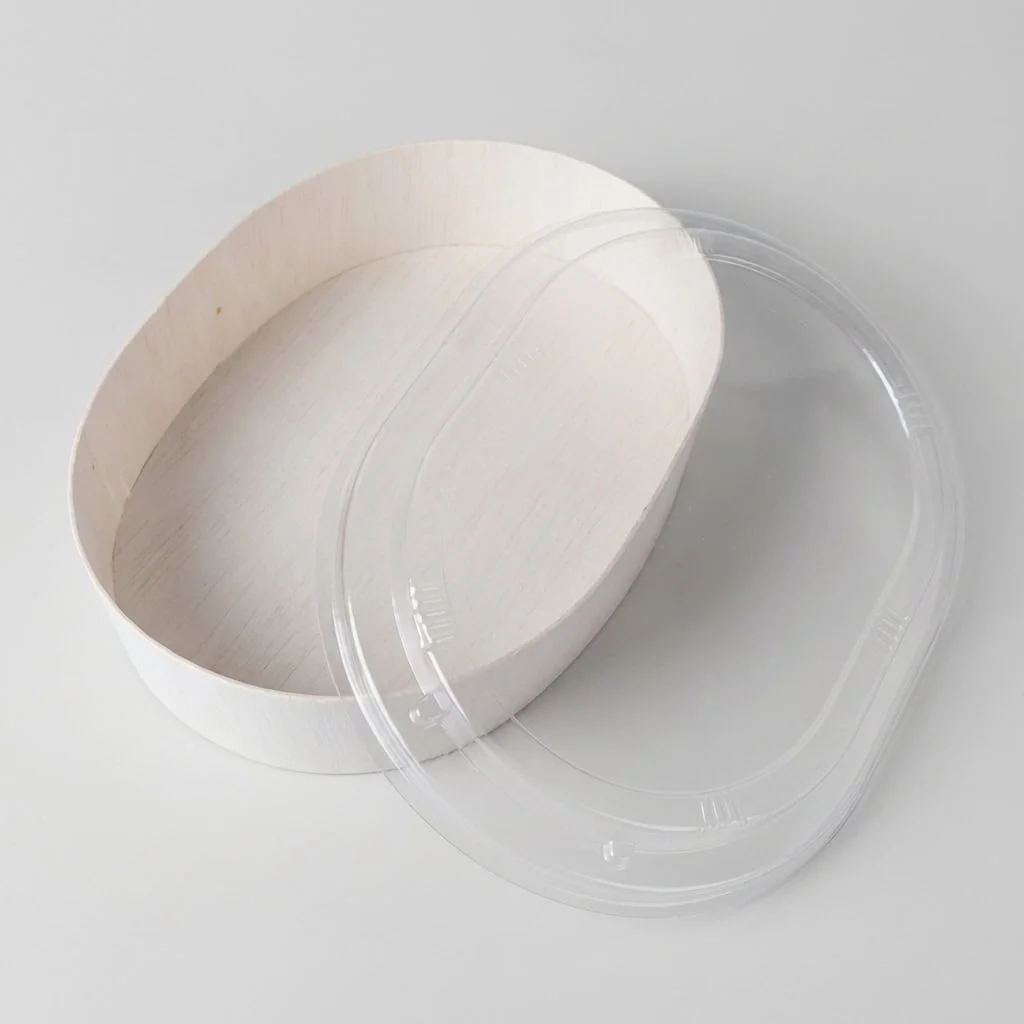
Lid options: The container is typically open-top for bakery counter display. Clear PET snap-on lids available for refrigerated retail where the dessert must be visible and protected. Wooden slip lids for a fully wood presentation — more expensive but fully compostable. Lid choice depends on whether the container is for counter display (open) or refrigerated grab-and-go retail (lidded).
Ready to get a recommendation?
Send us your requirements — we'll respond with material and production recommendations within 24–48 hours.
Why This Design Works
Poplar veneer at 1.0–1.5mm is the right material for a single-use food container that needs to look premium. Solid wood at this miniature scale (5–6 cm diameter) would be disproportionately expensive — the material cost per unit is manageable, but the machining time to hollow a solid block versus forming a veneer shell is roughly 4:1. Veneer forming uses a heated press mold — the poplar veneer is softened with steam, pressed into shape, and trimmed, producing a consistent thin-walled container in seconds per unit. Solid wood hollowing on the same shape would take minutes per unit on a CNC. For a product that sells by the carton (200–500 units) at a price point where packaging can't exceed the dessert cost, that production speed difference is decisive.
Three shapes serve different dessert categories — this isn't arbitrary variety. Round suits mousse cups and individual cheesecakes — the curved wall matches the natural shape of piped desserts and there are no corners where product gets trapped. Square suits firm desserts like Basque cheesecake and brownies — the straight walls match the way these desserts are portioned (cut into squares), so there's minimal gap between dessert and container. Oval suits elongated pastries like eclairs, fruit tarts, and sliced cheese portions — the shape follows the food's natural geometry. A bakery that produces all three dessert types can stock all three shapes and visually differentiate products by container shape without reading the label.
The unfinished interior is a functional food-safety choice, not an oversight. A lacquered or painted interior would seal the wood — but poplar is naturally porous and breathable. For cheese and mousse, that breathability regulates humidity inside the container, preventing condensation that makes the dessert surface wet. A sealed interior traps moisture and accelerates spoilage of delicate dairy-based products. The trade-off: unfinished wood will absorb some moisture and oils from the food over time — the container is designed for single use (one dessert, one service), not reuse. For multi-use applications, we recommend the food-grade wax interior coating.
Manufacturing Considerations
The #1 quality risk is veneer splitting during forming. Poplar veneer at 1.0–1.5mm is thin enough to bend into tight radii (the oval and round shapes have curved walls with roughly 2.5 cm radius), but the veneer must be at the right moisture content and grain orientation. Cross-grain bends — where the curve runs perpendicular to the grain direction — are the high-risk zones. Veneer sheets are selected for straight grain and consistent thickness; sheets with knots, grain run-out, or thickness variation above ±0.1mm are rejected before forming. The steam-softening time is calibrated to the ambient workshop humidity — drier days need longer steaming. Each formed shell is inspected for surface cracks, especially at the rim where the bend is tightest.
Food safety certification is the gatekeeping requirement for this product category. Unlike a desktop organizer or decorative box, a food-contact container must comply with the destination market's food safety regulations — FDA 21 CFR for the US, EU No 1935/2004 for Europe, LFGB for Germany. The adhesive used in the veneer forming process must be food-grade (typically a PVA or starch-based adhesive with food-contact certification). We maintain traceability on adhesive batch numbers and can provide certification documentation. If your market requires specific testing (migration testing, heavy metals, formaldehyde), mention this during inquiry — we'll include the relevant certificates in your documentation package.
The miniature scale creates handling and packing challenges at production speed. A 5 cm container weighs roughly 8–12 grams — it's light enough that a fan or open window affects placement on the production line. Nesting during packing is impossible at this scale without damaging the veneer edges — each container is individually placed in the master carton grid. For orders with branding, the hot stamp must be positioned within ±0.5mm of the target location on a 5 cm surface — a 0.5mm error on a full-size box is invisible; on a miniature container it's 1% of the face width and noticeably off-center. We use a registration jig that indexes each container by its base shape for consistent stamp placement.
Have a technical concern about your use case? Our team can walk you through how we'd handle it for your project.
Start with the round shape in natural poplar with no interior coating and no lid. Round is the most versatile — it works for mousse, cheesecake, panna cotta, and cheese portions equally well, which means one SKU covers the widest range of your customers' dessert products. Skip the interior wax coating on the first order — it's necessary only for high-moisture products held more than 4 hours, and most bakery-to-customer timelines are shorter than that. Add hot-stamp branding on the exterior — it's the most cost-effective upgrade and transforms the container from a generic wooden cup into branded bakery packaging. Order one carton per shape for a mixed sampler on your first order, then scale the shape that reorders fastest.
Start Your Project
Send us your design or reference images — we'll return with a pre-production sample for your approval.
Related Products
You may also be interested in
Frequently Asked Questions
Q: Is the poplar veneer food-safe for direct contact with desserts?
Q: How long can a dessert sit in the container before the wood absorbs moisture?
Q: What's the minimum order quantity for custom-branded containers?
Q: Can the containers be stacked for retail display?
Q: Are these containers compostable or biodegradable?
Send Us Your Requirements
Send your design, reference images, or product sample. We don't just quote a price — we respond with material recommendations, a feasibility assessment, and professional suggestions grounded in over 20 years of manufacturing experience. Expect a detailed response within 24–48 hours.
- Professional recommendations included
- Small MOQ & trial orders supported
- Worldwide shipping with export documentation