
Square Pine Wood Cake Box for Basque Cheese and Mousse Packaging
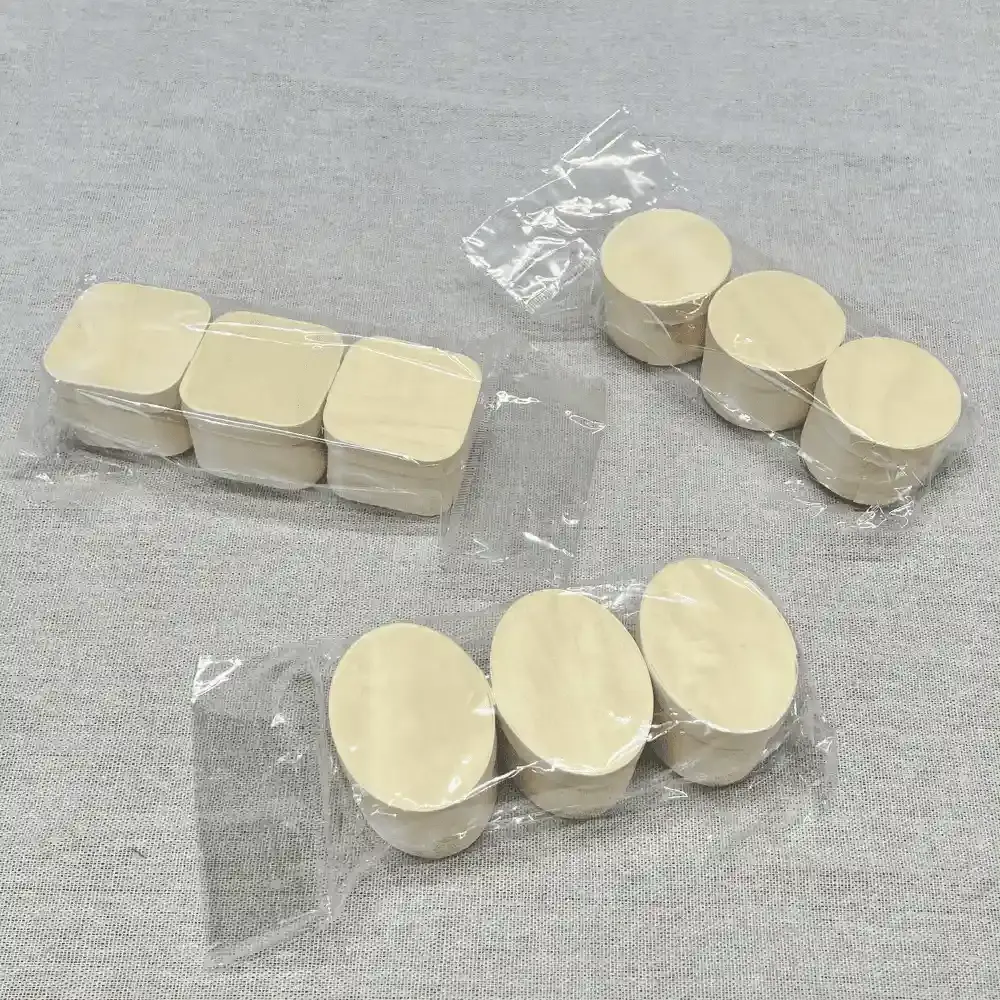
Square solid pine wood cake box with fitted lid, suitable for commercial bakeries packaging cheesecake and mousse cakes.
Key Features
- Solid pine wood construction — not veneer, not plywood; 3–4mm panel thickness provides structural rigidity that protects delicate desserts during transport and stacking
- Four graduated sizes — 2-inch (70×70×40mm), 3-inch small (80×80×40mm), 3-inch large (94×94×42mm), and 4-inch (110×110×64mm); each size maps to a standard dessert portion and carton quantity optimized for shipping density
- Fitted lid with interior rim — lid seats into a recessed lip on the box body, not just resting on top; keeps the lid aligned during stacking and prevents sliding during transit
- Stackable square footprint — flat lid and base allow secure vertical stacking for refrigerated retail display cases and efficient carton packing
- Carton-quantity ordering — each size ships in optimized carton counts (200–504 pcs depending on size); designed for bakery production schedules, not one-off retail
$0.68 - $3.40 / piece
Prices vary based on order quantity, dimensions, material selection, and logo printing method. Send an inquiry.
Specifications
- Material
- Solid pine wood (poplar veneer option available)
- Shape
- Square with rounded corners
- Sizes
- 2-inch (70×70×40mm), 3-inch small (80×80×40mm), 3-inch large (94×94×42mm), 4-inch (110×110×64mm)
- Surface Finish
- Natural, sanded smooth
- Usage
- Basque cheesecake, mousse, cheese, pastry, and gourmet bakery packaging
- Customization
- Dimensions, wood species, finish, interior coating, and laser engraving
Applications
Basque cheesecake and baked dessert packaging
Where the signature burnt-top cheesecake is baked directly in the wooden box or transferred after baking — the wood insulates better than aluminum, keeping the cheesecake warm longer for countertop display, and the natural grain frames the dark caramelized surface.
Refrigerated grab-and-go retail
Where individual cheesecake and mousse portions are packaged for supermarket and cafe cold cases — the wooden box stacks cleanly on refrigerator shelves, the lid protects against condensation drips, and the natural material differentiates the product from neighboring plastic-packaged desserts.
Gift and holiday dessert packaging
Where seasonal dessert gift sets (Christmas, Lunar New Year, Valentine's Day) are packaged in wooden boxes that the recipient keeps — the box becomes a reusable trinket container long after the cheesecake is eaten, creating ongoing brand visibility.
Customization Options
Dimensions: Four standard sizes cover most dessert portions. Custom dimensions available — the primary constraint is the lid-to-body fit ratio. The interior rim recess that seats the lid requires approximately 3mm of wall thickness, so very small boxes (<50mm) have proportionally thicker walls relative to interior volume. Large-format boxes (6-inch+) require thicker panels (5–6mm) to maintain rigidity.
Wood species: Pine is standard — light color provides neutral presentation, takes stain evenly, cost-effective at carton quantities. Poplar veneer option for a lighter, thinner-walled box — better suited for lower-profile desserts. Birch for a harder, finer-grained premium option — more expensive but the tighter grain reads as more refined for high-end patisseries.
Interior treatment: Natural sanded is standard — food-safe for direct contact with solid and semi-solid foods. Food-grade wax coating for moisture resistance — recommended for high-moisture desserts like mousse and unbaked cheesecake. Parchment paper liner — adds a barrier layer and a traditional bakery look; can be pre-inserted at the factory or shipped flat for the bakery to insert.
Exterior finish: Natural sanded is standard. Custom stain — any tone from light honey to dark walnut. Solid paint colors for brand-matched packaging. Distressed or whitewash finish for rustic bakery aesthetics. The finish can be applied to the exterior only (interior stays natural for food contact) or both surfaces.
Branding: Laser engraving on the lid top — most popular for bakery branding; the dark engraved mark contrasts with the light pine surface. Hot stamping for metallic foil logos — gold foil on natural pine is a classic bakery look. Custom-printed paper band or sleeve around the closed box. Direct lid printing via silk screen for multicolor logos at scale.
Ready to get a recommendation?
Send us your requirements — we'll respond with material and production recommendations within 24–48 hours.
Why This Design Works
Solid pine at 3–4mm thickness is the structural minimum for a dessert box that stacks and ships. The poplar veneer cake boxes in our range (0.6–0.8mm thick) are formed shells — lightweight and ideal for miniature single-bite desserts. This product serves a different need: larger portions in the 70–110mm range that require a box rigid enough to stack three or four high in a refrigerated display case without the bottom box collapsing. Solid pine panels at 3–4mm provide that rigidity. The trade-off is material cost and weight — a pine box at this scale costs roughly 2.5× more in materials and weighs 3× more than a veneer equivalent. For a 4-inch Basque cheesecake retailing at $8–12, that packaging cost is absorbable. For a $2 mini mousse, it's not — that's why we make both products.
The recessed lid rim is the detail that prevents the #1 customer complaint: lids that slide off. A flat lid that simply rests on top of the box body will shift when the box is stacked, tilted, or vibrated during transport — the lid slides off-center, exposing the dessert. The recessed rim creates a 2mm lip around the interior perimeter — the lid drops into this lip and is constrained in all four directions. It can't slide off. The lid can still be lifted straight up for opening — the fit is a friction seat, not a snap-lock. For maximum transport security, a clear elastic band or paper sleeve around the closed box provides belt-and-suspenders without adding per-unit hardware cost.
The square shape with rounded corners is a deliberate production efficiency choice. A square box uses four identical side panels — one setup, one cutting program, four pieces per box. A rectangular box uses two long and two short panels — two setups. A round box requires bending or turning — completely different manufacturing process. The square format maximizes material yield from standard pine boards (which are typically 600–900mm wide — cleanly divisible into the 70–110mm panel widths), and the box assembles on a simple corner jig without the curved clamping fixtures a round box requires. The gently rounded corners (R3–4mm) soften the look without complicating the corner joint — the panels are mitered at 45° and glued, with the rounded corner sanded in after assembly.
Manufacturing Considerations
The lid-to-body fit tolerance is the #1 QC checkpoint. A lid that's too tight won't seat fully — the bakery staff has to force it, which cracks the pine or splinters the rim. A lid that's too loose rattles and slides off. The target gap is 0.3–0.5mm between the lid edge and the interior rim — a friction fit that seats with light finger pressure and releases with a gentle lift. Each box is tested at assembly: the lid is placed and the box is tilted 45° — the lid should stay seated. Then the lid is removed with a one-finger lift — it should release without sticking. Boxes outside this range are reworked (sanding the rim or lid edge to adjust fit) or rejected.
Pine's resin content creates a specific issue for food packaging: pitch bleed. Pine contains natural resin canals — under heat (direct sunlight on a bakery counter, proximity to an oven, or a hot cheesecake fresh from baking), the resin can liquefy and seep to the surface, creating sticky spots on the wood. For dessert packaging, we select kiln-dried pine with resin content below 3% and avoid boards with visible pitch pockets. The kiln drying process sets the resin (heat polymerizes the compounds so they're solid at room temperature). For very hot-fill applications (dessert placed in the box above 60°C), we recommend the interior wax coating as an additional barrier. This is not an issue with poplar or birch — only pine, and only in specific heat conditions.
Carton-quantity production means QC is statistical, not piece-by-piece. At 300–500 pieces per carton, inspecting every box individually is uneconomical for a product at this price point. We use AQL (Acceptable Quality Level) sampling — typically AQL 2.5 for major defects (lid doesn't fit, cracked panel, splintered edge) and AQL 4.0 for minor defects (surface roughness, slight color variation). For food-contact products, we add a 100% visual check for foreign material (wood splinters, dust, debris) because a splinter in a cheesecake is a food safety incident, not just a quality complaint. Each carton is vacuumed before sealing to remove loose wood dust from the interior of each box.
Have a technical concern about your use case? Our team can walk you through how we'd handle it for your project.
Start with the 3-inch large size (94×94×42mm) in natural pine — this is the most versatile size for individual cheesecake and mousse portions and accounts for roughly 50% of bakery packaging orders in this category. Order the interior wax coating if your product has a shelf life beyond 24 hours or moisture content above 40% — it's worth the small per-unit premium for the food safety margin. Add laser-engraved branding on the lid — it's the most cost-effective branding method at carton quantities and the contrast on natural pine is excellent. Skip custom staining on the first order — natural pine gives you the broadest market appeal, and you can introduce colored finishes as seasonal or premium SKUs after validating baseline demand.
Start Your Project
Send us your design or reference images — we'll return with a pre-production sample for your approval.
Related Products
You may also be interested in
Frequently Asked Questions
Q: Can the cheesecake be baked directly inside the wooden box?
Q: Is the box grease-resistant — will butter or oil from the cheesecake stain through?
Q: What's the lid's hold strength — can I ship these boxes through courier services?
Q: How many boxes fit in a standard refrigerated display case?
Q: Do you offer the matching wooden trays or carriers for these boxes?
Send Us Your Requirements
Send your design, reference images, or product sample. We don't just quote a price — we respond with material recommendations, a feasibility assessment, and professional suggestions grounded in over 20 years of manufacturing experience. Expect a detailed response within 24–48 hours.
- Professional recommendations included
- Small MOQ & trial orders supported
- Worldwide shipping with export documentation