
Bamboo Divided Tea Bag Storage Organizer with Clear Glass Lid
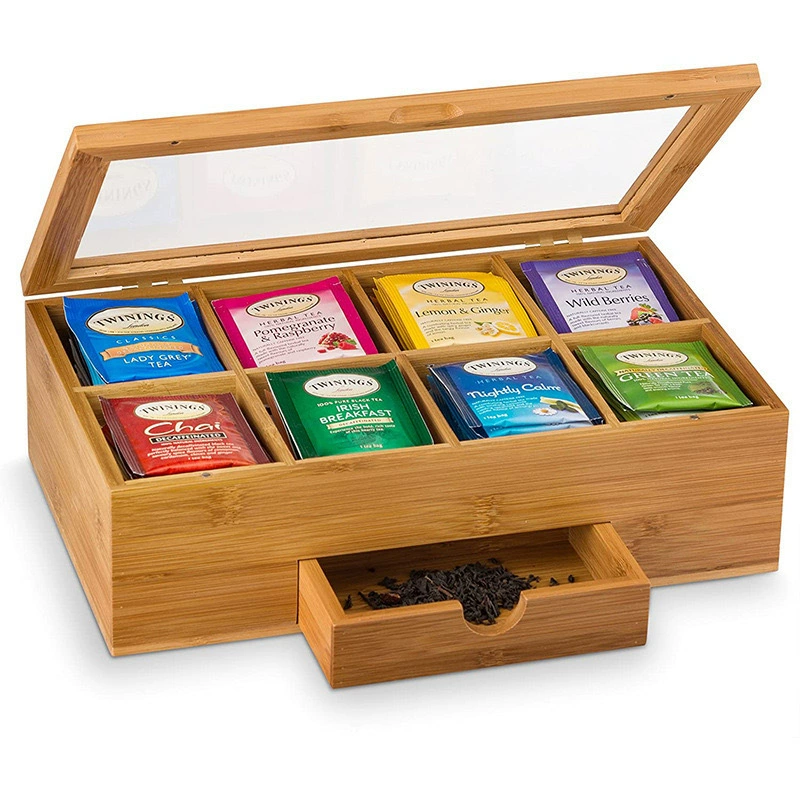
Bamboo tea storage chest with transparent glass lid and eight compartments, suitable for kitchen counter tea bag organization and pantry beverage station setup.
Key Features
- Transparent glass lid — full-view glass panel set in a bamboo frame lets the user see every tea variety at a glance without opening the box; eliminates the "open every box to find the chamomile" problem that opaque tea storage creates
- Eight divided compartments — each compartment sized to hold standard tea bags (approximately 6×7×5 cm per section); eight sections is enough for a serious tea drinker's rotation (Earl Grey, English Breakfast, green, chamomile, peppermint, rooibos, chai, oolong) without overwhelming a standard kitchen counter footprint
- Flip-top hinged lid — the lid opens fully on a rear-mounted hinge, providing simultaneous access to all eight compartments; unlike a lift-off lid where the lid must be set aside, the flip-top stays attached and stays open, making one-handed tea selection possible
- Bamboo construction — harder and more moisture-resistant than pine in kitchen environments; bamboo's natural antimicrobial properties are relevant for a box that sits on a kitchen counter near sinks and food prep areas
- Kitchen counter scale — approximately 28×18×10 cm, sized to hold a meaningful tea collection without dominating the counter; the bamboo finish reads as intentional kitchen decor, not utility pantry storage
$0.96 - $4.00 / piece
Prices vary based on order quantity, dimensions, material selection, and logo printing method. Send an inquiry.
Specifications
- Material
- Bamboo with tempered glass lid
- Compartments
- 8 sections (2×4 grid), 6 or 12 available
- Dimensions
- Approximately 28×18×10 cm
- Lid
- Flip-top hinged with tempered glass panel
- Application
- Tea bag storage, coffee pod organizer, beverage station
Applications
Home tea station organization
Where a tea drinker's collection of 6–8 tea varieties lives on the kitchen counter in organized, visible, dust-protected storage — the glass lid turns tea bags into a display rather than clutter, and the organized compartments encourage using the full variety rather than reaching for the same front-of-cabinet box every time.
Office break room and hospitality
Where offices, clinics, and salons offer tea to clients and staff — the glass lid lets everyone see what's available without opening the box, the 8 compartments organize by tea type, and the bamboo construction reads as upscale hospitality rather than utilitarian breakroom supplies.
Coffee pod and sweetener station
Where the compartments hold coffee pods, sugar packets, and sweetener varieties alongside tea bags for a complete hot-beverage station — the glass lid keeps everything clean and visible, and the 8 sections provide enough variety for a multi-beverage setup.
Customization Options
Compartment count: Standard is 8 compartments (2×4 grid). Also available in 6-compartment (2×3 grid, larger per-compartment size) and 12-compartment (3×4 grid, smaller per-compartment size). The 8-compartment layout hits the sweet spot for most tea drinkers. The 6-compartment version suits coffee pod storage (larger cavities fit Nespresso and K-Cup pods). The 12-compartment version suits offices and tea enthusiasts with extensive collections.
Dimensions: Standard is approximately 28×18×10 cm. Custom width, depth, and height available. The glass lid adds approximately 1 cm to the overall height — factor this into shelf and cabinet clearance if the box is stored under overhead cabinets.
Lid options: Glass lid (standard) for full visibility. Solid bamboo lid for a consistent all-bamboo look — choose this if the contents don't need to be visible or if the buyer wants a lid that matches the box body. Acrylic lid available as a shatter-resistant alternative to glass — lighter and less fragile during shipping, but more prone to scratching over time.
Wood species: Bamboo is standard — the best material for kitchen counter use due to its hardness, moisture resistance, and antimicrobial properties. Pine available at lower cost — choose for budget positioning but note that pine will absorb kitchen humidity more readily and may develop a slightly uneven lid fit in consistently humid kitchens. Acacia available for a darker, more dramatic kitchen aesthetic.
Branding: Laser engraving on the bamboo lid frame (the wood border around the glass) — visible without covering the glass viewing area. Silk screen printing on the glass panel itself — a frosted logo or pattern on the glass reads as premium. Compartment label engraving — each compartment divider can be engraved with a tea variety name (Earl Grey, Green, etc.) for a curated, gift-ready presentation.
Ready to get a recommendation?
Send us your requirements — we'll respond with material and production recommendations within 24–48 hours.
Why This Design Works
The glass lid is the feature that makes a tea organizer actually get used — opaque lids create an out-of-sight, out-of-mind problem that abandons tea to the back of cabinets. In a cabinet, tea boxes stack, slide, and get forgotten. The glass-lidded bamboo box is designed to live on the counter, not inside a cabinet — the glass makes the contents visible and attractive, turning tea bags from pantry clutter into a countertop display. When the user can see the chamomile is down to one bag, they restock. When they can see the green tea they forgot about, they drink it before it goes stale. An opaque tea box holds tea. A glass-lidded tea box manages tea. For a retail buyer, the glass lid is the conversion feature — it's the reason a customer chooses this box over a $10 opaque bamboo tea chest: they want to see their tea, and they want their counter to look like a tea shop, not a storage unit.
Eight compartments is the minimum-viable tea collection size — fewer and the box is half-empty for a typical tea drinker; more and the compartments get too small for standard tea bags. A tea drinker who cares enough to buy a dedicated tea organizer has at least 5–7 varieties. A 4-compartment box forces them to combine varieties, defeating the organizational purpose. A 6-compartment box works but leaves one of their varieties homeless or forces a combination. Eight compartments accommodates a full rotation without waste. More than 8 (e.g., 12) creates compartments too small to comfortably fit tea bag envelopes, and most drinkers don't have 12 active varieties — the extra compartments sit empty, making the box look underutilized. The 8-compartment 2×4 grid is the layout that fits a real tea drinker's actual behavior.
The flip-top hinge keeps the lid attached — a seemingly small detail that determines whether the box works as daily-use equipment or occasional-use storage. A lift-off lid requires two hands: one to lift the lid, one to find a place to set it down, then a third hand to grab the tea bag. In practice, the user sets the lid on the counter, where it takes up space and risks getting knocked off or splashed. A flip-top lid stays attached and stays open at 95°, leaving both hands free and the lid out of the way. For a box that might be opened 3–5 times per day (once for morning black tea, once for afternoon green, once for evening chamomile), the flip-top saves roughly 15 seconds per open-close cycle compared to a lift-off lid. Over a year of daily use, that's about 4.5 hours of not fumbling with a detached lid. The flip-top costs more to manufacture (hinges + installation labor), but for a daily-use product, it pays back in user satisfaction.
Manufacturing Considerations
The #1 quality risk is glass lid fit — a glass panel that's even 1mm too small rattles in the frame; 1mm too large and it won't seat or, worse, cracks when the frame expands in humidity. The glass panel sits in a routed recess in the bamboo lid frame, held in place by a combination of friction fit and clear silicone adhesive. The recess must be cut to the glass panel's exact dimensions plus 0.2mm on each side for thermal expansion clearance — tight enough to eliminate play, loose enough to prevent stress cracking when the bamboo frame expands in humid kitchen environments. We cut the glass to size with a tolerance of ±0.2mm and rout the recess to match with the same tolerance. After assembly, each lid is tested: close firmly 10 times, listen for glass rattle; tilt the box to 45° in each direction, check for glass movement. Any rattle or movement is rejected.
The glass panel is a shipping vulnerability — bamboo packaging with a glass component requires different packaging than all-wood products. The glass panel is 3mm tempered glass — shatter-resistant but not shatter-proof. A sharp impact to the center of the lid during transit can crack the glass even if the bamboo frame survives intact. We add a corrugated cardboard insert that covers the full lid surface during shipping, secured by foam corner protectors. For bulk orders, boxes are packed with a 2 cm foam spacer between each unit's lid and the next unit's base, so stacking pressure is distributed around the glass, not through it. The glass is tempered for safety — if it does break, it shatters into small granular pieces rather than sharp shards.
Bamboo lid frames can experience slight warping in high-humidity environments, which changes the lid-to-base alignment. Bamboo is more dimensionally stable than pine (bamboo's tangential expansion is roughly 0.0014 per 1% moisture change vs pine's 0.0020), but it's not zero-movement. In a kitchen with consistent 60–70% RH, a bamboo lid frame may expand by 0.3–0.5mm across its width. The hinge mounting must accommodate this — we use elongated screw holes in the hinge leaf that attaches to the lid, allowing 0.5mm of lateral movement, so the bamboo can expand without stressing the hinge screws or causing the lid to bind against the box body.
Have a technical concern about your use case? Our team can walk you through how we'd handle it for your project.
Start with the standard 8-compartment format in natural bamboo with the tempered glass lid at approximately 28×18×10 cm. This configuration hits the retail sweet spot: 8 compartments for a complete tea rotation, glass lid for e-commerce-friendly visibility, natural bamboo for warm kitchen aesthetics. Offer compartment engraving (tea variety names on each divider) as a premium SKU — this turns a $20 tea organizer into a $30 curated tea collection box, particularly effective for gift retail and wedding registry markets where the "instant tea collection" concept sells. For the coffee pod market, offer the 6-compartment version with larger cavities — tea and coffee buyers are separate customer segments, and the smaller compartment count with larger cavities signals "this is for coffee" without changing the product fundamentally.
Start Your Project
Send us your design or reference images — we'll return with a pre-production sample for your approval.
Related Products
You may also be interested in
Frequently Asked Questions
Q: Is the glass lid tempered or standard glass?
Q: Will the glass fog up in a humid kitchen?
Q: Do standard tea bags fit in each compartment?
Q: Can this hold coffee pods instead of tea bags?
Q: How does the bamboo finish hold up on a kitchen counter?
Send Us Your Requirements
Send your design, reference images, or product sample. We don't just quote a price — we respond with material recommendations, a feasibility assessment, and professional suggestions grounded in over 20 years of manufacturing experience. Expect a detailed response within 24–48 hours.
- Professional recommendations included
- Small MOQ & trial orders supported
- Worldwide shipping with export documentation