
Custom Black Walnut Square Mini Wooden Storage Box for Jewelry and Kids Toys
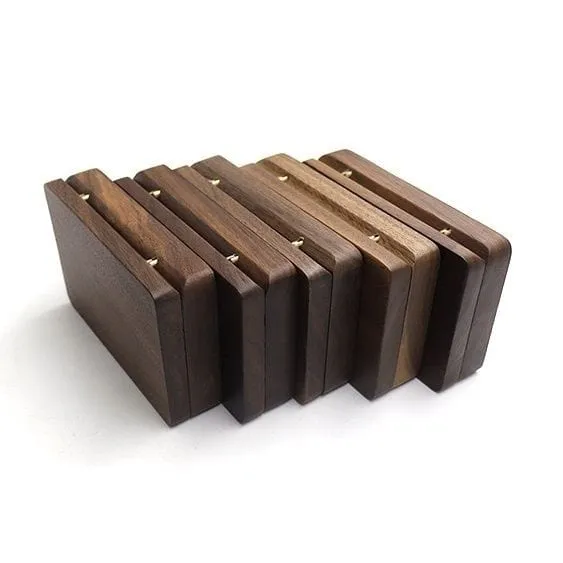
Solid black walnut mini storage box with through-dovetail corner joints, suitable for jewelry presentation, luxury keepsake packaging, and boutique gift retail.
Key Features
- Solid black walnut throughout — no veneer, no MDF substrate, no edge-banding; the same dark chocolate heartwood runs through lid, sides, and base, darkening to a richer tone with age
- Through-dovetail corner joints — mechanical interlock at all four corners cut at 1:6 slope for hardwood; no nails or fasteners visible, the end-grain triangles are the decorative detail
- Compact 12.5×12.5×9.5 cm format — sized for a watch, bracelet stack, tie clips, or a child's first keepsake collection; small enough for a nightstand, substantial enough to feel valuable in the hand
- Lid with solid brass knob option — flat lid for clean stackable display, turned brass knob for one-finger opening; knob threaded insert is flush with the lid underside so the interior ceiling stays smooth
- Natural oil-and-wax finish — food-safe mineral oil and beeswax blend that saturates the walnut fibers rather than sitting on top; deepens the natural color without building a plastic-looking film
$1.80 - $7.88 / piece
Prices vary based on order quantity, dimensions, material selection, and logo printing method. Send an inquiry.
Specifications
- Wood Type
- Solid black walnut
- Construction
- Through-dovetail corner joints
- Dimension
- 12.5 × 12.5 × 9.5 cm
- Lid Options
- Flat lid, lid with brass knob
- Surface Finish
- Natural oil-and-wax
- Usage
- Jewelry storage, keepsake box, boutique gift packaging
- Customization
- OEM sizing, wood species, lid style, interior lining, and branding
Applications
Jewelry brand packaging
Where the box IS the packaging — customer receives the jewelry inside a walnut box they'll keep on their dresser for decades, with the brand's logo laser-engraved on the interior lid underside, visible every time the box is opened.
Boutique gift and souvenir retail
Where small-format luxury items — cufflinks, tie clips, artisan chocolates, commemorative coins — need packaging that signals the value of what's inside before the lid is lifted.
Children's keepsake and first-jewelry market
Sized for a child's first bracelet, a lost tooth, or collected treasures; walnut is hard enough to survive being dropped from nightstand height — a pine box in the same application would show corner dents within months.
Customization Options
Dimensions: Standard is 12.5×12.5×9.5 cm. Scale up or down — 10 cm square for ring boxes, 15 cm for watch and bracelet boxes, 18–20 cm for multi-piece jewelry sets. Internal depth can be split with a removable tray for two-tier storage. Aspect ratio can shift to rectangular (e.g., 18×12 cm) for longer items like necklace chains.
Wood species: Black walnut is standard and recommended — its density, workability, and aging characteristics are ideal for a small box that will be handled daily. Cherry as a lighter alternative — reddish-brown that darkens faster than walnut, slightly less hard, dovetails cut just as cleanly. Maple for a contemporary pale aesthetic with very fine grain — harder than walnut but shows dust and wear marks more readily on the light surface. Oak for a rustic version with pronounced grain figure — the open grain texture is a love-it-or-hate-it choice for jewelry boxes.
Lid configuration: Flat lid (clean, stackable), lid with centered brass knob, or hinged lid with concealed barrel hinges. The knob option is most popular — it's the right balance of functional and understated. Hinged lids require mortising for the hinge leaves — more labor, roughly 15–20% higher unit cost, but the right choice for boxes intended as permanent furniture on a dresser rather than packaging.
Interior lining: Unlined (natural oiled walnut interior) is standard. Optional: adhesive black or beige velvet lining on base and lid underside; suede leather insert for a more tactile unboxing experience. Velvet lining adds roughly 10–15% to unit cost — it's a hand-applied step that can't be fully automated.
Branding: Laser engraving on the lid top (visible when closed) or interior lid underside (visible when opened — subtler, more intimate). Interior base branding — visible when the box is empty, hidden when filled. Hot stamping on the lid exterior for a metallic foil logo. Silk screen printing on the base underside for branding that's discoverable but not displayed.
Ready to get a recommendation?
Send us your requirements — we'll respond with material and production recommendations within 24–48 hours.
Why This Design Works
Through-dovetails on a box this small aren't decorative — they're the right joint for the material and the application. Walnut is a dense, oily hardwood. Where pine compresses slightly under joint stress (letting a tight pin-and-tail fit hold through friction alone), walnut holds its shape — a dovetail that's slightly loose at assembly stays slightly loose. The joint has to be cut precisely because the wood won't forgive a sloppy fit. But when it's right, a walnut dovetail is mechanically locked in both directions — the angled tails can't pull out under tension, and the interlocking geometry resists racking better than finger joints. For a box that will be opened hundreds of times, picked up by the lid, and possibly dropped, that mechanical lock matters more than on a decorative box that mostly sits on a shelf.
Black walnut isn't chosen for its price — it's chosen for how it ages. Pine yellows. Paulownia dents. Bamboo doesn't develop character over time. Walnut is one of the few woods that actually gets better with use — the natural oils in the wood oxidize, shifting from milk-chocolate brown toward a deeper espresso tone over years of handling. Scratches and wear marks blend into the dark grain rather than standing out as damage. The oil-and-wax finish supports this aging process — it sinks into the fibers rather than sealing them under plastic, so the wood can still breathe and darken naturally. A walnut box at year five looks richer than at day one. That's part of the value proposition for a keepsake product.
The 12.5 cm square format lands in a specific sweet spot. Smaller than 10 cm and a man's watch won't fit. Larger than 15 cm and it reads as a desk box, not a personal keepsake. At 12.5 cm, it holds a bracelet, a pair of cufflinks, a watch, or a stack of rings — the items people actually keep in a bedside valet. The square footprint is more space-efficient on a crowded nightstand or vanity than a rectangular box of equivalent volume, and it stacks cleanly in retail display. The 9.5 cm internal height is enough for a watch on its side or a bracelet laid flat — shallower and the lid wouldn't close over bulkier pieces.
Manufacturing Considerations
The #1 quality risk is dovetail fit on small-scale boxes. The tails and pins on a 12.5 cm box are roughly half the size of those on a full-scale drawer — a 0.3mm gap that would be acceptable on a blanket chest is visibly sloppy on a jewelry box held at reading distance. The pins are cut slightly oversized and hand-fitted to the tails — a step that can't be fully automated. Each corner is inspected under magnification at assembly. A dovetail that's too tight splits the pin socket when driven home; too loose and the box racks. The target is a friction fit that seats fully with light mallet pressure — no glue should be doing the structural work.
Grain matching across panels is the second critical QC point for a premium product. On a pine box, grain mismatch is expected — it's part of the rustic character. On a walnut box at this price point, a panel that's noticeably lighter or darker than its neighbors reads as a defect. We select panels from the same board or sequential boards from the same log, and mark each set at the rough-cut stage to keep them together through machining and assembly. The four side panels should read as one continuous grain wrap around the box — the dovetail corners are the only visual interruption. Boxes with a contrast jump of more than 15% between adjacent panels are rejected at assembly.
Seasonal movement in a solid-wood box this small is real but manageable. Because the box is small, the absolute movement across seasonal humidity changes is tiny — a 12.5 cm walnut panel moving 1% shifts by 0.125mm. That's within the clearance of a well-fitted lid. The risk isn't the lid binding — it's the base panel. If the base is glued in rigidly (captured in a groove on all four sides), seasonal expansion can split the base or push the corner joints apart. We float the base panel in a groove with 1mm of expansion room on each side — tight enough not to rattle, loose enough to move.
Have a technical concern about your use case? Our team can walk you through how we'd handle it for your project.
Order the brass knob lid and oil finish for your first run. The brass knob version outsells the flat lid roughly 3:1 in retail — it reads as a jewelry box rather than a generic wooden box, and the one-finger opening matters when the customer is holding a bracelet in their other hand. Skip felt lining on the first order — the oiled walnut interior is beautiful on its own and won't show wear for years. Add velvet lining as an upgrade SKU for the second order after you've validated baseline demand. For branding, laser-engrave the interior lid underside rather than the lid top — it's the detail the customer discovers on first opening, and it keeps the exterior clean for buyers who prefer unbranded home decor.
Start Your Project
Send us your design or reference images — we'll return with a pre-production sample for your approval.
Frequently Asked Questions
Q: Will the black walnut color change over time?
Q: Why dovetails instead of finger joints or mitered corners?
Q: Can the interior be customized with dividers or ring rolls?
Q: Is the brass knob solid brass or plated?
Q: How is the box packaged for retail — does it need additional gift boxing?
Send Us Your Requirements
Send your design, reference images, or product sample. We don't just quote a price — we respond with material recommendations, a feasibility assessment, and professional suggestions grounded in over 20 years of manufacturing experience. Expect a detailed response within 24–48 hours.
- Professional recommendations included
- Small MOQ & trial orders supported
- Worldwide shipping with export documentation