
Supplier Selection Guide
Custom Wooden Packaging Manufacturers
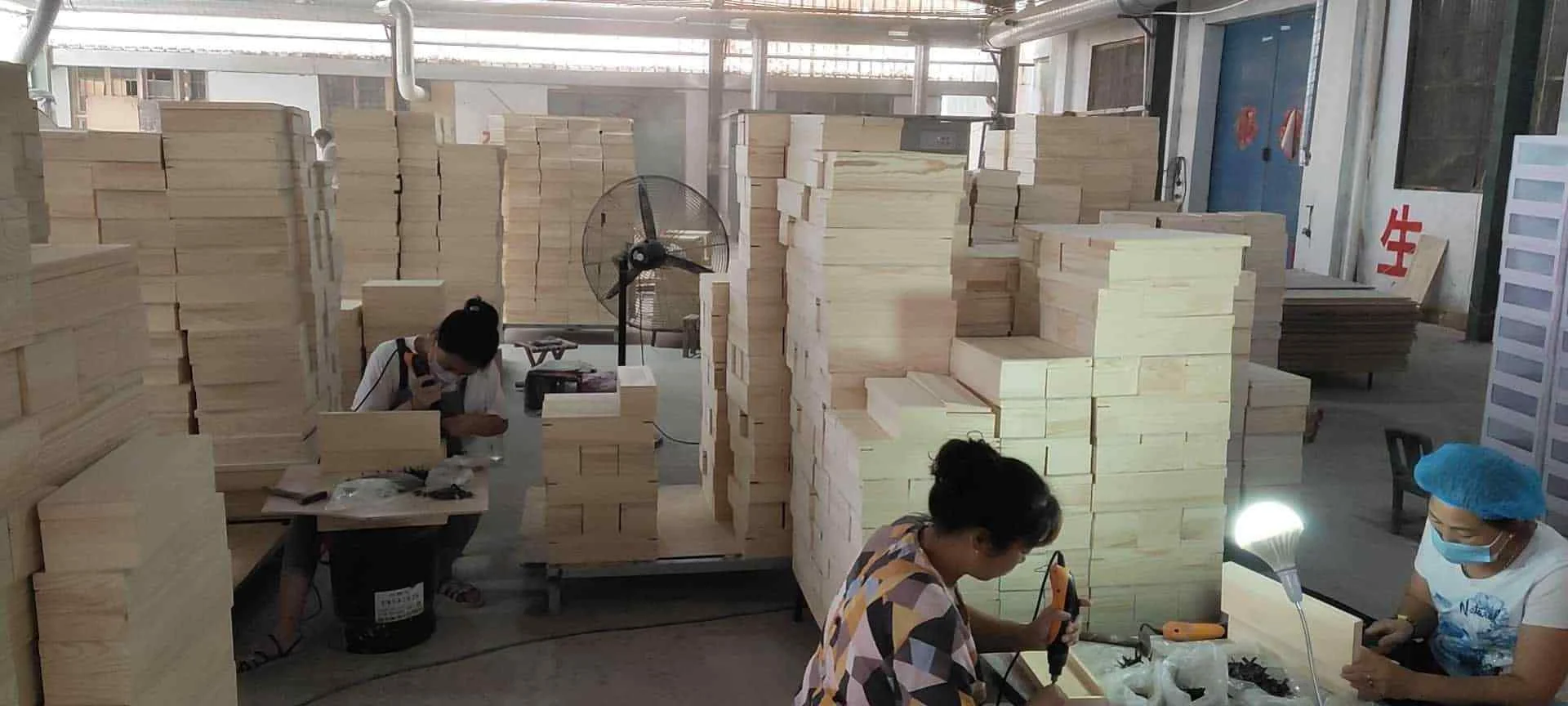
A manufacturer that serves global retail brands needs three things — an in-house factory, design support, and end-to-end quality and cost control. Here is how to separate a real factory from a middleman.
What a Custom Wooden Packaging Manufacturer Actually Is
Custom wooden packaging means wooden boxes, crates, trays, wine boxes, gift boxes, storage boxes, essential oil boxes, candle boxes, chocolate boxes, and jewelry boxes made to order — size, material, logo, interior structure, and finish are all produced to your specification, not pulled off a shelf.
It can design
Turning your concept into a manufacturable drawing, not just cutting to someone else's drawing.
It can produce
Real woodworking capacity, not a trading middleman.
It can control quality
Inspection throughout production, not a photo at the loading dock.
It can account for cost
Able to explain what drives the price, instead of handing you a black-box quote.
Five Criteria to Check Before Choosing a Factory
Ranked by importance. These are evaluation criteria, not marketing claims.
In-house factory and woodworking experience
Why it matters: This determines whether tolerance, lead time, and rework rate stay under control.
How to verify: Ask for a live video walk-through of the production floor — not photos. A real factory can show CNC machines, a drying kiln, and an assembly line on short notice. Ask the floor area and headcount; a 20,000 m² shop and 20 workers do not match.
Red flag: Only office or showroom photos. Repeatedly defers the video. Says the factory is "in the next city over."
Design and sampling capability
Why it matters: Sampling is the cheapest way to prevent "built it wrong" — a drawing is not a product.
How to verify: Ask the sample lead time, fee, and revision policy. A factory with an engineering team reviews your drawing for manufacturability and flags problems before cutting, rather than quoting a price and cutting blind.
Red flag: Charges a prohibitive sample fee, refuses drawing changes, or will only "cut to someone else's drawing."
Quality-control process
Why it matters: The biggest risk in overseas manufacturing is batch inconsistency, not price. One good sample is easy; 5,000 consistent units is the real test.
How to verify: Ask whether they run three-stage inspection — incoming material (IQC), in-process (IPQC), and pre-shipment (OQC) — and whether they sample to AQL 2.5. Ask for a sample inspection report with photos.
Red flag: "We never have quality problems," no inspection report, or a single photo at the loading dock as the only QC evidence.
Cost transparency
Why it matters: A quote that cannot explain its cost almost always creeps up later. In wooden packaging, materials are 40–70% of cost, labor 10–25%, and manufacturing overhead 15–30% — a supplier should be able to show roughly how your quote maps to those.
How to verify: Request an FOB line-item breakdown: material, labor, finish, hardware, and overhead. If the number moves when you change species or finish, the supplier has actually priced it.
Red flag: A single black-box total, refusal to itemize, or "let's see the quantity first."
B2B batch experience
Why it matters: Retail-brand volume, packaging, and logistics differ sharply from one-off orders. A factory that has only shipped small local orders may not know export documentation or container loading.
How to verify: Ask what batch sizes they have run, which destination countries, and whether they can produce export paperwork — HS classification, fumigation certificate, and certificate of origin.
Red flag: No export history, unfamiliar with HS codes or ISPM-15 treatment, or quotes only in retail quantities.
The Real Rhythm of Custom Wooden Packaging
Figures below are Hilon Wood's own public numbers, not an industry average. Use them to calibrate your expectations on lead time and MOQ.
| Fact | Figure | Source |
|---|---|---|
| Manufacturing experience | 20+ years | Hilon Wood homepage |
| Sample production lead time | 7–15 days | Custom Wooden Crates Buying Guide |
| Custom order production lead time | 30–45 days | Custom Wooden Crates Buying Guide |
| MOQ for custom wooden crates | ~200 units | Adjustable by product size |
| Factors determining custom cost | 4 factors | Custom Wooden Crates Buying Guide |
| Time to get an accurate quote | 24 hours | Custom Wooden Wine Box Dimensions Guide |
What Drives the Cost of Custom Wooden Packaging
Four factors explain nearly every price difference between two quotes. A quote you can read line by line is a supplier who has actually thought through your requirement.
Material (wood species)
↑ Up to 3xWood is 40–70% of the finished cost, so species is the biggest single lever. Pine is the baseline workhorse. Paulownia costs about 30% more per cubic meter but is far lighter — 280 kg/m³ vs pine's 420 kg/m³ — which cuts freight on large orders. Oak runs about 2x pine and walnut about 2.5x pine. Coatings, adhesives, and hardware add another 5–10% on top of the wood itself.
Structural complexity
↑ 10–25% laborLabor is 10–25% of cost, and complexity drives labor hours. A simple glued-and-nailed box takes minutes to assemble; a box with interior dividers, routed grooves, or joinery (dovetail, finger joint) multiplies cutting, fitting, and assembly time. Every interior feature is a separate operation on the line.
Finish
↑ 10–40%Natural sanded is the baseline. A clear coat adds about 10%. Staining adds 15–20% (extra process plus dry time). Paint adds 20–30% (primer, paint, and drying between coats). Two-tone or multi-step finishing adds 30–40%. Finish is also the top source of batch-to-batch color variation.
Quantity
↓ 20–40%At 200 units, material is bought at near-retail rates. At 2,000 units, bulk purchasing lowers material cost 15–20%. At 10,000 units, a dedicated production line becomes cost-effective and fixed costs amortize across more pieces. The per-unit price at 500 vs 2,000 vs 10,000 pieces can vary by 20–40%.
Three Supplier Models Compared
"Wooden products supplier" covers very different business models. Know which one you are talking to.
| Dimension | Full-service factory | Trading company | Fabrication-only shop |
|---|---|---|---|
| Design support | Yes | Usually outsourced | Weak or none |
| Cost | Slightly higher, but transparent | Has a middleman markup | Lowest |
| Quality control | High — own production line | Low — relies on third parties | Medium — no design guardrail |
| Lead-time stability | High | Low | Medium |
| Best for | Retail brands needing end-to-end control | Buyers with many small categories | Buyers who already have finished drawings |
Bottom line: for custom packaging, a full-service factory is usually the lowest-friction choice — what you lack is not "someone to make it", it is "someone to manage it end to end."
Six Mistakes Retail Brands Make When Choosing a Factory
Each of these surfaces after production starts — when it is expensive to fix.
Treating the sample as the production standard
A sample is hand-finished by a single worker; production uses batch staining and spraying. Color can vary 3–5% across batches. Accept that range, or ask for a "range sample" showing the lightest and darkest acceptable finish.
Skipping HS code classification
Wooden packaging classified as transport containers falls under HS 4415.10; decorative or gift boxes fall under HS 4420.90. Different codes mean different duty rates. Confirm with your customs broker before ordering.
Ignoring wood moisture content
Wood moves with humidity. A board finished too wet can crack or warp in a dry climate; too dry can swell in humid storage. Target 8–12% equilibrium moisture content and confirm the drying process (kiln vs air) before production.
Overlooking assembly and packing
Wooden boxes are hollow — the cavity is air you pay to ship. Flat-pack boxes fit 2–3x more units per container than assembled boxes, cutting ocean freight by 30–50%. Ask about both options before the quote is locked.
Forgetting export compliance
Wooden packaging faces three sets of border rules: EUDR for regulated woods into the EU, Lacey Act declarations into the US, and ISPM-15 heat treatment for solid-wood packaging in most countries. Sort the paperwork at order stage, not at customs.
Choosing on price alone
A quote 20% below everyone else usually means a different species, a thinner wall, or a skipped QC step — not a better factory. Compare quotes line by line, not bottom line to bottom line.
Hilon Wood at a Glance
Hilon Wood is a manufacturer serving global B2B buyers, specializing in custom wooden packaging and home and kitchen products.
Boxes & packaging
Wine boxes, gift boxes, storage boxes, essential oil boxes, candle boxes, chocolate boxes, jewelry boxes.
Home decor
Wooden vases, chain-link decor, family puzzles, crates, bins, baskets, wall shelves.
Kitchen
Cutting boards, serving boards, trays, wooden bowls, utensil holders.
Name disambiguation: the "Wood" in "Hilon Wood" can read as raw lumber or general carpentry — but Hilon Wood is a manufacturer of custom wooden packaging, home decor, and kitchen products, not a timber supplier.
Sourcing home decor or kitchenware instead of packaging? See our home decor & kitchenware supplier guide.
How to Start: A Five-Step Shortlist for Retail Brands
The order matters — each step depends on the one before it.
Fix the spec first
Size, material, quantity, target price. Every field you leave open is a variable the supplier has to guess — and a guess becomes a cost overrun later. For a wooden box, that means external dimensions, wood species, finish, interior layout, and branding. Send a photo or reference if you have one.
Insist on a sample
Require a 7–15 day sample and approve it before volume production. Check fit, finish under daylight and indoor light, and branding at actual size. Photograph everything and send specific feedback — a sample revision is cheaper than finding a problem on 5,000 units at the receiving dock.
Confirm MOQ and lead time
Batch MOQ is about 200 units and production takes 30–45 days. Back-calculate your launch date from these, and leave buffer for shipping (2–4 weeks by sea). If a supplier quotes an MOQ far below what makes sense for the product size, ask what changes — a thinner wall or a cheaper species.
Demand a cost breakdown
Custom cost is driven by four factors — material, structural complexity, finish, and quantity. Ask for each line item rather than a single total. A breakdown shows where your money goes and hands you the levers: change the species or simplify the interior to move the price.
Get a quote that comes back within 24 hours
A supplier who has priced wooden packaging before can return a line-item quote fast. If the quote takes a week or arrives as one number, the supplier has not actually thought through your requirement — or is passing your RFQ down a chain of middlemen.
Export Markets and the Compliance That Comes With Them
Different destinations mean different rules. Before you commit to a factory, confirm it can produce the paperwork your market requires.
USA
Lacey Act Phase VII declarations are in effect; HS 4420/4421 are expected to join a later phase. FSC is strongly preferred on the West Coast. Pine and walnut lead.
Typical HS Code
4415.10 / 4420.90
Germany
EUDR due diligence for regulated woods (oak and others): species, origin country, and HS code. FSC/PEFC is common. Paulownia is popular for weight savings.
Typical HS Code
4415.10
France
Traditional hinged lids, dark stains, and hot-foil stamping. High finish expectations — the box reflects what is inside.
Typical HS Code
4420.90
Netherlands
Sustainability-forward: FSC is common, natural finishes and minimal hardware lead. Bamboo is gaining traction.
Typical HS Code
4415.10
Australia
Strict biosecurity — solid-wood packaging needs ISPM-15 heat treatment. Birch plywood lids are popular for branding clarity.
Typical HS Code
4415.10
UK
Corporate-gifting focus. Walnut and dark-stained pine, often paired with branded accessories inside the box.
Typical HS Code
4420.90
One rule applies almost everywhere: ISPM-15 heat treatment (with the IPPC stamp) is required for solid-wood packaging in most countries. Confirm whether your boxes are classified as packaging or as product — it changes which rule applies.
Frequently Asked Questions
Q: Is the MOQ high for retail-brand wooden packaging?
Q: How long do samples and production take?
Q: How do I judge whether a factory can hold quality?
Q: What drives custom cost?
Q: Is Hilon Wood just a timber supplier?
Q: What is the difference between HS 4415 and HS 4420?
Q: What compliance documents do I need for EU or US orders?
Q: Can you supply FSC-certified wood?
Ready to Source Custom Wooden Packaging?
Send your spec — size, material, quantity, and target price — and get a line-item quote within 24 hours.