A Practical Guide to Custom Wooden Crates for B2B Buyers
Wooden crates show up everywhere in retail and home spaces — used as in-store display fixtures, product packaging, gift containers, and home storage pieces. For B2B buyers, the challenge is knowing which crate type, material, and finish fits their specific application. Retail brands, event planners, subscription box companies, and home goods retailers each need different things from a crate.
This guide covers what matters when sourcing custom wooden crates — construction types, wood species, finishes, branding options, and what to look for in a supplier for retail, display, and home storage applications.
Key Takeaways
- Pine and paulownia are the two most common materials for retail and decorative crates; pine handles heavier use, paulownia is lighter with a smoother surface
- Crate type sets the cost and look: slat crates are the simplest, decorative crates use better wood and finishing, nesting crates add precision and functionality
- Customization costs depend on 4 factors: material grade, joinery method, finish type, and order volume
- Production lead times run 7–15 days for custom orders after design confirmation
- MOQs start at 200 units for custom crate orders, scaled by design complexity
Types of Wooden Crates and Their Applications
Not all crates are built the same way. Construction method, material grade, and finish level determine which type fits a given application.
Standard Slat Crates
Slat crates use spaced wooden slats fixed to a frame, leaving gaps between boards. This open construction keeps material costs down while providing adequate structure for lighter items. Common retail and home applications include shelf displays, pantry storage, produce bins in grocery settings, and general-purpose organizational crates.
The natural ventilation from the slat gaps makes these practical for fresh goods displays and any setting where airflow matters. In home decor retail, unfinished slat crates are often sold as-is for customers to stain or paint themselves.
Decorative and Display Crates
Decorative crates prioritize appearance over sheer durability. Manufacturers use higher-grade boards — fewer knots, cleaner surfaces, tighter grain — and apply finish work that standard crates skip.
Common finishes for decorative crates include:
- Natural clear coat — shows the wood grain, works across rustic and modern looks
- Whitewash or gray wash — the farmhouse/cottage aesthetic that dominates home decor retail
- Dark stain — gives pine a richer, furniture-grade look
- Painted colors — Pantone-matched for brand-specific retail displays
- Charred surface — a burned finish inspired by Shou Sugi Ban, increasingly common in high-end home goods
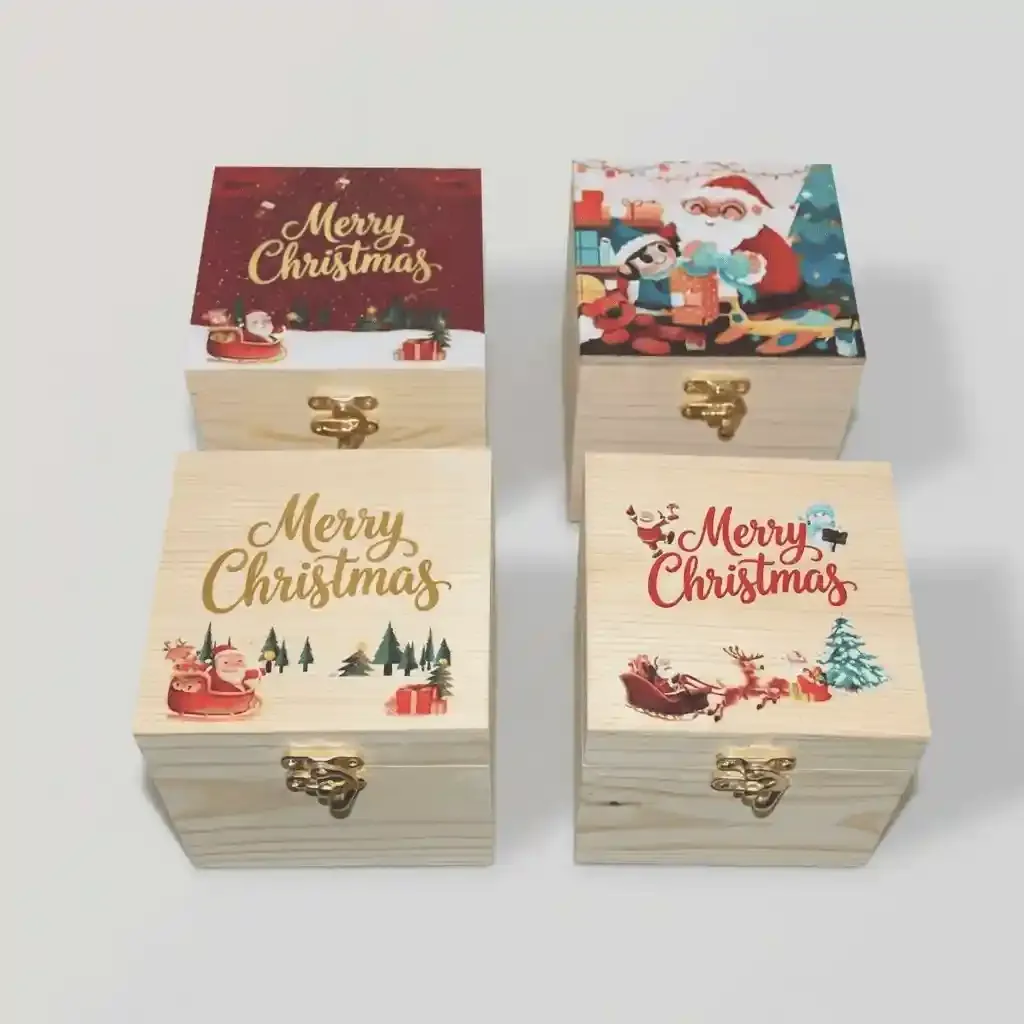
Retail brands use decorative crates for in-store merchandise displays, subscription box packaging, gift presentation, and window dressing. Home decor retailers stock them as standalone decorative pieces — customers use them as bookshelf organizers, coffee table catch-alls, and fireplace-side storage.
Nesting and Stackable Crates
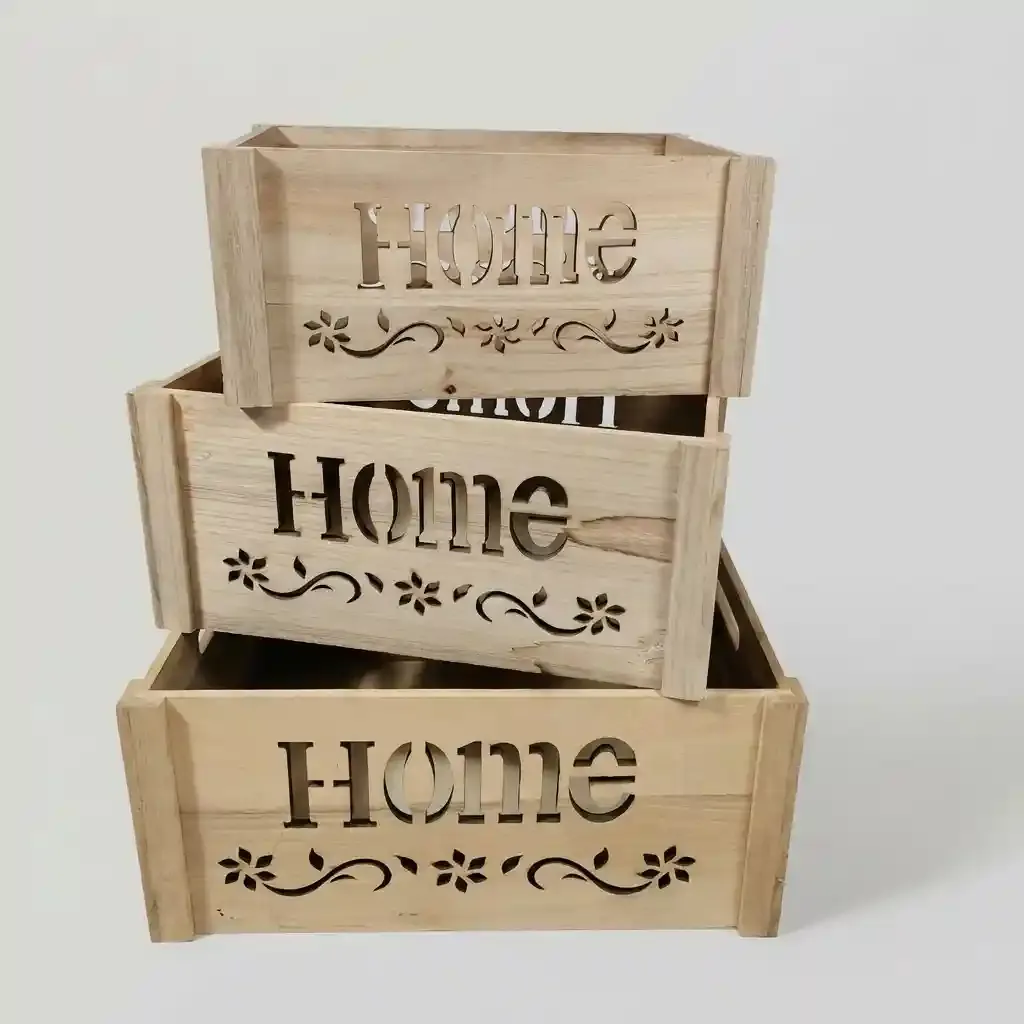
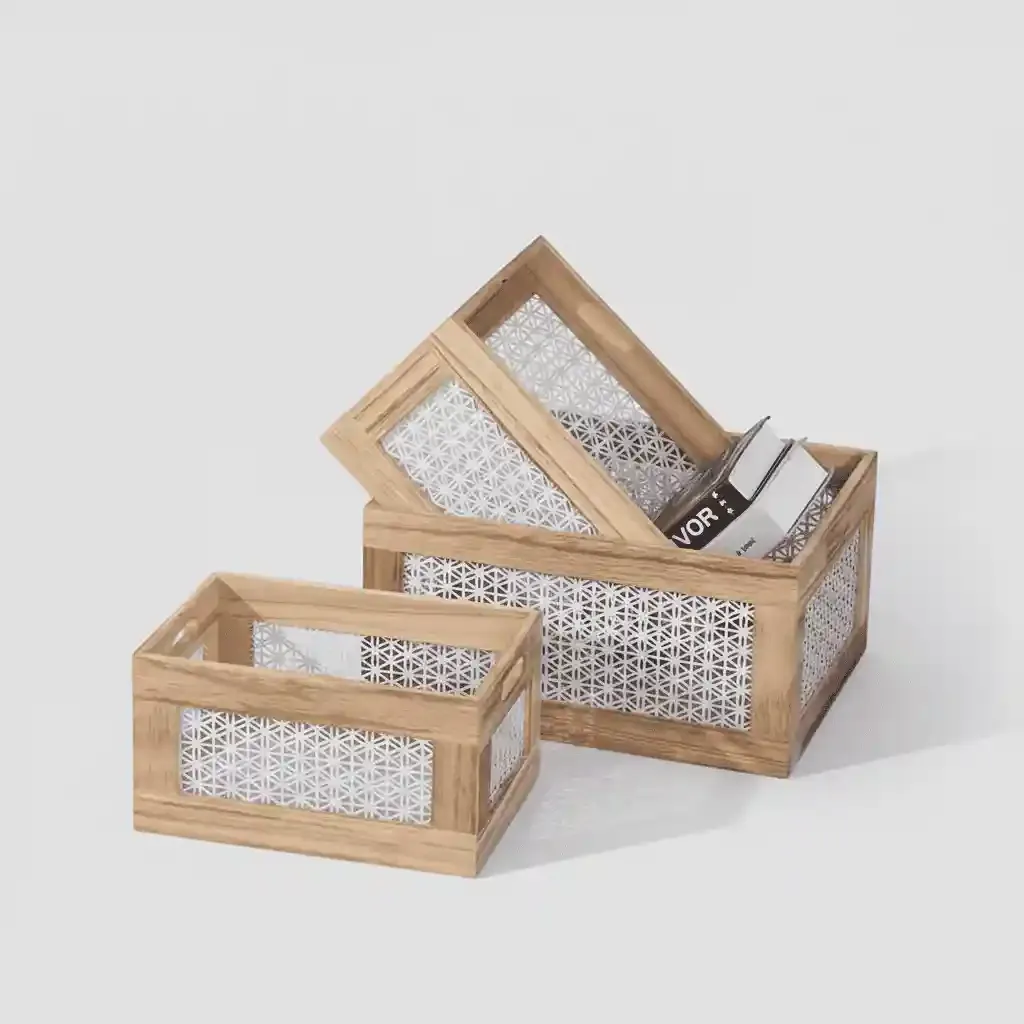
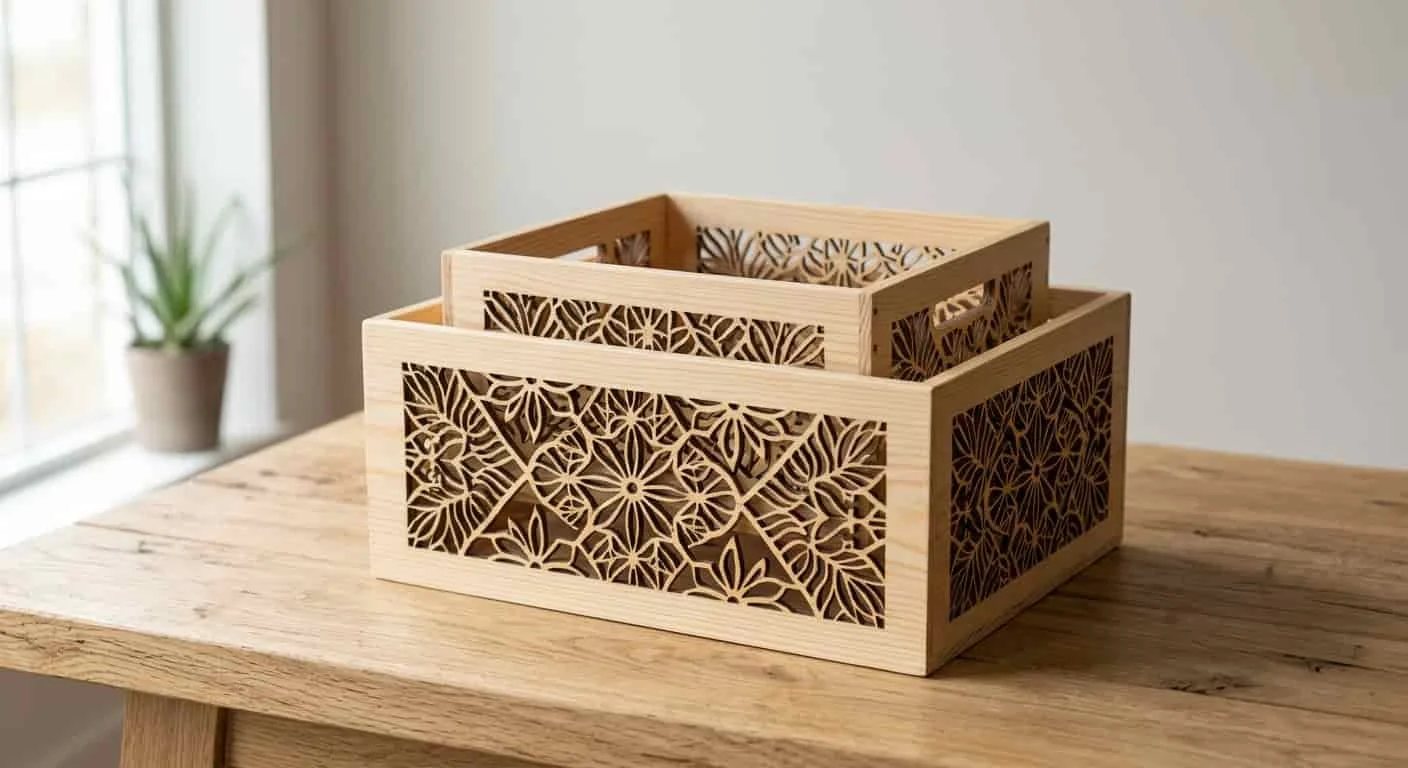
Nesting crates come in graduated sets — three or more crates that fit inside each other when empty. Laser-cut designs with decorative patterns (geometric cutouts, lattice work, scroll patterns) are the most common variant in retail.
Unlike industrial nesting crates designed for freight efficiency, decorative nesting sets target home and office use. A typical set includes three sizes ranging from roughly 30cm to 45cm in length. The patterns are cut by CNC laser, which allows designs that would be impractical with manual joinery.
Stackable crates — where each crate securely sits on top of the next — serve retail spaces that need flexible, reconfigurable displays. Open-top designs let customers see products from above while the stackable structure makes efficient use of vertical space.
| Crate Type | Best For | Typical Material | Typical MOQ |
|---|---|---|---|
| Standard Slat Crate | Retail display, home storage, pantry organization | Pine, poplar | 200–500 pcs |
| Decorative/Display | Gift packaging, retail displays, home decor | Pine, paulownia, bamboo | 200–500 pcs |
| Nesting/Stackable | Home organization, decorative storage sets | Pine, paulownia, birch plywood | 200–500 pcs |
Materials Used in Wooden Crate Manufacturing
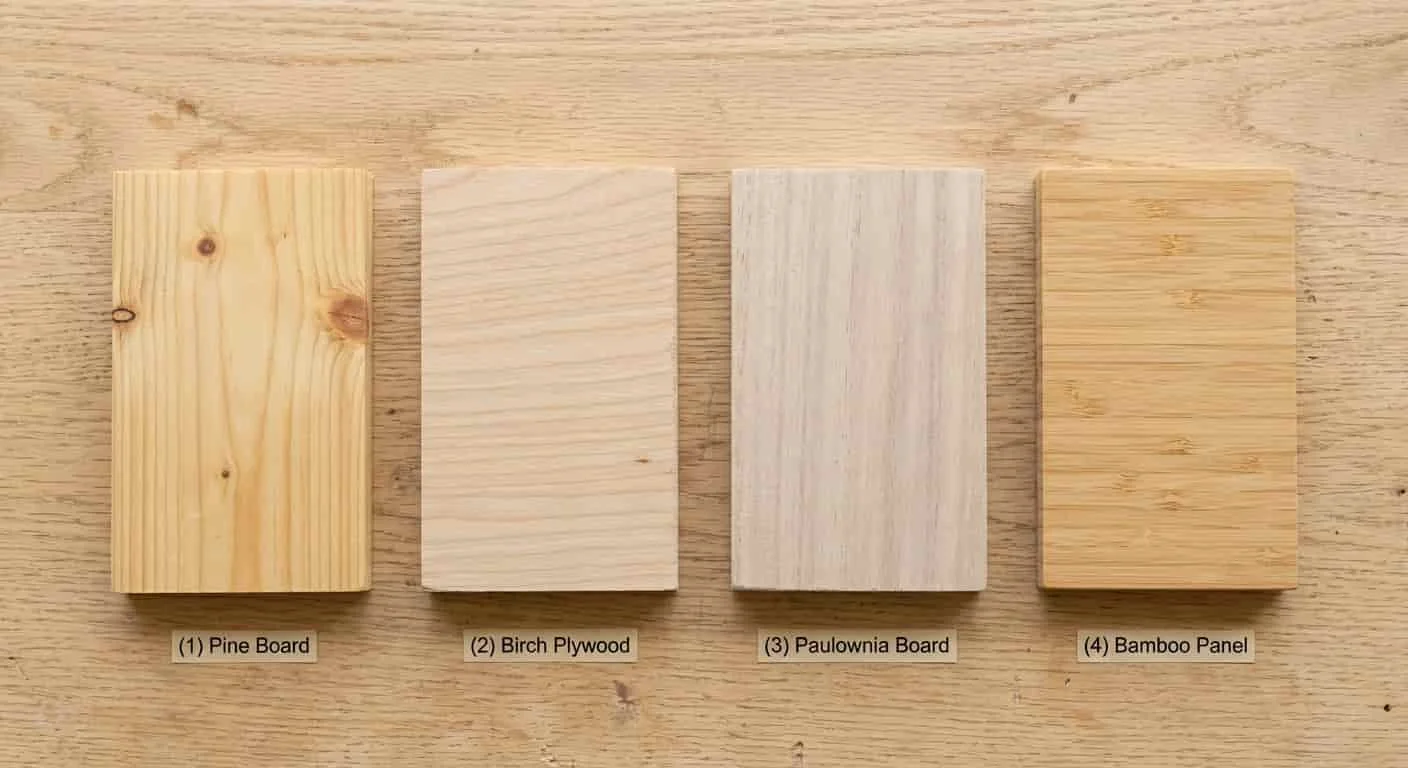
Hilon works with several materials for custom crates — pine, paulownia, bamboo, birch plywood, and poplar — each chosen for weight, grain character, workability, and how well it takes finish. The wood you pick affects the crate's weight, appearance, surface quality, and how it wears over time.
Pine
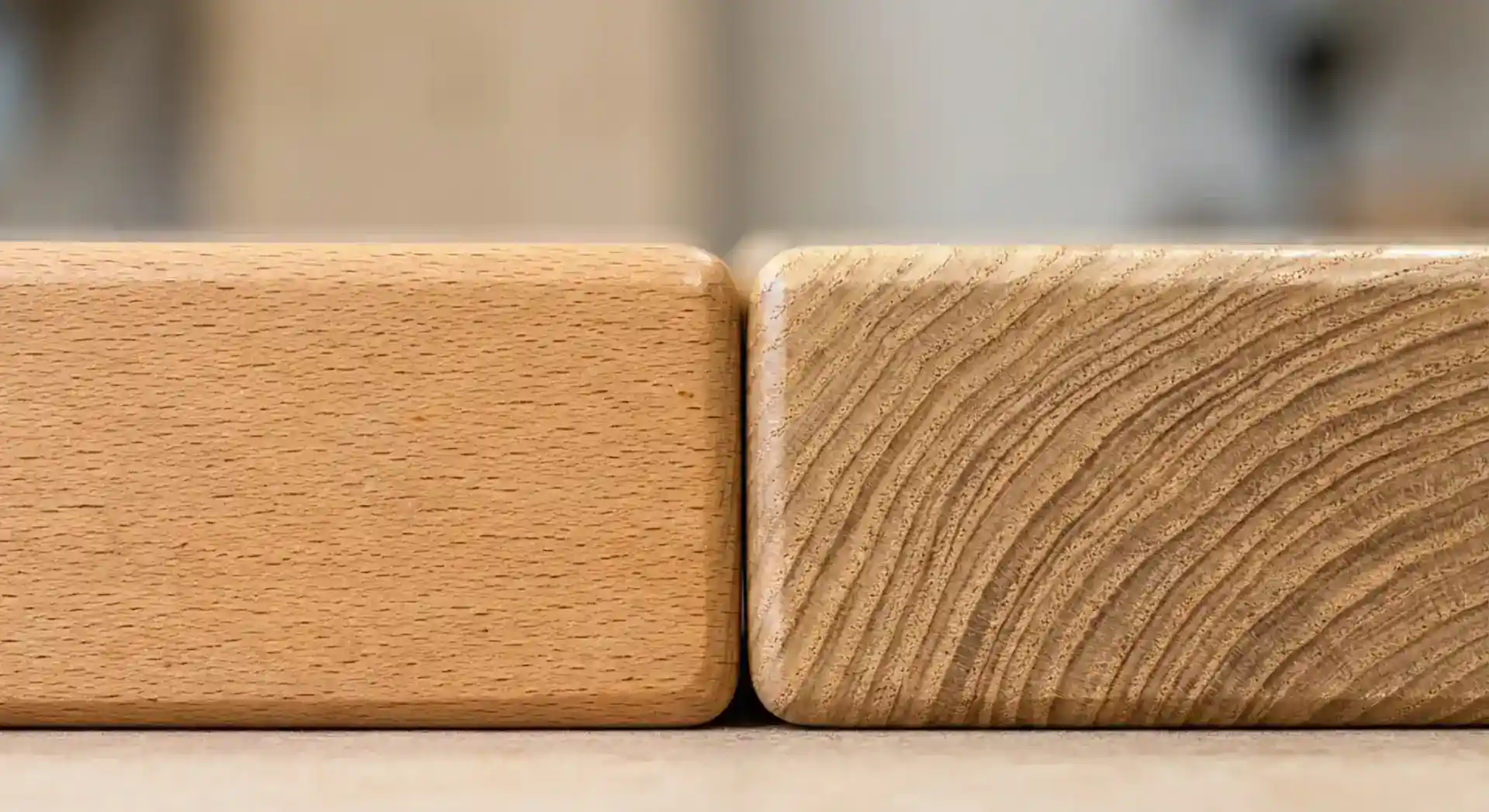
The workhorse of crate manufacturing. Pine is easy to machine, holds nails and screws well, and takes stain, paint, and clear coats evenly. Its visible grain pattern gives it character that works for both rustic and modern settings. Most retail display and decorative crates use pine.
Pine is the most affordable solid wood option. It's durable enough for daily handling in retail environments. The tradeoff: pine boards can have knots and sap pockets, so if a clean, uniform surface is important, specify a higher board grade or consider paulownia instead.
Paulownia
About 40% lighter than pine with a noticeably smoother, more consistent surface. Paulownia has a subtle grain and pale color that takes a wide range of finishes. It's softer than pine — not the choice for anything that'll take heavy abuse — but for decorative crates, gift packaging, and display pieces where weight and surface quality matter, it's a strong option.
The weight difference matters in retail settings where staff move displays frequently or where freight costs are calculated by weight.
Bamboo
Bamboo crates have a distinct look — clean, light-colored, with fine, linear grain lines. Bamboo is harder than pine (comparable to birch in density, around 600–700 kg/m³) and handles humidity changes better. It's technically a grass, which can support certain eco-certification claims. Retailers often pick bamboo for displays where they want a crisp, contemporary appearance with an eco-conscious story.
Birch Plywood
Birch plywood offers the smoothest surface among crate materials — ideal for printed branding, paint-grade finishes, and designs that need clean, sharp edges. The layered construction resists warping and splitting, so it holds up well in environments with temperature or humidity swings (retail stockrooms, covered outdoor displays).
Plywood crates are heavier than solid pine of equivalent dimensions but more dimensionally stable. For crates with large flat panels — like display risers or signage holders — birch plywood performs better than solid wood over time.
Poplar
Poplar has a smooth, nearly knot-free surface that makes it the go-to for painted crates. It machines cleanly and takes paint more evenly than pine. The wood itself is light in color with subtle grain, so it's rarely used with clear finishes — it shines under opaque paint where the surface quality matters more than the wood's natural look.
Wood Quality and Workmanship: What to Check
Even within the same wood species, crate quality varies significantly based on board selection, joinery, and finishing. For B2B buyers who can't visit the factory, knowing what to look for in samples helps avoid surprises in bulk production.
Moisture Content
Wood with moisture content above 12–14% is prone to warping, cracking, or developing mold — especially in sealed packaging or when crates move between different climates. Properly dried crate wood sits at 8–12% moisture. A crate that arrives flat and true but develops a twist within a week of unpacking is a telltale sign of insufficient drying.
For crates destined for air-conditioned retail spaces or heated homes, the target should be 8–10% — closer to the equilibrium moisture content those environments will impose on the wood.
Board Selection
Not all boards from the same tree are equal. Quality-conscious manufacturers sort boards by grade before cutting:
- Clear grade: No knots, uniform color. Used for decorative crates and premium retail displays.
- Standard grade: Small, tight knots allowed. Acceptable for most retail and storage crates.
- Utility grade: Larger knots, more color variation. Used for crates that will be painted or where a rustic look is intentional.
A well-made sample should show consistency — not one perfect side and one rough side. Check all faces, especially the bottom and inside panels.
Joinery Quality
Joints should be tight — no visible gaps where boards meet, no glue squeeze-out, no misaligned corners. For nailed butt joints (the most common crate construction), nails should sit flush or slightly countersunk, not proud. For box joints or dovetails, the fit should be snug without visible filler or putty.
Finish Consistency
Stain should be even across the surface — no blotchy patches, no dark lap marks where the applicator overlapped. Paint should be smooth without drips, runs, or thin spots. Clear coats should feel consistent to the touch, not tacky or rough in patches. The inside surfaces don't need the same finish level as the outside, but they shouldn't be completely raw either — at minimum, a light sanding prevents splinters.
Customization Options for Wooden Crates
Custom crates are built to spec, not pulled from stock. The main customization levers include dimensions, branding, joinery, and finish.
Dimensions and Structure
Custom sizing is the most common request. Crate dimensions are built around what goes inside — product dimensions plus clearance. This matters for:
- Products with non-standard shapes that don't fit off-the-shelf crate sizes
- Matching existing shelving, gondola systems, or display fixtures
- Creating a specific visual proportion for retail presentation
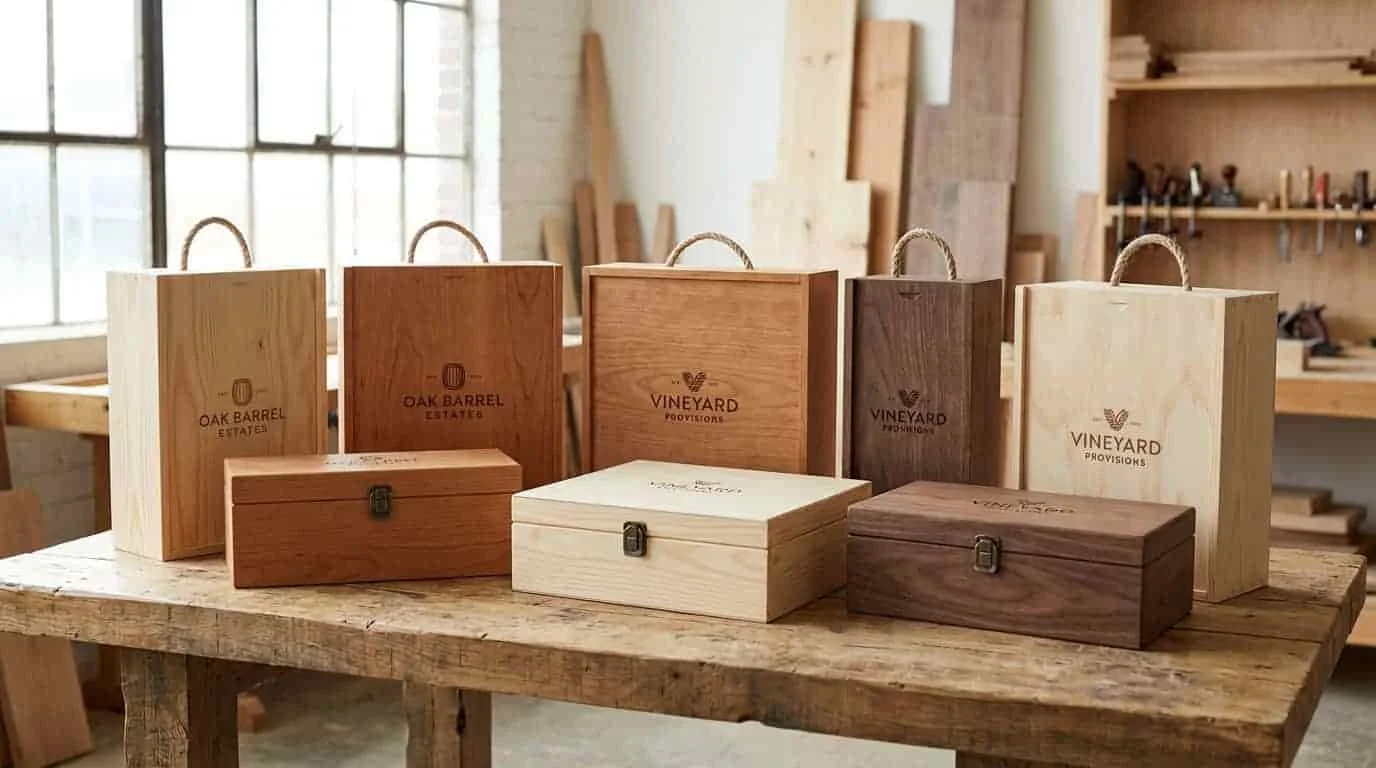
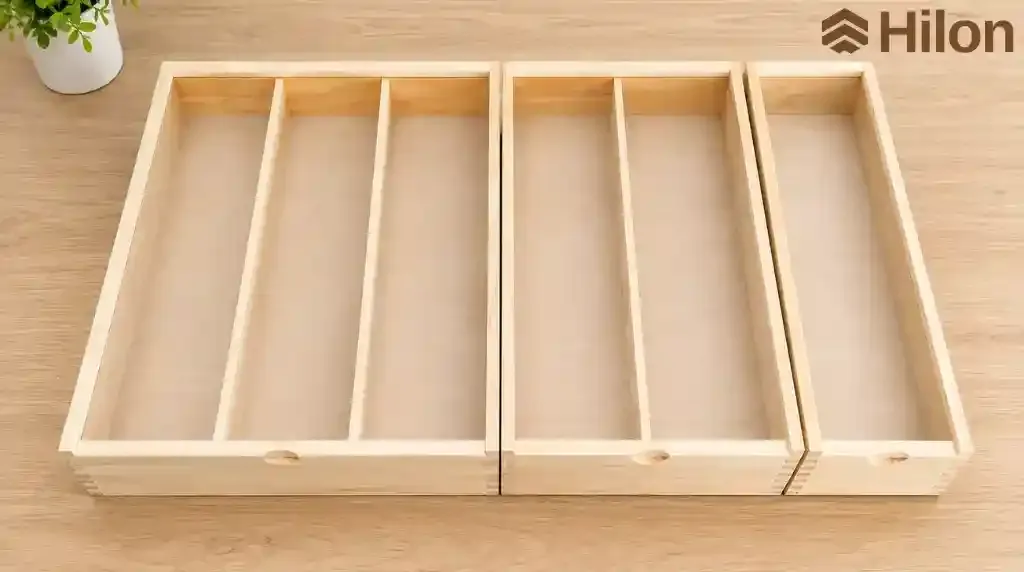
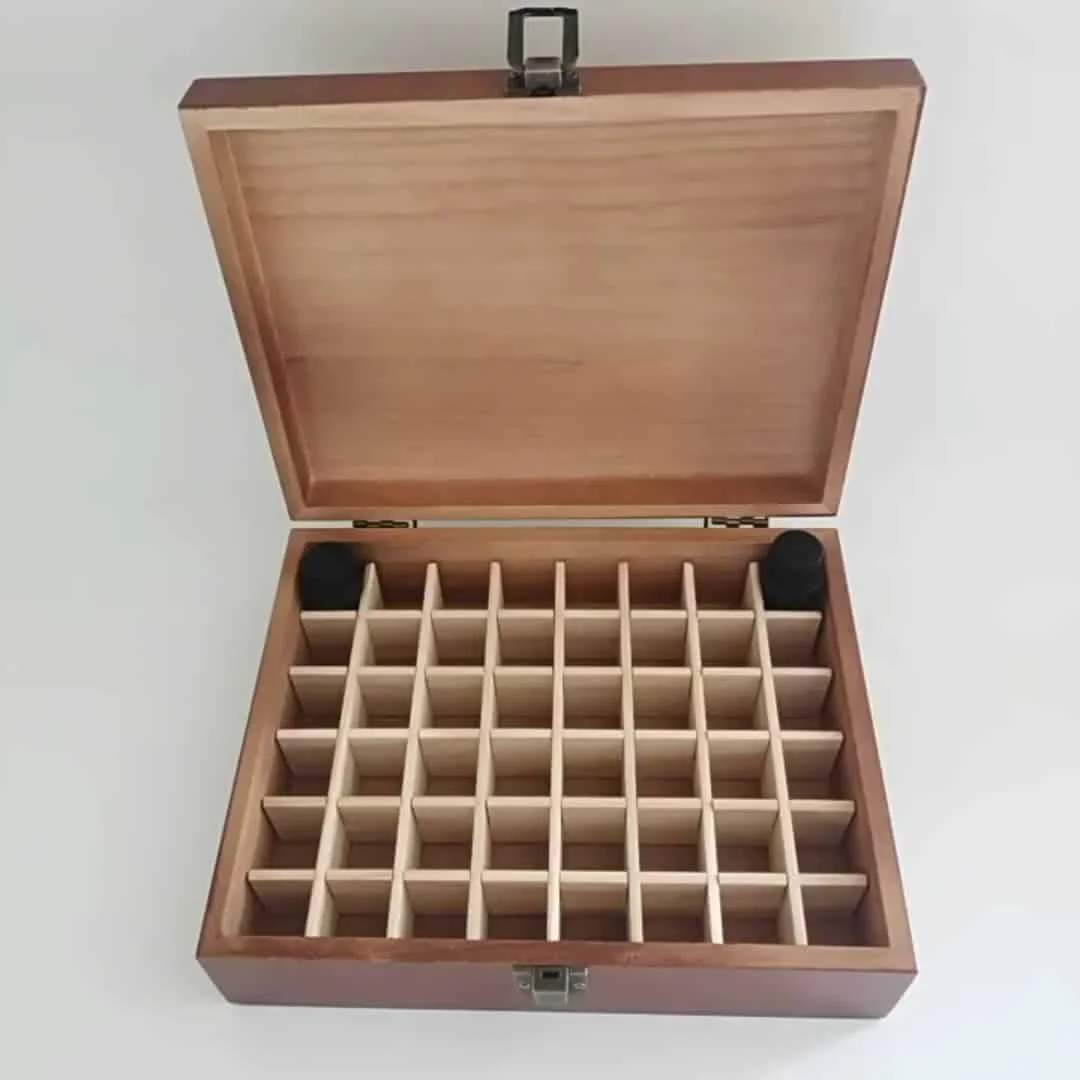
Structural options include open-top designs, hinged lids with clasp hardware, sliding lids that ride in a groove, and lift-off lids. Internal dividers, foam inserts, and fabric liners turn a basic crate into a fitted presentation piece.
Branding and Marking
Retail-facing crates carry brand identity. The most common branding methods include:
- Laser engraving: Permanent, fine-detail marking. Best on lighter woods (bamboo, birch, paulownia) where the contrast is highest. Dark woods show laser marks less clearly.
- Silk-screen printing: Single or multi-color logos. Cost-effective at volume. Works on both raw and painted surfaces.
- Hot stamping / foil stamp: Metallic foil pressed into the wood surface. Gold, silver, and copper foils are the most popular. Adds a premium accent.
- Branding iron: Heated metal die pressed into the wood. Creates a darkened, debossed mark. No ink or consumables — once the die is made, it lasts for thousands of impressions.
- Custom color painting: Pantone-matched finishes to align with brand colors. Most practical on poplar or MDF surfaces that provide a smooth base for paint.
Joinery Methods
The way boards connect affects both look and durability:
| Method | Durability | Relative Cost | Best For |
|---|---|---|---|
| Nailed butt joints | Standard | Baseline | Display and lightweight crates |
| Box joints | Medium | +10–20% | Retail crates needing a cleaner look |
| Dovetail joints | High | +30–50% | Premium crates where joinery is a visible design feature |
Dovetail and box joints add visual interest — they're often left exposed on decorative crates as a design detail rather than hidden.
Finish and Treatment
Surface treatment defines the final look and feel:
- Sanded only: Raw wood, no coating. The most natural look. Works for rustic or DIY-positioned products where customers may want to finish the crate themselves.
- Clear lacquer: Protects the wood while letting the grain show through. Standard for retail crates that will be handled regularly.
- Stained: Darkens and enriches the grain. Available in a range of tones from light honey to dark walnut.
- Painted: Full opaque coverage. Any color. The most customizable option.
- Whitewashed / gray washed: Semi-transparent light finish that mutes the wood tone while keeping the grain visible. Dominant in farmhouse and coastal decor styles.
- Distressed / wire-brushed: Mechanically or manually aged to look worn. Wire brushing removes softer earlywood and leaves the harder grain lines raised. Often combined with stain for a vintage look.
- Charred / burned: Surface lightly charred with flame, then brushed and sealed. Creates a dark, textured surface with natural variation from piece to piece.
How to Evaluate Wooden Crate Suppliers
When comparing manufacturers, look past the unit price. Three areas matter most for crate sourcing.
Material Quality
Ask for a breakdown of the wood grade being quoted — not just the species. Two suppliers can both quote "pine crates" while using different board grades that produce noticeably different results. Request photos of raw boards before finishing to see the knot level and grain consistency.
For painted crates, ask what primer and paint system the factory uses. Two coats of basic paint over raw wood looks very different from primer + two finish coats — and durability differs even more.
Customization Experience
Not every wood products factory handles crates well. A factory that mainly produces flat cutting boards may struggle with the three-dimensional assembly, corner joinery, and hardware attachment that crates require. Key questions to ask:
- What percentage of their output is crates versus other wood products?
- Can they show photos of past crate orders similar to what you're requesting?
- What's their standard lead time for a new custom crate design?
- How do they handle seasonal volume changes?
Sampling and Quality Control
Always get a physical sample before committing to production quantities. A sample tells you what the factory considers acceptable — pay attention to details they may have overlooked: how the bottom panel is attached, whether inside corners are sanded, if the finish is even across all surfaces.
For detailed guidance on comparing suppliers, see our post on how to compare custom wood products suppliers.
Common Mistakes When Ordering Custom Crates
- Choosing wood based on price alone. Pine is the cheapest solid wood option, but if your crate needs a smooth, knot-free surface for branding, the cost of filling, sanding, and priming pine to that standard can erase the material savings versus starting with paulownia or poplar. Pick the material that fits the finish requirement, not just the lowest board cost.
- Not specifying moisture content. Wood that wasn't properly dried will warp after the crate leaves the factory — especially if it travels through different humidity zones. Crate lids that fit perfectly at the factory can swell shut or develop gaps at the destination. Specify 8–12% moisture content in your requirements.
- Assuming all surfaces will have the same finish quality. Unless you explicitly specify finish coverage, manufacturers may leave inside surfaces, bottoms, and hidden edges rough-finished or unfinished. If your crate will be handled from all sides — as retail display pieces are — specify finish coverage on all visible surfaces.
- Ordering bulk without a trial run. A single sample shows what the factory can do. A 10-unit trial order shows what they actually do consistently. Run a small batch before committing to a container-sized order. Issues with corner alignment, finish evenness, and lid fit often only emerge across multiple units.
Frequently Asked Questions
How long does production take for custom crate orders?
Production lead time is typically 7–15 days for a new custom design after the sample is approved and the order is confirmed. Complex designs with multiple finish steps, hardware, or inserts may extend toward the longer end of that range. The timeline depends on the factory's current production schedule, so confirm lead times when placing your order.
What's the minimum order quantity for custom crates?
MOQs for custom crate orders start at 200 units. The exact MOQ depends on the design complexity — crates with intricate laser-cut patterns, multi-step finishes, or custom hardware may require higher minimums because the setup time is greater. Simpler slat crate designs tend toward the lower end of the MOQ range.
What customization options are available for wooden crates?
Custom crates can be tailored in dimensions, wood species, joinery method, finish, lid style, and branding. Branding options include laser engraving, silk-screen printing, hot stamping, branding iron, and custom color painting. Internal features like dividers, foam inserts, and fabric liners are also available. Setup costs for branding templates or finishing stencils are one-time charges, not per-unit costs.
What's the difference between pine and paulownia for crates?
Pine is heavier, harder, and less expensive. It has visible grain and occasional knots. Best for crates that will be handled frequently or hold heavier items. Paulownia is about 40% lighter, with a smoother, more consistent surface and finer grain. It's softer and costs more per board, but the weight savings and surface quality make it the better choice for decorative crates, gift packaging, and display pieces where appearance and easy handling matter more than heavy-duty durability.
Can I get a sample before placing a bulk order?
Yes. Physical samples are standard practice for custom crate orders. The sample should be produced using the same materials, joinery, and finish specified for the production run. Sample lead time is usually 5–10 days plus shipping. The sample cost is typically credited toward the bulk order. If the sample has issues, discuss them with the supplier and request a revised sample before authorizing full production.
What finishes work best on different wood types?
Pine takes stain well but can absorb unevenly — a pre-stain conditioner helps achieve uniform color. Paulownia's smooth surface is well suited to clear coats and light stains. Bamboo's dense, uniform texture works well with clear finishes and light engraving. Poplar paints beautifully but rarely looks good with stain due to its muted, greenish undertone. Birch plywood provides the flattest, most uniform surface for paint-grade and printed finishes.
Next Steps for Buyers
Sourcing custom wooden crates comes down to matching the crate type to your application, picking the right material for the intended finish, and working with a manufacturer who has specific crate experience — not just general woodworking capability.
If you're planning a crate order — whether decorative crates for retail displays, sturdy crates for home and storage organization, or branded crates for gift packaging — having clear specs on dimensions, material, finish, and quantity keeps the quoting process efficient. At Hilon, we produce custom wooden crates across multiple styles, materials, and finishes. Contact us with your requirements for a quote, or visit our custom wooden boxes page to explore related packaging options, or see the full list of industries we serve.