
Wooden Blind Box with Combination Lock for Secure Storage
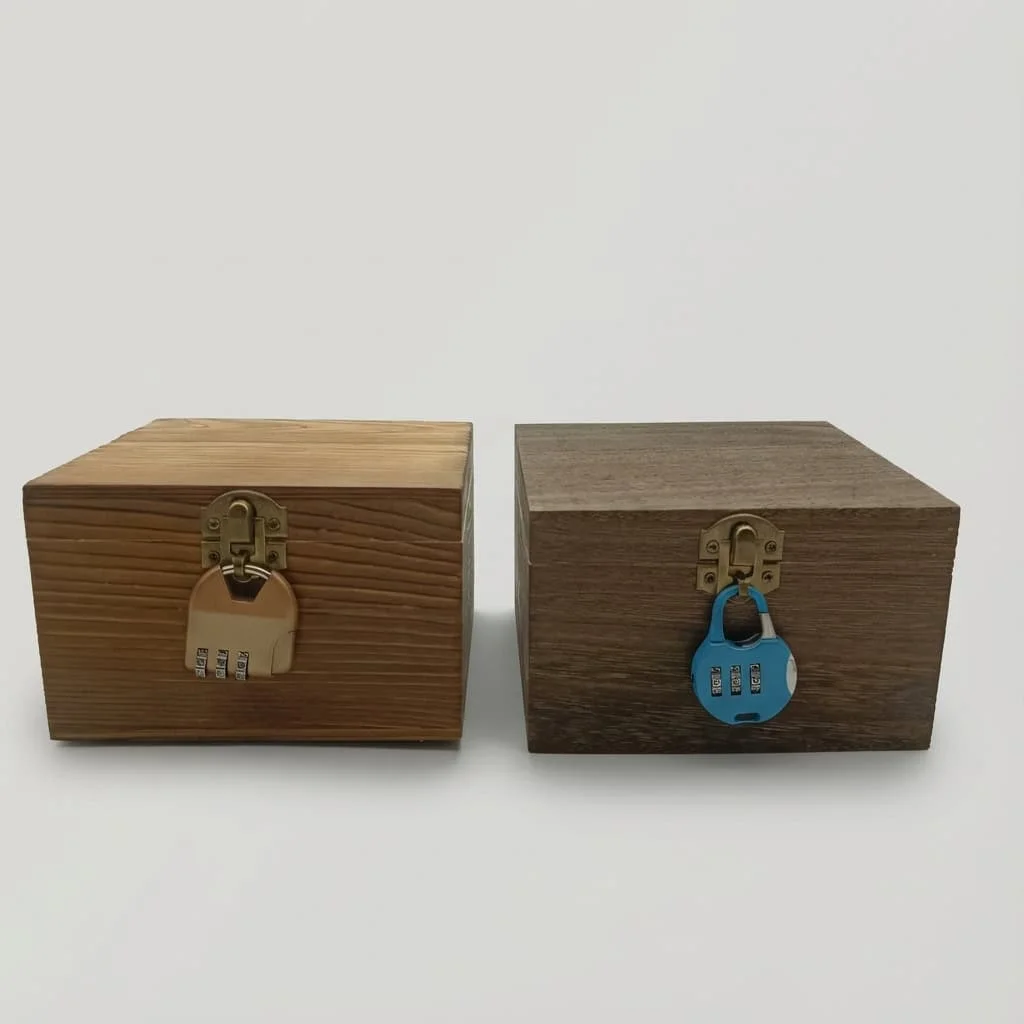
Wooden storage box with integrated combination lock and latch closure, suitable for mystery box retail concepts and interactive gift packaging.
Key Features
- Integrated 3-digit combination lock — resettable code mechanism built into the front latch plate; the lock engages a metal hasp that secures the lid closed, and the recipient must know (or solve for) the combination to open
- Blind box concept — the exterior reveals nothing about the contents; the lock adds a layer of anticipation and interaction that transforms opening from a mechanical action into an experience
- Multiple wood species — pine for cost-effective volume orders, bamboo for hardness and eco-positioning, paulownia for lightweight shipping; each species accepts the lock hardware with the same mounting pattern
- Lift-off or hinged lid — lift-off for clean exterior lines with the lock as the only visible hardware; hinged for one-handed access after unlocking without misplacing the lid
- Full finish range — natural, stained, painted, varnished, and charred; the lock hardware finish can be matched (antique bronze, nickel, brass, black) to the box finish for a cohesive look
$1.80 - $7.00 / piece
Prices vary based on order quantity, dimensions, material selection, and logo printing method. Send an inquiry.
Specifications
- Materials
- Pine, bamboo, or paulownia wood
- Closure
- 3-digit resettable combination lock (4-digit optional)
- Lid Style
- Lift-off or hinged
- Finishes
- Natural, stained, painted, varnished, charred
- Hardware Finishes
- Antique bronze, nickel, brass, black
- Application
- Mystery box retail, secure keepsake storage, interactive gift packaging
Applications
Mystery box and blind-box retail
Where the locked box IS the retail concept — customers purchase a sealed box without knowing the exact contents (similar to the blind-box toy trend), and the combination lock adds a puzzle-solving layer that extends the experience beyond simply lifting a lid.
Secure keepsake and document storage
Where personal items (letters, jewelry, cash, USB drives) are stored with basic security — the combination lock prevents casual access by children, roommates, or cleaning staff without the key-management problem of a keyed lock.
Interactive gift and event packaging
Where the gift recipient receives the combination separately (in a card, via text, as a puzzle clue) — for weddings, corporate events, and promotional campaigns where the unboxing ritual is part of the brand experience.
Customization Options
Lock type: Standard is a 3-digit resettable combination lock (000–999). 4-digit lock for higher security (0000–9999). The lock mechanism is a standard component with proven reliability — the same type used on luggage and school lockers. Keyed lock available as an alternative — simpler to open, no combination to forget, but adds key management.
Lid style: Lift-off lid is most popular for blind-box applications — the lid comes off completely after unlocking, providing full access. Hinged lid for storage applications where the box is accessed frequently. The lock latch engages a metal catch plate on the lid or front panel depending on lid style.
Wood species and finish: Pine (natural, stained, painted), bamboo (natural, varnished), paulownia (natural, painted, charred). The charred finish with a black lock is particularly popular for mystery boxes — the dark exterior and metal hardware create a premium, enigmatic look. Custom Pantone-matched paint and custom stain tones available.
Dimensions: Custom to buyer specification. Common sizes: small (15×10×8 cm for personal items), medium (20×15×10 cm for gift sets), large (25×20×12 cm for multi-item mystery boxes). The lock plate requires roughly 5×3 cm of front panel surface — very small boxes may need a smaller lock or a top-mounted lock position.
Branding: Laser engraving on the lid or front panel — can include the combination hint or a brand message. Silk screen printing for colored branding. The lock face itself can be custom-printed with a brand logo or a 3-digit starting code. Interior branding — a message revealed only after unlocking.
Ready to get a recommendation?
Send us your requirements — we'll respond with material and production recommendations within 24–48 hours.
Why This Design Works
The combination lock transforms a wooden box from passive packaging into an interactive object. A standard hinged or lift-off lid box is opened in one second — lift, done. A combination lock box takes 10–30 seconds to open — find the code (provided or solved), dial the digits, release the latch, then open. That 10–30 seconds is the product experience. For a mystery box retailer, it's the moment of anticipation. For a corporate gift, it's the ritual. For a child's keepsake box, it's the feeling of having something worth locking. The lock mechanism costs roughly 15–20% of the total unit cost — it's the most expensive single component — but it's also the component that differentiates this box from every other wooden box in our catalog.
The blind box concept — where the exterior conceals the contents — is a retail model, not just a box feature. In the blind-box collectible market (toys, trading cards, accessories), the sealed box creates purchase urgency through uncertainty — the buyer doesn't know which variant they'll get. Adding a combination lock to that model adds a second layer: not only do you not know what's inside, you have to solve for entry. The combination can be printed on a card inside a sealed envelope, sent via email after purchase, or incorporated into a puzzle on the box exterior. This turns a $2 wooden box into a $15–25 retail experience. The box isn't just packaging — it's part of the product.
The 3-digit lock hits the usability sweet spot between security and convenience. A 1- or 2-digit lock offers negligible security — a child can try all combinations in minutes. A 4-digit lock offers 10,000 combinations (better security) but takes longer to dial and more combinations to forget. A 3-digit lock offers 1,000 combinations — enough that random guessing is impractical (average 500 attempts to crack, roughly 15–20 minutes of dialing), but few enough that the owner can try all combinations in a reasonable time if they forget. For a keepsake box or gift packaging, this is the right security level — it prevents casual access without becoming a frustration device.
Manufacturing Considerations
The #1 quality risk is lock mechanism failure — either the latch doesn't engage, or worse, it won't release. A box that can't be opened because the lock mechanism jammed is a customer service disaster. We test every lock mechanism before installation — dial through all digits, set and reset the combination, engage and release the latch 5 times. After installation on the box, we test the complete assembly — lock, unlock, open, close, lock again — 3 full cycles. The lock mechanism is the only component we 100% test (not sample-test) because a failure renders the entire box unusable.
Lock plate alignment on the front panel is critical for clean latch engagement. The lock's catch plate on the lid (or front panel) must align with the lock body on the box within ±0.5mm in both axes. If the catch plate is too high, the latch scrapes and won't engage reliably. If too low, there's a gap between the lid and body when locked. We install the lock and catch plate using a drilling jig that references the box corner and top edge — the same jig positions both components so they're guaranteed to align. Each box is checked in the locked position — the lid must sit flush with no gap, and the latch must engage with a clean click.
The lock adds weight to the front panel — larger boxes need reinforcement at the lock mounting area. On a small pine box (15×10 cm), the lock weight is negligible. On a large box (25×20 cm) with a heavy lock, the front panel can develop a slight bow over time if the lock is the only weight concentration. For boxes above 20 cm width, we add an internal reinforcing strip behind the lock mounting area — a thin pine batten glued vertically behind the front panel that distributes the lock's weight across a wider area.
Have a technical concern about your use case? Our team can walk you through how we'd handle it for your project.
Start with the medium format (20×15×10 cm) in pine with a 3-digit combination lock, lift-off lid, and natural sanded finish. Pine at this size hits the price point that works for both mystery box retail (where the box cost must leave margin for the contents) and gift packaging. The lift-off lid is simpler and less expensive than hinged — and for a lock-secured box where the opening ritual is deliberate, the lift-off motion adds to the experience rather than detracting. Offer the charred finish as a premium SKU — it's the most popular upgrade for mystery boxes because the dark exterior reads as enigmatic and premium. Include a small instruction card with each box showing how to set and reset the combination — this prevents the #1 customer support issue (locked themselves out).
Start Your Project
Send us your design or reference images — we'll return with a pre-production sample for your approval.
Related Products
You may also be interested in
Frequently Asked Questions
Q: Can the combination be reset by the end user?
Q: What happens if the customer forgets the combination?
Q: Is the lock durable enough for daily use?
Q: Can the exterior be fully sealed so there's no indication of what's inside?
Q: What's the difference between the combination lock box and the combination lock box with handle?
Send Us Your Requirements
Send your design, reference images, or product sample. We don't just quote a price — we respond with material recommendations, a feasibility assessment, and professional suggestions grounded in over 20 years of manufacturing experience. Expect a detailed response within 24–48 hours.
- Professional recommendations included
- Small MOQ & trial orders supported
- Worldwide shipping with export documentation