
Wooden 9-Grid Storage Box Organizer
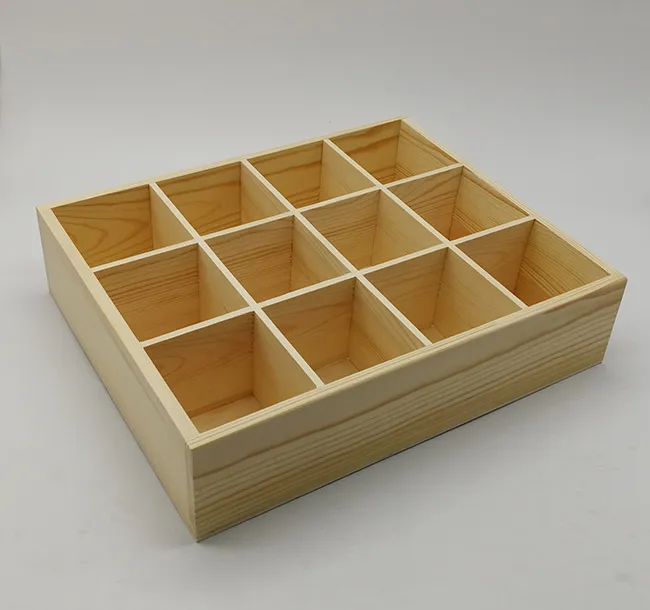
Solid pine wood storage box with nine evenly divided compartments in a 3×3 grid layout, suitable for organizing and displaying small-item collections. The symmetrical grid provides visual order and individual separation that open trays cannot achieve.
Key Features
- 3×3 grid layout — nine compartments of equal size, arranged symmetrically; each compartment provides individual separation so items don't touch, mix, or scratch each other; the grid imposes visual order on small-item collections that otherwise look cluttered in open trays
- Fixed dividers — the dividers are permanently joined with glued cross-lap joints and seated in routed grooves in the box walls; unlike removable dividers that shift, rattle, or get lost, the fixed grid holds its structure and maintains compartment integrity through handling, stacking, and shipping
- Solid pine wood construction — kiln-dried pine with sanded smooth surface; the natural wood grain provides a warm, neutral backdrop that doesn't compete with the items being displayed; pine keeps the per-unit cost accessible for multi-unit purchases (a customer organizing 5 essential oil collections buys 5 boxes)
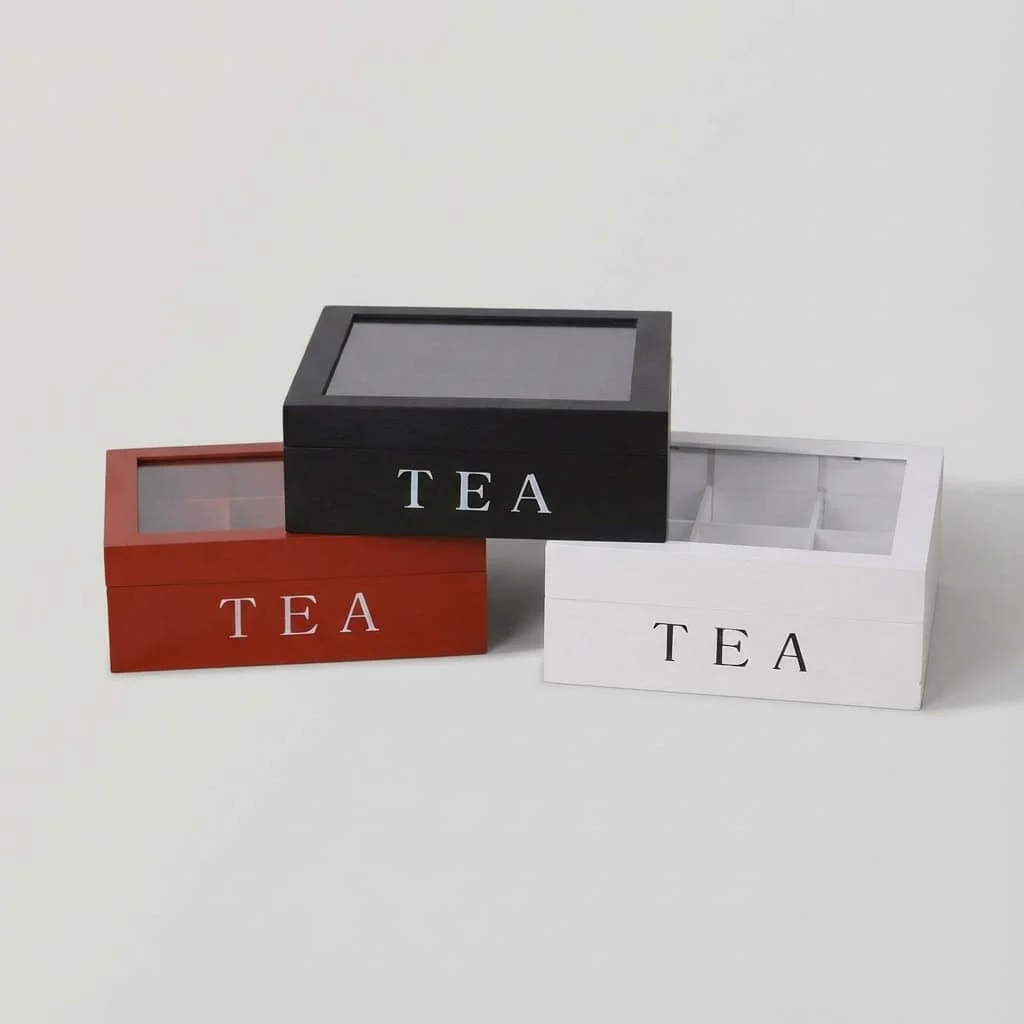
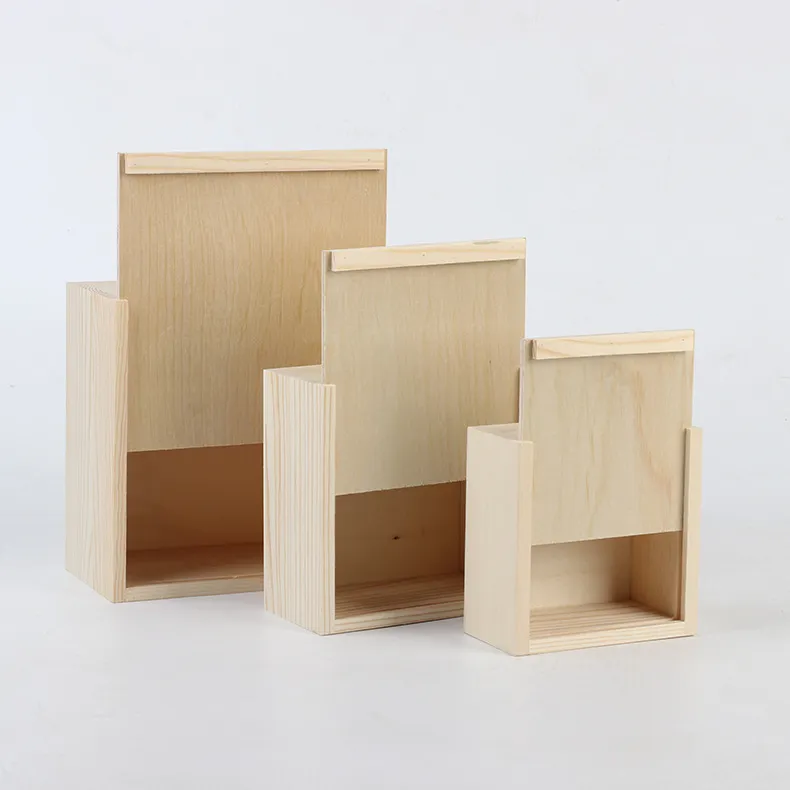
- Open-top design — no lid in the base configuration, providing instant visual inventory and zero-friction access; lid options available (sliding wood, hinged, or transparent acrylic) for applications needing dust protection or retail display with lid
- Customizable compartment count — the 9-grid (3×3) is standard; 4-grid (2×2), 6-grid (2×3), 12-grid (3×4), and other layouts available by adjusting divider positions; the grid scales to fit the product being organized
$2.50 - $10.00 / piece
Prices vary based on order quantity, dimensions, material selection, and logo printing method. Send an inquiry.
Specifications
- Wood Type
- Solid pine wood (paulownia, birch, bamboo available on request)
- Capacity
- 9 compartments (customizable to other grid counts)
- Design
- Open-top grid layout with fixed dividers
- Surface Finish
- Natural unfinished (custom finishes available)
- Usage
- Essential oil sampler kits, tea bag assortments, jewelry display, gift packaging, craft storage
- Lid
- Optional — sliding, hinged, or acrylic
- Customization
- Compartment size, box dimensions, lid type, logo engraving, surface finish, packaging
Applications
Essential oil sampler and collection sets
Where 9 essential oil bottles (5ml, 10ml, or 15ml) are organized in a grid box for retail sampler kits — each oil gets its own compartment, the grid keeps bottles upright and separated, and the open top lets customers see and smell each oil without removing bottles from the box.
Tea bag and gourmet product assortments
Where 9 tea varieties are presented in a tasting collection — each compartment holds a different flavor, the grid creates a clean, organized presentation, and the symmetrical layout photographs well for e-commerce product images and social media.
Jewelry, craft, and small-item retail display
Where earring pairs, rings, beads, or small craft items are separated by type in a retail display box — the grid keeps items organized by SKU, and customers can browse all options without opening individual containers.
Customization Options
Compartment layout: Standard 3×3 (9 compartments). Also available: 2×2 (4), 2×3 (6), 3×4 (12), and custom grid arrangements. Compartment dimensions are determined by the box exterior dimensions divided by the grid count, minus divider wall thickness (approximately 5–6mm per divider). For products with specific dimensions (e.g., essential oil bottles of 22mm diameter), we calculate the grid to provide approximately 2–3mm clearance per compartment.
Lid options: No lid/open-top (standard) — instant access, best for retail display and daily-use organization. Sliding wooden lid — dust protection with zero overhead clearance. Hinged lid with hardware — full access, stays attached. Transparent acrylic lid — full visibility with dust protection, popular for retail where customers need to see but shouldn't touch.
Dimensions: Fully customizable. Standard size approximately 25×25×8 cm — fits 9 standard essential oil bottles (15ml) or 9 tea bag compartments comfortably. The exterior footprint is determined by: (compartment width × grid count) + (divider count × divider thickness) + (2 × wall thickness).
Finish: Natural sanded (standard) — warm pine, neutral backdrop. Clear varnish for a protected, finished look. Stained, painted, or whitewashed for brand-matched presentation. Charred for a rustic, artisanal aesthetic.
Branding: Laser engraving on the front face or box bottom. Screen printing for colored branding. Compartment label engraving — each compartment divider or floor can be engraved with a product name, scent name, or tea variety. Branded sleeve packaging for retail-ready presentation.
Ready to get a recommendation?
Send us your requirements — we'll respond with material and production recommendations within 24–48 hours.
Why This Design Works
The 3×3 grid arrangement hits a mathematical sweet spot — 9 is enough compartments to be genuinely useful for collections, but not so many that compartments become too small for practical items. At 3 compartments per side, each cell in a 25×25 cm box is approximately 7.5×7.5 cm — large enough for an essential oil bottle, a tea bag envelope, a pair of earrings, or a small spice jar. A 2×2 grid (4 compartments) feels sparse — it holds a sampler, not a collection. A 4×4 grid (16 compartments) creates cells under 5 cm — too small for most items beyond beads and buttons. The 3×3 is the Goldilocks grid — it organizes a meaningful collection without sacrificing compartment usability. For the essential oil market (one of the largest buyers of grid-organizer boxes), 9 slots maps to a starter collection: lavender, peppermint, tea tree, lemon, eucalyptus, rosemary, orange, frankincense, and one wildcard.
The fixed-divider construction is a functional advantage, not a cost compromise — removable dividers create three problems that fixed dividers solve. First: removable dividers shift during transport. If the box is shipped with products inside, a removable divider can slide, allowing bottles to contact each other and potentially break. A fixed divider stays put — the compartment structure is the same in the shipping carton as it is on the retail shelf. Second: removable dividers get lost. A consumer who takes out a divider to reconfigure the box may lose it — now the box is a 8-grid plus one double-wide compartment, which looks broken. Fixed dividers can't be lost. Third: removable dividers rattle. A fixed grid is rigid and silent. For a product that's supposed to feel organized and serene (essential oils, tea collections), a rattly divider undercuts the experience.
The open-top design is correct for the core use case (retail display and daily-access organization) — lids are offered as an option, not imposed as a default. For an essential oil retailer, the customer needs to see and smell the oils — a lid is a barrier. For a tea drinker who accesses the box 3 times per day, a lid is friction multiplied by 1,000+ open/close cycles per year. The base open-top configuration accepts that for many grid-organizer use cases, instant access is more valuable than dust protection. For buyers who need lids (jewelry storage, long-term archival, dusty environments), they're available — but they're not forced on buyers who don't need them.
Manufacturing Considerations
The #1 quality issue is divider alignment — a divider that's even 1mm out of parallel creates compartments that are visibly different sizes, which ruins the grid's visual symmetry. The grid's appeal is its perfect regularity. If one compartment is 1mm narrower than its neighbor, the human eye detects the irregularity — the grid looks "off" even if the viewer can't articulate why. We cut all divider slots in a single CNC operation, with the box walls clamped in their final assembled position. The CNC program positions every slot relative to a common datum edge, ensuring slot-to-slot spacing is consistent within ±0.2mm across the entire grid. After assembly, each box is checked: measure the width of each compartment in a row — all must be within ±0.3mm of each other.
Cross-lap joints where dividers intersect are the mechanical weak point — all the lateral load from unequally filled compartments concentrates at these intersections. A cross-lap joint is formed by cutting a half-depth slot in each divider where they cross, creating an interlocking + shape. The joint is glued on all four contact faces. If the slot depth is inconsistent (one slot cut to 55% of divider height, the mating slot at 45%), the joint has less glue surface on the shallower side and can separate under load. We cut all cross-lap slots to exactly 50% of divider height with a tolerance of ±0.2mm, ensuring maximum glue surface on both pieces. After glue-up, each cross-lap joint is tested with a 1.5 kg lateral force applied — the joint must hold without visible movement or cracking.
Pine's seasonal expansion affects the grid geometry — if the box exterior expands but the dividers don't (or vice versa), the grid can bow or the joints can stress. The box walls and dividers are all pine — they expand and contract at roughly the same rate. However, the grain direction matters: the box walls typically run with the grain horizontal around the perimeter, while divider grain direction varies. For the most stable grid, we orient all dividers with the grain running horizontally (parallel to the box bottom), matching the primary expansion direction of the box walls. This grain orientation alignment minimizes differential expansion between the box and the dividers.
Have a technical concern about your use case? Our team can walk you through how we'd handle it for your project.
Start with the 3×3 grid in natural sanded pine at approximately 25×25×8 cm, open-top (no lid). This configuration is the volume seller — it fits essential oil bottles, tea bags, jewelry, and craft supplies equally well, and the natural pine finish works across all retail and home contexts. For the essential oil market (the highest-volume buyer for this product), offer the box with a transparent acrylic lid as an upgrade — the lid allows retail display (customers see the oils, can't touch them without staff assistance) and keeps the bottles dust-free between uses. For the tea market, offer the sliding lid — tea bags need dust protection more than oils do, and the sliding lid's zero-clearance opening works in kitchen cabinets. The 9-grid open-top pine box is the Swiss Army knife of our grid-organizer line — stock it deep, offer lid upgrades, and capture volume across multiple buyer categories.
Start Your Project
Send us your design or reference images — we'll return with a pre-production sample for your approval.
Frequently Asked Questions
Q: What size items fit in each compartment?
Q: Can the grid layout be changed from 3×3?
Q: Does the box come with a lid?
Q: Will the dividers warp or loosen over time?
Send Us Your Requirements
Send your design, reference images, or product sample. We don't just quote a price — we respond with material recommendations, a feasibility assessment, and professional suggestions grounded in over 20 years of manufacturing experience. Expect a detailed response within 24–48 hours.
- Professional recommendations included
- Small MOQ & trial orders supported
- Worldwide shipping with export documentation