
Wooden Tea Storage Box with Clear Lid for Desk Organization
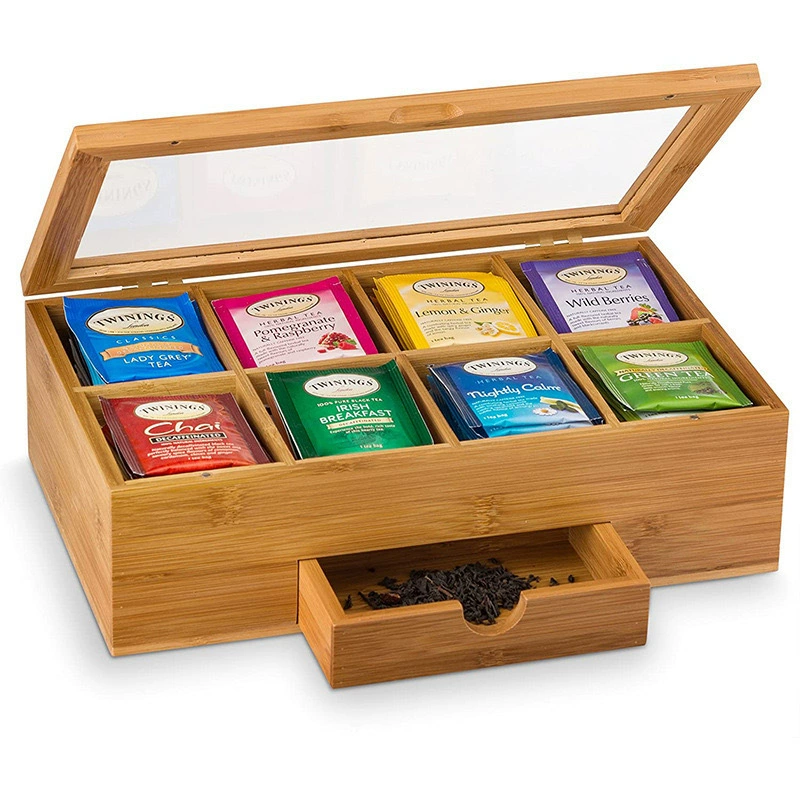
Bamboo tea storage box with clear hinged acrylic lid, metal latch, and partitioned interior, suitable for office pantries, hospitality stations, and home countertop organization.
Key Features
- Clear hinged acrylic lid with metal latch — the lid pivots open on metal hinges and locks closed with a positive latch; more secure than a friction-fit lid for a box that's moved between counter, shelf, and serving station
- Multi-compartment bamboo interior — 6 or 8 equal compartments standard; each cell sized for standard tea bags or coffee pods, with dividers tall enough to prevent bags from migrating between compartments when the box is carried
- Solid bamboo construction — harder and more moisture-resistant than pine; bamboo's natural antimicrobial properties matter in a food-service environment where wet tea bags and coffee drips are routine
- Natural clear varnish finish — seals the bamboo surface against tea stains and moisture without hiding the distinctive bamboo grain; wipe-clean maintenance with no oiling or re-seasoning required
- Compact countertop footprint — roughly 25×18×8 cm; large enough to hold a week's tea supply for a small office, small enough to sit alongside a coffee maker without dominating the beverage station
$1.20 - $5.00 / piece
Prices vary based on order quantity, dimensions, material selection, and logo printing method. Send an inquiry.
Specifications
- Wood Type
- Bamboo
- Compartments
- 6 or 8 equal (custom layouts available)
- Lid
- Clear acrylic hinged lid with metal latch
- Surface Finish
- Clear varnish
- Usage
- Tea bag and coffee pod organization, office pantry, cafe condiment station
- Customization
- Compartment layout, dimensions, wood species, finish, and branding
Applications
Office pantry and breakroom tea service
Where multiple tea varieties need organized, visible storage — the clear lid lets employees see what's available without opening the box, and the latch prevents the lid from flopping open when someone grabs the box one-handed.
Cafe and coffee shop condiment station
Where tea bags and sugar packets are self-serve — the hinged lid stays open during service hours for customer access, then latches closed at closing time to keep contents clean and pest-free overnight.
Home kitchen and countertop organization
Where the box lives on the counter next to the kettle — the bamboo and clear acrylic look intentional in a modern kitchen, not like temporary packaging, and the compact footprint leaves room for the coffee maker and toaster.
Customization Options
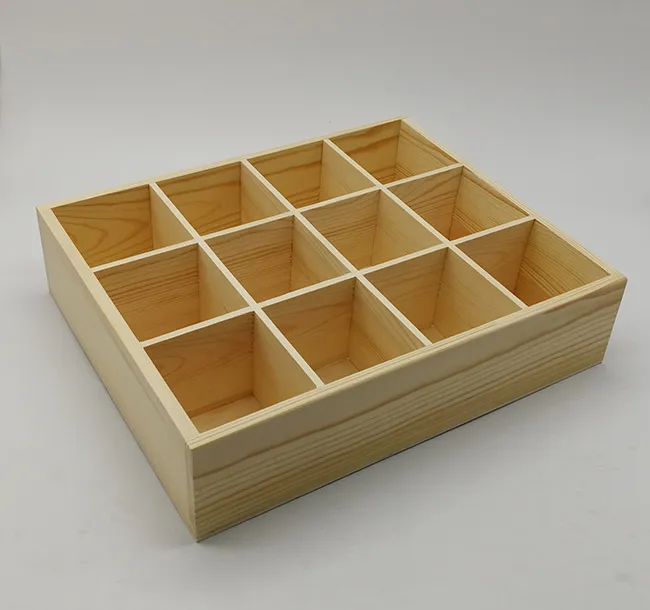
Compartment layout: Standard is 6 or 8 equal compartments. Custom layouts available — 4 larger compartments for oversized tea bags and coffee pods, mixed grid (3 tea + 3 coffee compartments of different sizes), or a 2-section layout (half tea bags, half loose leaf accessories). Divider height is matched to your tallest product format — pyramid tea bags need taller dividers than flat rectangular bags.
Dimensions: Standard is approximately 25×18×8 cm. Scale up for larger inventories (12+ compartments for tea shops) or down for personal desk use (4 compartments). The compartment depth must accommodate your tea bag format — standard rectangular bags need roughly 8–10 cm width per cell and 5–6 cm depth.
Wood species: Bamboo is standard and recommended — its moisture resistance and natural antimicrobial properties suit food service. Pine for a lower-cost alternative — lighter color, takes stain well, but requires the varnish finish for moisture protection. Acacia for a darker, more premium look — harder than bamboo but roughly 1.5× the material cost.
Finish: Clear varnish is standard — seals against moisture and stains while keeping the natural grain visible. Matte lacquer for a more contemporary, non-reflective look. Natural oil finish for a tactile feel — less spill protection than varnish, better suited for home use than commercial food service.
Branding: Laser engraving on the bamboo front panel — subtle, permanent, high contrast on bamboo. Engraving on the acrylic lid — frosted mark visible when the lid is closed, less visible when open. Silk screen printing on the lid for colored logos. Interior branding — a small engraved logo on the base panel, visible when the last tea bag is taken.
Ready to get a recommendation?
Send us your requirements — we'll respond with material and production recommendations within 24–48 hours.
Why This Design Works
The metal latch on a hinged lid serves a specific function that the bamboo-tea-bag-organizer-box model doesn't address. That model uses a friction-fit hinged lid — fast to open, fine for a box that stays on the counter. This model adds a metal latch because it's designed for environments where the box gets moved — carried from the supply cabinet to the beverage station, transported between rooms in a hotel, or stacked in a catering kit. A friction-fit lid can pop open when the box is tilted or jostled; a positive latch can't. The latch also signals to guests and employees that this is permanent equipment, not disposable packaging — it's the same hardware language as a tea chest or a toolbox, not a takeout container.
Six or eight equal compartments is the most broadly compatible layout for multi-variety tea service. A typical office or cafe stocks 4–8 tea varieties: English Breakfast, Earl Grey, Green, Chamomile, Peppermint, and maybe a rooibos or chai. Six compartments cover the basics; eight covers a premium selection. Equal sizing means no variety gets priority placement — the Earl Grey doesn't get a bigger bin than the Chamomile. The dividers extend to within 2mm of the acrylic lid — tall enough that tea bags can't slide over the top into the neighboring compartment when the box is carried or tilted. That's the detail that prevents the morning frustration of finding English Breakfast bags mixed into the Green tea.
Bamboo with clear varnish is the right material choice for a box that lives in a beverage station. Beverage stations are wet environments — kettle steam, coffee drips, condensation rings from cold milk pitchers. Unfinished wood absorbs that moisture, swells, and eventually warps or grows mold at the base. Bamboo is naturally more moisture-resistant than pine (absorbs less water, dries faster), and the clear varnish seals the surface completely — a wet tea bag can sit on the varnished surface for an hour without leaving a mark. The varnish also prevents tea tannins from staining the wood — without it, a dropped black tea bag would leave a permanent brown spot on raw bamboo within minutes.
Manufacturing Considerations
Hinge alignment on a latching lid is more demanding than on a friction-fit lid. On a friction-fit lid, the lid just needs to sit flat — minor hinge misalignment is absorbed by the wood-to-wood contact. On a latching lid, the latch catch plate on the front panel must align with the latch hook on the lid within 0.5mm in both the closed position. If the hinge mortises are even slightly deeper on one side, the lid tilts and the latch doesn't engage — it bounces off the catch plate instead of locking. We use a jig that routes both hinge mortises and positions the latch catch plate in a single setup, referencing the same panel edge. Each assembled box is tested: latch and unlatch 10 times — the latch must engage with a clean click every time, no scraping or misalignment.
Bamboo's silica content accelerates tool wear — this is a production cost factor, not just a material property. Bamboo contains natural silica (silicon dioxide) that dulls cutting edges faster than pine or poplar. Router bits cutting bamboo compartment dividers and hinge mortises need replacement roughly every 500–800 units versus 1,500–2,000 for pine. We track tool life by unit count and replace bits proactively before the edge degradation affects cut quality — a dull bit on bamboo produces fuzzy cuts and chipped edges at the divider slots. This is absorbed into the per-unit cost rather than showing up as a quality issue, but it's why bamboo products carry a small premium over equivalent pine products.
The varnish finish on interior compartments requires careful application to avoid pooling. Compartment corners are 90° inside angles — varnish pools in the corner if applied too heavily, drying glossy and slightly tacky. We spray the interior with reduced pressure and a wider fan pattern, building the film in three light passes rather than one heavy coat. Each compartment is inspected under raking light after curing — glossy pools are sanded back with 320-grit and re-sprayed. For large orders, this is the most labor-intensive QC step because it can't be automated — every compartment corner must be visually checked by a person.
Have a technical concern about your use case? Our team can walk you through how we'd handle it for your project.
Order the 8-compartment layout in bamboo with clear varnish and metal latch. Eight compartments gives the customer flexibility — six varieties plus two compartments for sugar packets, stirrers, or seasonal teas. The metal latch is worth the small hardware cost for any application where the box gets moved — it prevents the most common failure mode (lid opens, contents spill). Skip custom branding on the first order unless you already have confirmed wholesale buyers who require it — the natural bamboo and clear acrylic look complete and retail-ready without a logo, and adding branding before you've validated the market commits you to a branded inventory. Add laser engraving on the front panel for your reorder.
Start Your Project
Send us your design or reference images — we'll return with a pre-production sample for your approval.
Frequently Asked Questions
Q: How many tea bags fit in each compartment?
Q: Does the metal latch rust in a humid beverage station environment?
Q: Can the dividers be removed to create larger compartments?
Q: Does the box stack with other boxes of the same model?
Q: Is this the same as the bamboo tea bag organizer box on your site?
Send Us Your Requirements
Send your design, reference images, or product sample. We don't just quote a price — we respond with material recommendations, a feasibility assessment, and professional suggestions grounded in over 20 years of manufacturing experience. Expect a detailed response within 24–48 hours.
- Professional recommendations included
- Small MOQ & trial orders supported
- Worldwide shipping with export documentation