When comparing custom wood products suppliers and manufacturers, many buyers tend to focus on two simple factors:1
“Who is cheaper?”
“Who has better quality?”
While these questions are common, they often lead to incomplete decisions.
Experienced buyers evaluate suppliers in a more structured way. Instead of looking at price or quality in isolation, they focus on value comparison.
They usually ask:
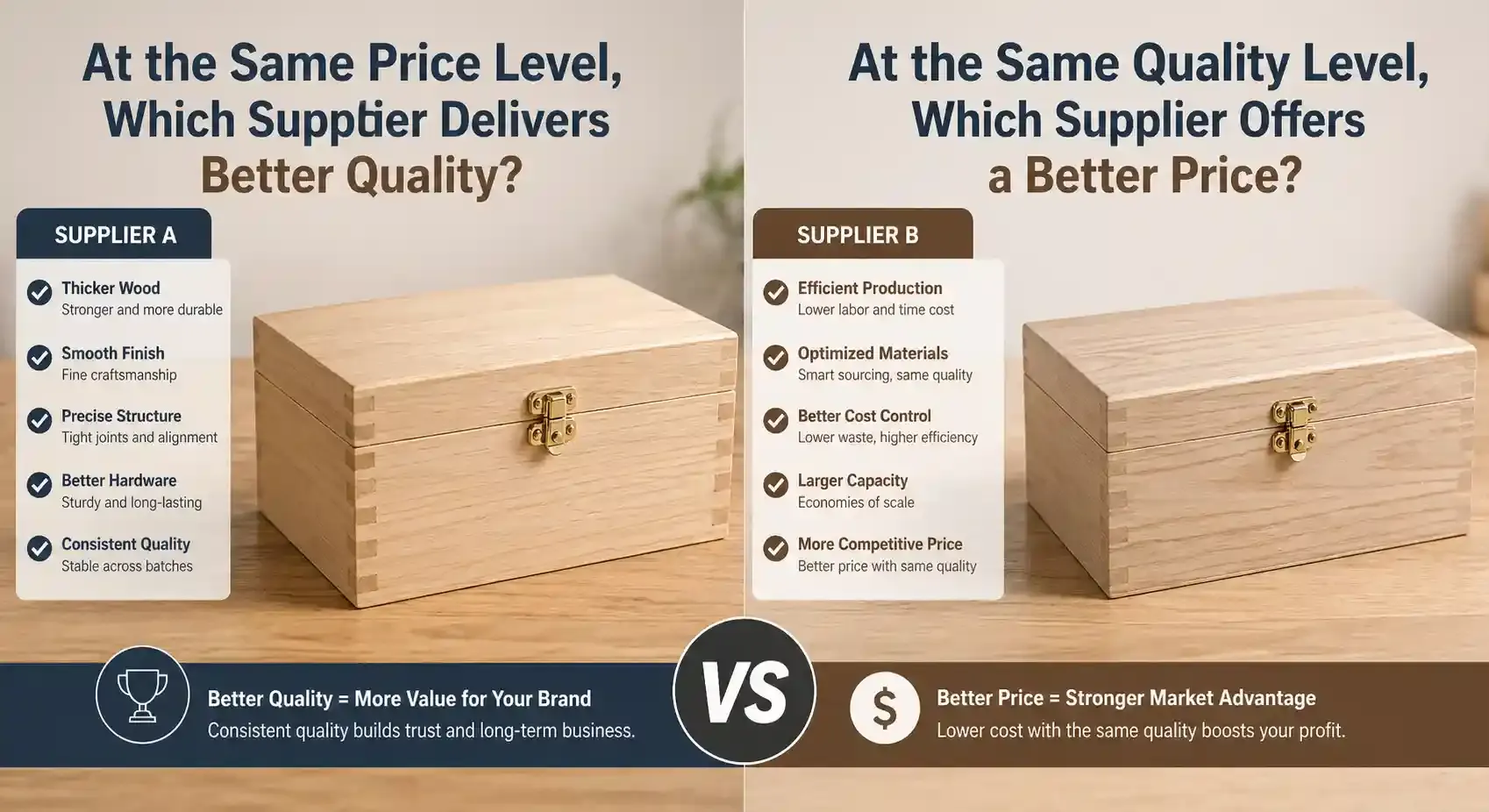
👉 At the same price level, which supplier delivers better quality?
👉 At the same quality level, which supplier offers a better price?
This shift in thinking is critical.
Because in custom wood products manufacturing, price alone does not define value, and quality alone does not define cost efficiency. The real difference between suppliers lies in how well they balance materials, craftsmanship, customization capability, and production efficiency.
In other words, the goal is not simply to find the cheapest or the highest quality option — but to identify the manufacturer who delivers the best overall value for your specific product requirements.
This is the real way professional buyers evaluate custom wood products suppliers and manufacturers.

Same Price, Who Offers Better Quality?
When comparing custom wood products suppliers, many buyers assume that the same price means the same product quality.
In reality, this is rarely true.
Even when two suppliers quote identical prices, the actual value delivered can be very different due to differences in materials, production standards, and craftsmanship.
That is why experienced buyers do not only look at price — they analyze what is actually included behind that price.
What “Same Price” Really Means in Custom Wood Products
In custom wood manufacturing, “same price” is often misleading.
A quoted price usually represents a baseline configuration, but it does not guarantee:
- Same material grade
- Same production process
- Same finishing quality
- Same hardware components
For example, two suppliers may both quote $5 per unit, but one may use higher-grade wood and better finishing, while the other reduces cost through material or process adjustments.
This is why price alone cannot be used as a reliable comparison standard.
Key Factors That Affect Custom Wood Products Quality at the Same Price Level
Even at the same price point, different custom wood products suppliers may deliver noticeably different results. This is mainly due to variations in material selection, production methods, and quality control standards.
Material selection
Different wood types such as pine, paulownia, oak, or bamboo directly affect durability, texture, and appearance. Even within the same wood type, grade differences can significantly change product quality.
Wood thickness
Thicker materials generally provide better strength and durability. However, some custom wood products suppliers may reduce thickness to control costs while keeping the same external appearance.
Surface finishing
Finishing quality affects both aesthetics and product protection, including sanding smoothness, coating consistency, and color uniformity.
Hardware and accessories
Hinges, locks, magnets, and other accessories strongly influence usability and perceived quality, even though they are often overlooked.
Craftsmanship details
Details such as joint precision, engraving clarity, and assembly accuracy are key indicators of manufacturing capability.
How to Identify a Higher-Value Custom Wood Products Supplier at the Same Price
To identify which supplier truly offers better value at the same price level, experienced buyers focus on deeper evaluation rather than surface comparison.
Key methods include:
- Request detailed material specifications, not just product photos
- Compare sample products side by side, not quotations alone
- Check structural strength and finishing details carefully
- Evaluate consistency between samples and mass production capability
- Assess whether the supplier can offer design optimization suggestions
Practical lead-time and order signals are also worth comparing side by side. Ask each supplier how quickly they return an accurate quote, how long samples take, what production lead time they commit to, and what minimum order quantity they require. As a reference, Hilon Wood typically provides an accurate quote within 24–48 hours, produces samples in 7–15 days, and completes custom wooden crate orders in 30–45 days. MOQ for custom wooden crates is around 200 units, adjustable depending on product size.
In most cases, a more experienced custom wood products manufacturer can deliver better structure, better materials, and better finishing within the same cost range.
Same Quality, Who Offers a Better Price?
When two suppliers deliver custom wood products that meet the same specification requirements, their internal production systems, sourcing methods, and operational efficiency can lead to significantly different pricing outcomes.
Understanding cost structure is therefore the key to explaining why prices vary across suppliers.
Labor cost
Labor cost is one of the most fundamental components in custom wood manufacturing. It includes wages for cutting, assembly, sanding, finishing, and quality control processes.
Different regions and factories have different labor cost levels, but more importantly, efficiency also plays a major role. A skilled workforce can reduce errors, rework rates, and production time, which directly lowers overall cost per unit.
Production efficiency
Production efficiency reflects how effectively a manufacturer converts raw materials into finished products.
Factories with optimized workflows, better machinery, and standardized processes can significantly reduce waste and production time. This leads to lower unit cost even when material and design remain the same.
Inefficient production systems often increase hidden costs such as rework, material loss, and longer lead times.
Supply chain advantages
A stable and integrated supply chain allows suppliers to control raw material costs more effectively.
Suppliers with long-term partnerships with wood mills, hardware providers, and finishing material suppliers can secure more stable pricing and reduce fluctuations in raw material costs.
This advantage becomes especially important in custom wood products, where material selection directly impacts total cost.
Raw material sourcing strategy
Beyond supply chain access, sourcing strategy itself also affects pricing.
Some manufacturers optimize cost by selecting different wood grades, alternative material combinations, or regionally available resources without changing the final product appearance or function.
This flexibility allows them to maintain competitive pricing while meeting specification requirements.
What Defines “Real Value” in Custom Wood Products
In custom wood products manufacturing, “value” is not determined by a single factor such as price or appearance. Instead, it is the result of multiple elements working together to define the overall commercial and functional performance of a product.
When comparing different custom wood products suppliers, understanding real value helps buyers make more informed sourcing decisions, especially when comparing different suppliers across regions and cost structures.
Material + Craftsmanship + Customization + Efficiency
Real value in custom wood products is built on four key pillars. When comparing different custom wood products suppliers, these factors provide a more reliable basis for evaluation than price alone.
Material
Material defines the foundation of the product, including wood type, grade, and stability. It directly affects durability, appearance, and long-term performance. Different custom wood products suppliers may quote similar prices while using different material grades, which leads to noticeable differences in final quality.
Craftsmanship
Craftsmanship reflects the precision of production, including cutting accuracy, surface finishing, and assembly quality. A capable wood products manufacturer maintains consistent workmanship across bulk orders, reducing defects and ensuring stable quality. Craftsmanship reflects the precision of production, including cutting accuracy, surface finishing, and assembly quality.
Customization
Customization represents custom wood products suppliers’ ability to adapt designs, structures, and branding requirements to specific market needs.
Efficiency
Efficiency determines how effectively a manufacturer can control production cost, lead time, and consistency without compromising quality.
When these four elements are well balanced, the product achieves higher overall value regardless of price positioning.
Why Price Alone Does Not Reflect True Value
Price is only a reflection of cost structure, not product value.
Two products with similar prices may have completely different internal cost compositions, leading to differences in material quality, production standards, or customization depth.
Focusing only on price can lead to incomplete decision-making because it ignores what is actually delivered behind the quotation.
In custom wood manufacturing, true value is better measured by what the buyer receives in terms of durability, usability, and brand impact rather than the unit price alone.
Why Quality Alone Does Not Guarantee Better Business Results
High product quality does not automatically translate into better business performance.
A product may have excellent craftsmanship and materials but still fail to deliver commercial success if it lacks cost efficiency, market suitability, or scalability.
In contrast, a well-balanced product with optimized cost structure and appropriate quality level can often generate better margins and stronger market competitiveness.
Therefore, successful sourcing decisions require balancing quality with cost efficiency and business objectives, rather than focusing on quality in isolation.
Why Value-Based Comparison Leads to Better Business Decisions
In custom wood products sourcing, decisions based only on price or surface-level quality often miss the bigger picture.
When comparing different custom wood products suppliers, a value-based approach focuses on the overall balance between cost structure, product performance, and business outcomes. This helps buyers select suppliers that are suitable not only for current orders, but also for long-term cooperation and stable supply.
Lower Risk in Sourcing Decisions
A value-based comparison reduces sourcing risk by encouraging buyers to evaluate custom wood products suppliers beyond a single factor such as price or appearance.
When buyers assess materials, craftsmanship, production stability, and customization capability together, they gain a more complete understanding of supplier reliability. This reduces the likelihood of issues such as inconsistent quality, delayed deliveries, or unexpected cost increases.
As a result, sourcing decisions become more predictable and controllable, especially for long-term production planning.
Better Product Positioning in Your Market
Products selected through a value-based approach are more aligned with market expectations and brand positioning.
Instead of choosing based only on lowest cost or highest specification, buyers can select a balanced solution that fits their target customers, pricing strategy, and brand identity.
This allows custom wood products to better support marketing goals, improve customer perception, and strengthen competitiveness in different market segments.
Higher Long-Term Profit Margins
Value-based sourcing directly contributes to better long-term profitability.
By optimizing the balance between cost structure and product value, buyers can reduce unnecessary production costs while maintaining or improving perceived product quality.
This creates more flexible pricing strategies, healthier margins, and better scalability when order volume increases.
Over time, consistent value-based decisions lead to stronger business stability and improved overall return on investment.
Conclusion – Think Like a Professional Buyer, Not a Price Buyer
In custom wood products sourcing, the difference between an average buyer and a professional buyer is not what they buy, but how they evaluate suppliers and make decisions. Instead of focusing on price alone, professional buyers always consider the overall value, including cost structure, product performance, and long-term business impact.
A value-driven mindset leads to more stable sourcing outcomes, better product consistency, and stronger competitiveness in the market.
Focus on Value, Not Just Cost
Professional buyers do not treat price as the only decision factor. Instead, they evaluate what is actually included behind the price, such as material quality, craftsmanship, production efficiency, and customization capability.
By focusing on overall value, buyers can select suppliers that provide the best balance between cost and performance, rather than simply choosing the lowest quotation.
This approach helps ensure that purchasing decisions support both product quality and business goals.
Build Long-Term Supplier Relationships With a Custom Wood Products Supplier
Instead of switching suppliers frequently based on small price differences, professional buyers prioritize long-term cooperation based on consistent performance.
Reliable custom wood products suppliers that maintain stable quality, clear communication, and predictable delivery schedules become strategic partners in business growth.
Over time, this type of relationship reduces sourcing risks, improves production efficiency, and creates more opportunities for cost optimization and product development.
This article was made by Hilon Wood. We are dedicated to custom wooden products manufacturing.
Custom Wooden Products Wholesale at Hilon Wood
Hilon Wood provide custom wooden products for wholesale projects based on your drawings, samples, or target market needs. Our production covers wooden boxes, packaging, home decor and storage, and kitchen items, with flexible options in size, material, structure, and logo application. We work with a wide range of wood materials and can recommend suitable materials based on your design, budget, and application. Small trial orders are supported.
Let us manufacture custom wooden products for you.