
Unfinished Hinged-lid Paulownia Wooden Storage Box
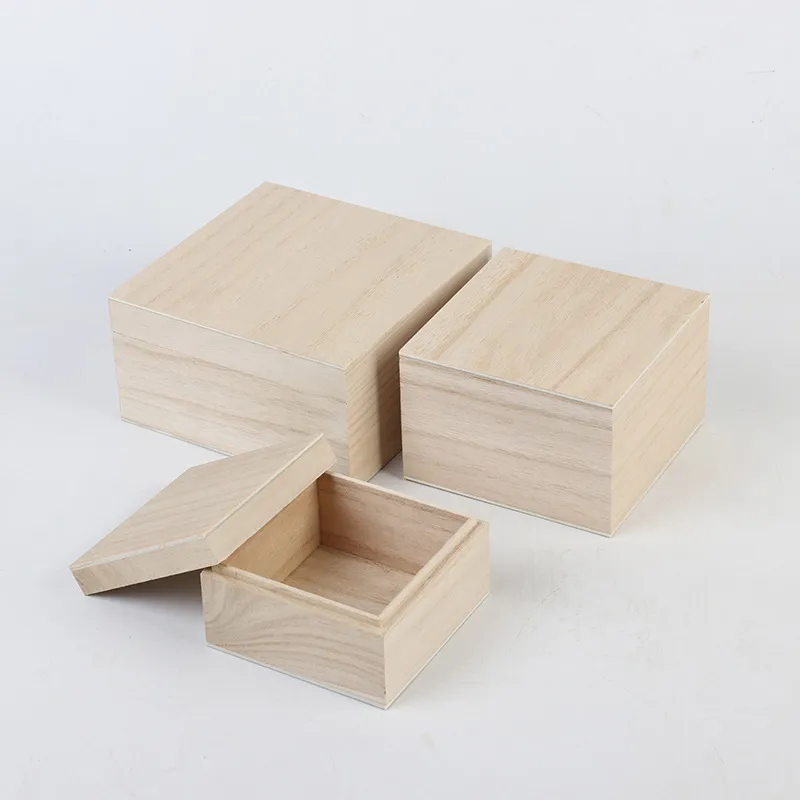
Hinged-lid paulownia wood storage box with unfinished surface, engineered as a lightweight customization blank for DIY projects and personalized gift packaging.
Key Features
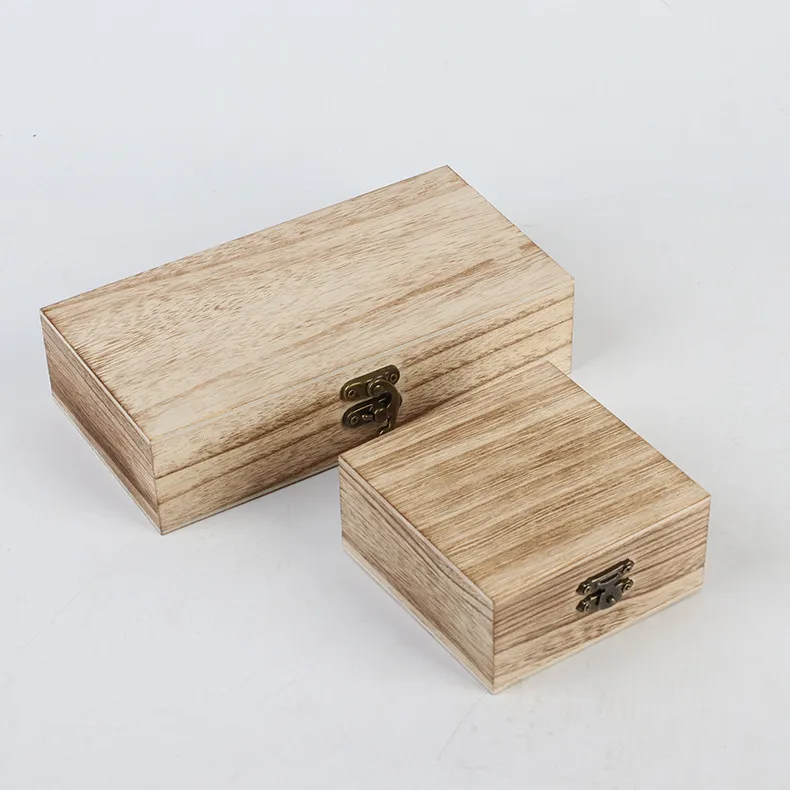
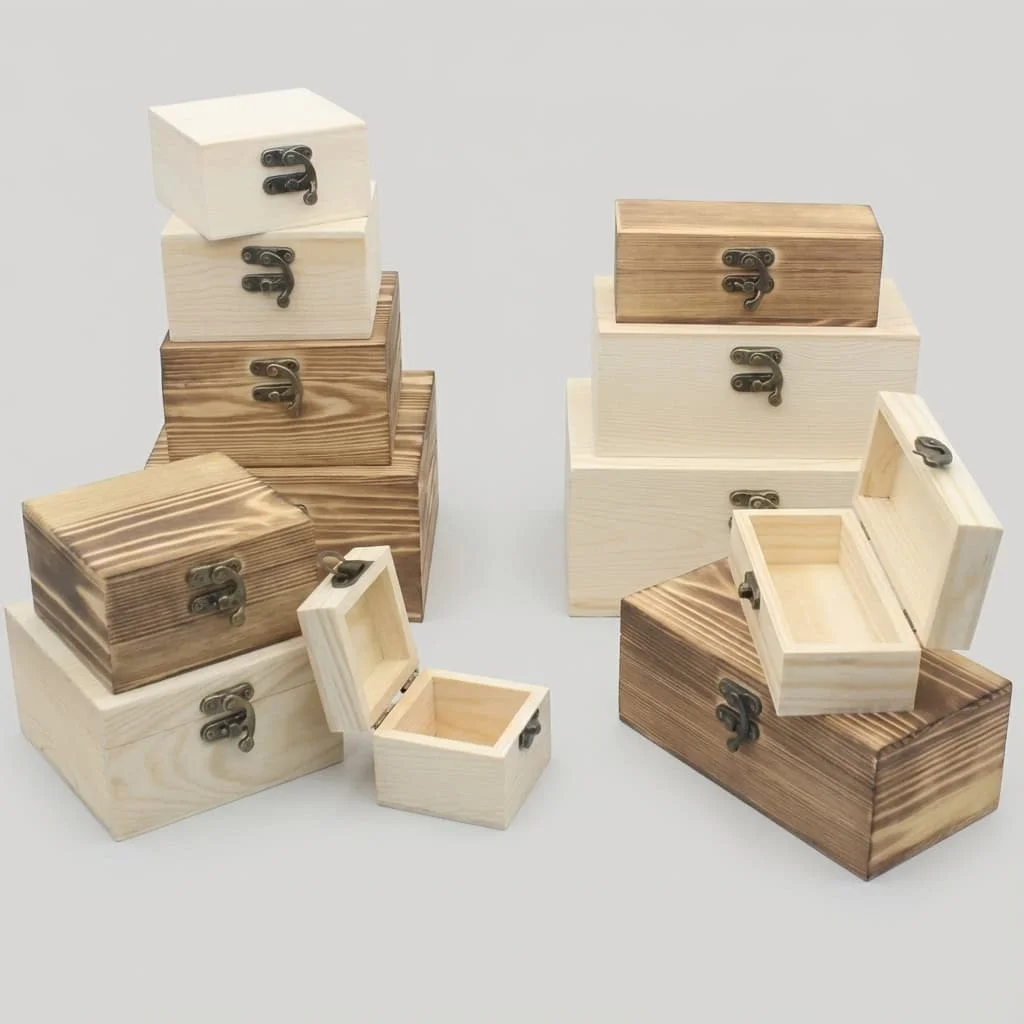
- Hinged lid with optional latch — full-length metal hinge for smooth opening to past 90°; an optional metal latch (available on request) adds closure security for transported or frequently handled boxes; the hinge stays attached (unlike lift-off lids) so the lid is never misplaced
- Paulownia wood — approximately 40% lighter than pine at the same dimensions; the weight savings compound across shipping, handling, and end-user portability; paulownia's smooth, even grain takes paint, stain, and decoupage with less surface prep than pine's more pronounced grain
- Unfinished sanded surface — no finish applied; the box ships as a smooth, 220-grit sanded blank ready for the buyer's creative treatment; nothing to sand off, no existing finish to work around, no chemical off-gassing to worry about for sensitive applications
- Clean rectangular profile — simple lines and smooth surfaces that don't compete with the buyer's customization; the box is designed to be a canvas, not a statement piece — the user's paint, stain, or decoupage is the statement
- Lightweight portability — at approximately 250–350 grams for a medium-sized box, paulownia is light enough for a child to carry a keepsake box, for a craft fair vendor to transport dozens of display boxes, and for air freight shipments to minimize dimensional-weight charges
$0.72 - $2.70 / piece
Prices vary based on order quantity, dimensions, material selection, and logo printing method. Send an inquiry.
Specifications
- Material
- Paulownia wood (pine, bamboo, birch options available)
- Lid
- Hinged with metal hinge, optional metal latch
- Finish
- Unfinished sanded (varnish, stain, paint options available)
- Application
- DIY crafts, classroom projects, custom small-business packaging
Applications
DIY craft and maker projects
Where the unfinished box is purchased as a raw material for creative projects — decoupage memory boxes, hand-painted jewelry cases, wood-burned keepsake chests, mosaic-topped trinket boxes; the blank box is the starting point, not the finished product.
Children's craft and educational projects
Where lightweight, unfinished wood boxes are used in classroom and camp craft activities — the light paulownia is easy for small hands to handle, the unfinished surface accepts any craft medium, and the hinged lid adds a functional element that kids find satisfying.
Custom small-business packaging
Where a small brand finishes and brands the boxes themselves — painting, staining, engraving, adding a branded ribbon or tag — to create custom packaging at a lower per-unit cost than fully finished custom boxes from the factory.
Customization Options
Dimensions: Fully customizable. Standard sizes: small (10×10×5 cm for jewelry and trinkets), medium (20×10×5 cm for desk and craft storage), large (25×15×8 cm for multi-item storage). The hinged lid adds approximately 8mm to the overall height when closed (hinge barrel protrudes from the back).
Latch option: No latch (standard) — the lid stays closed by friction and gravity; appropriate for shelf-stored boxes. Metal latch available — a small brass or nickel clasp mounted on the front panel; adds security for transported boxes and a vintage aesthetic for finished products.
Wood species: Paulownia (standard) — lightweight and smooth-grained. Pine available for a heavier, more dent-resistant alternative. Bamboo available for a harder, pre-finished look. Birch available for the smoothest painting surface — birch's tight, uniform grain requires the least surface prep for a flawless paint finish.
Finish: Unfinished sanded (standard) — the blank-canvas option. If the buyer wants a factory finish, clear varnish, stain, or paint options are available — but the unfinished option is the core value proposition for this product. Bulk unfinished boxes can be ordered with no individual packaging for the lowest possible unit cost.
Ready to get a recommendation?
Send us your requirements — we'll respond with material and production recommendations within 24–48 hours.
Why This Design Works
The hinged lid makes this a useable everyday box, not a display-only container — the #1 reason people abandon decorative boxes is lid inconvenience. A lift-off lid requires two hands and a clear surface to set the lid down. A hinged lid opens with one hand and stays attached. For a box that holds daily-use items — jewelry, desk supplies, craft tools — the hinge is the feature that keeps the box in active use. The recipient opens the lid, grabs what they need, closes it — three seconds, one hand, no hunting for where they set the lid. The hinge is the difference between a box that lives on the dresser (used daily) and one that migrates to the back of a cabinet (opened annually).
This product's value proposition is fundamentally different from our finished boxes — it's sold as a component, not a finished good. A finished walnut jewelry box competes on material quality, finish, and presentation. An unfinished paulownia box competes on price, weight, and surface readiness — the buyer's value isn't in the box itself, it's in what they'll turn the box into. For a craft business that sells hand-painted memory boxes at $35 each, the $5 blank box is a cost of goods sold line item — the lower it is, the higher their margin. For a teacher buying 30 boxes for a classroom project, the $3 per-box cost makes the project feasible where a $12 finished box would not. Positioning this as a component (not a finished product) changes the buyer's expectations and the competitive set — we're not competing with finished jewelry boxes, we're competing with blank craft supplies.
Paulownia's low density is a genuine functional advantage for this product category, not a material compromise. A jewelry box made of dense walnut signals quality through weight. A craft blank made of lightweight paulownia signals accessibility — it's easy to handle, easy to ship, easy for children to use, easy on the buyer's budget. For a classroom of 25 second-graders decorating memory boxes for Mother's Day, a 200-gram paulownia box is manageable; a 500-gram pine box is a struggle. For an Etsy seller shipping hand-painted boxes to customers, the 40% weight savings on paulownia vs pine translates directly to lower shipping costs and higher margins. The material choice aligns with the use case.
Manufacturing Considerations
The #1 quality issue is hinge screw retention in paulownia — the wood's low density (Janka ~200–250) provides less screw-holding power than pine or hardwood. A #4 wood screw in paulownia has roughly 40–50% of the holding strength of the same screw in pine. To compensate: we use slightly longer screws in paulownia (#4 × 12mm instead of #4 × 8mm), pre-drill pilot holes at 80% of screw shank diameter (tighter than the 75% softwood standard to maximize fiber engagement), and apply a small drop of wood glue into each pilot hole before driving the screw — the glue reinforces the wood fiber around the screw thread. This three-step approach (longer screw, tighter pilot hole, glue reinforcement) brings paulownia hinge retention to approximately 85% of a standard pine installation — acceptable for normal use.
The unfinished surface is an inspection challenge — there's no finish to hide minor imperfections, but the surface quality standard is different than for finished boxes. A finished box must be flawless under direct light because the finish reflects light and highlights defects. An unfinished box will be painted, stained, or decoupaged by the buyer — minor grain variation, slight color differences between panels, and small (sub-0.5mm) surface irregularities will be covered by the buyer's own finish. Our inspection standard for unfinished boxes focuses on structural integrity and smoothness (no splinters, no rough patches) rather than cosmetic perfection (color matching, grain pattern consistency). This lower cosmetic standard is part of what keeps the per-unit cost low.
Have a technical concern about your use case? Our team can walk you through how we'd handle it for your project.
Start with the medium rectangular format (20×10×5 cm) in unfinished paulownia with no latch. This size is the most versatile — large enough for meaningful storage (jewelry, desk supplies, craft tools), small enough for cost-sensitive bulk orders (classroom projects, craft fair inventory). Sell in bulk packs (10, 25, 50 units) with simplified packaging — each box nested or stacked, no individual wrap, no retail packaging — to minimize per-unit cost and packaging waste. The value is in the blank, not the presentation. Offer the latch as an optional upgrade — some buyers want the vintage aesthetic a latch provides, but the majority don't need it and shouldn't pay for it. For the buyer who wants the lightest possible weight at the lowest possible cost, there's no better wood than paulownia in our catalog.
Start Your Project
Send us your design or reference images — we'll return with a pre-production sample for your approval.
Frequently Asked Questions
Q: Why is the box sold unfinished?
Q: Will the hinge hold up with repeated use given how soft paulownia is?
Q: Can the box be used for food products?
Send Us Your Requirements
Send your design, reference images, or product sample. We don't just quote a price — we respond with material recommendations, a feasibility assessment, and professional suggestions grounded in over 20 years of manufacturing experience. Expect a detailed response within 24–48 hours.
- Professional recommendations included
- Small MOQ & trial orders supported
- Worldwide shipping with export documentation