
Custom Single Bottle Wooden Wine Box with Sliding Lid
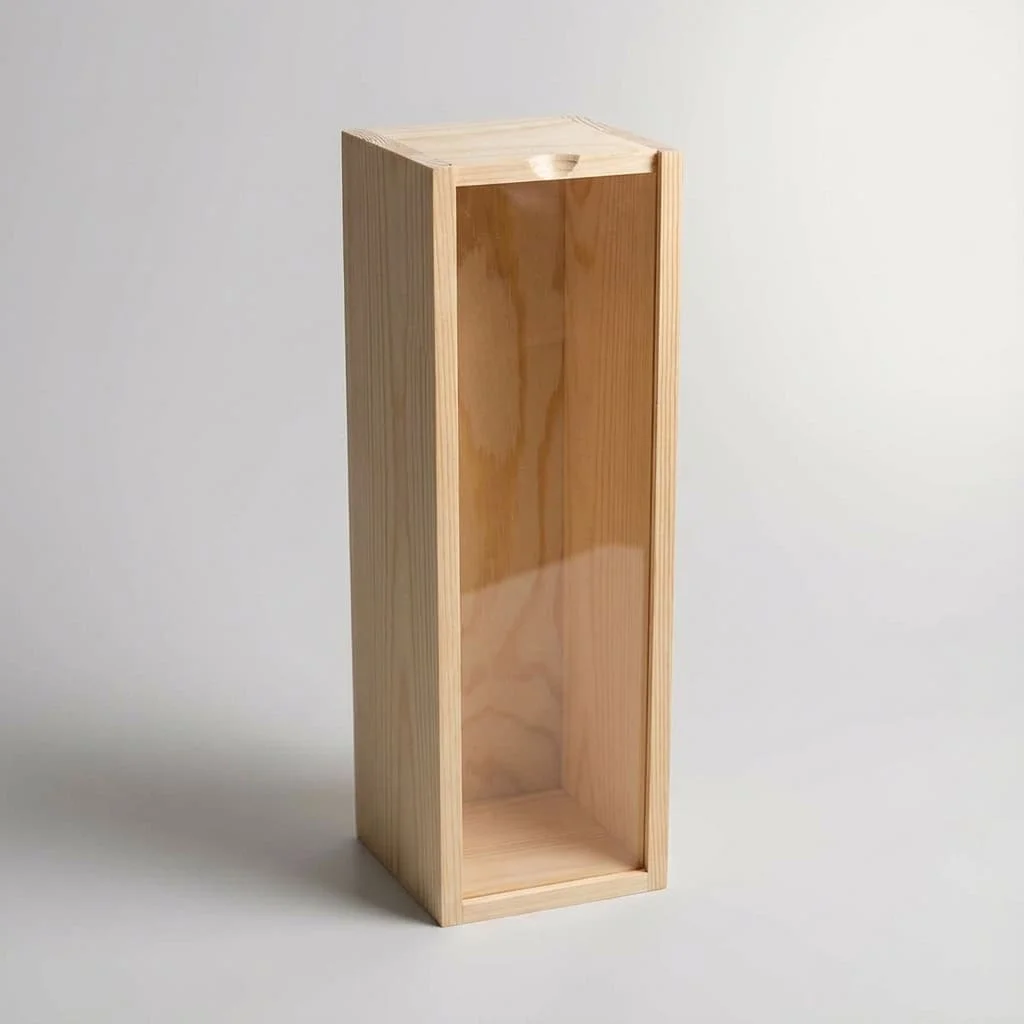
Custom single-bottle wooden wine box with all-wood sliding lid and finger notch, built for winery retail shelves and premium single-bottle gift presentation.
Key Features
- All-wood sliding lid with finger notch — solid pine plywood panel slides in routed grooves, lift and slide with one finger, no hinges to align, no latches to fasten, no metal hardware on the exterior
- Pine plywood lid and bottom — cross-laminated construction resists warping and swelling, the lid won't bind in tracks when humidity changes
- Solid pine side panels with routed track grooves — the sliding mechanism is machined directly into the wood, no separate runners or tracks to install or fail
- Sized for one standard 750ml wine bottle — custom dimensions available for Champagne, Burgundy, or specialty bottle profiles
- Natural sanded finish — clean, light wood ready for branding or use as-is; the simplest, most cost-effective single-bottle box in the catalog
$1.80 - $8.00 / piece
Prices vary based on order quantity, dimensions, material selection, and logo printing method. Send an inquiry.
Specifications
- Material
- Pine wood (sides), high-grade pine plywood (lid and bottom)
- Capacity
- 1 x 750ml standard wine bottle
- Closure
- Sliding lid with finger notch
- Surface Finish
- Natural/unfinished (sanded smooth)
- Customization
- Available for dimensions, materials, and branding
Applications
Cost-sensitive single-bottle gifting at scale
The all-wood sliding lid has no metal hardware, no acrylic panel, and no complex joinery — it's the most affordable single-bottle box to produce. For corporate gifting programs, wine club shipments, and event favors where per-unit cost matters but presentation can't suffer, this design delivers a clean wooden box at the lowest manufacturing cost.
Minimalist brand presentation
No visible hardware, no mixed materials, no decorative distractions. The all-wood sliding lid box is a single material on the exterior — warm pine from every angle. For brands whose identity is natural, simple, and honest, the design language matches the message.
Retail environments where staff need fast bottle access
The sliding lid lifts out completely in one motion — faster than unlatching a hinged lid, faster than sliding acrylic in a track. For tasting rooms, wine shops, and gift stores where staff open and close boxes repeatedly throughout the day, the finger notch and simple slide action reduce handling time per box.
Customization Options
Wood Species — Body. Pine is standard — cost-effective, machines clean track grooves, lightweight. Paulownia for even lighter weight. Hardwood (oak, walnut) for premium positioning — note that harder woods require slower feed rates for clean groove routing and increase production cost beyond material cost alone. Pine vs hardwood options →
Lid Material. Pine plywood is standard — cross-laminated for stability, the best material for a sliding panel that must not swell and bind. Solid wood lid available but less stable across humidity changes — the track clearance must be increased to accommodate wood movement, which means a slightly looser fit. Birch plywood for a smoother, lighter-colored surface. Acrylic lid available for visibility — see our acrylic lid single-bottle box for that configuration.
Finish. Natural sanded is standard — clean, light, lowest cost. Stained in any color — note that stain adds thickness to the lid and can tighten the track fit, so we compensate with slightly wider grooves for stained lids. Clear coat for sheen and protection. Painted for opaque color. The sliding track interior is left unfinished — finishing the grooves would add friction and bind the lid.
Dimensions. Standard fits one 750ml Bordeaux bottle. Adjustable for Champagne (taller, wider), Burgundy (wider body), half-bottles, or custom profiles. The lid travel distance must be at least the bottle height plus neck — the finger notch must clear the front panel for the lid to lift out completely.
Branding. Laser engraving on the lid: permanent, visible when the box is closed and the lid is in place. Laser engraving on the front panel: visible whether the lid is open or closed. Screen printing: good on the smooth plywood lid surface. Hot foil stamping for metallic branding. The lid is the natural branding surface — it's the largest uninterrupted face on the box.
Interior. Standard is raw pine — bottle rests directly on the pine plywood bottom. Felt-lined cavity available for a softer bottle contact surface. The interior cavity depth is set to leave the bottle neck slightly below the lid — the lid slides over the bottle without contact.
Ready to get a recommendation?
Send us your requirements — we'll respond with material and production recommendations within 24–48 hours.
Why This Design Works
The all-wood sliding lid is the simplest mechanism in wood packaging — and simplicity is the feature. A sliding lid has three parts: the lid panel, and two grooves routed into the side panels. There are no hinges to align, no latches to fasten, no acrylic to scratch, no metal to corrode. The mechanism is the wood itself. For buyers where per-unit cost is the dominant constraint — large corporate orders, wine club shipments, event favors — every eliminated component reduces both material cost and assembly labor. The sliding lid also means the box can be opened and closed thousands of times without hardware fatigue — there's nothing to wear out except the wood itself, and at 0.5mm clearance the wood-on-wood sliding action is self-lubricating.
Pine plywood for the lid isn't a downgrade from solid wood — it's the right material for a sliding panel. A solid wood lid will expand and contract across its width with humidity changes. In a sliding track, that movement either binds the lid (if it swells) or makes it rattle (if it shrinks). Pine plywood, with its cross-laminated veneers, moves a fraction as much — the alternating grain directions cancel each other's expansion. The lid stays dimensionally stable, the track clearance stays consistent, and the sliding action stays smooth from factory to destination. This is function-driven material selection, not cost-cutting.
The finger notch is a small detail with an outsized impact on daily usability. Without a notch, the user must press their palm flat against the lid and slide it back — friction-dependent, unreliable if hands are dry or the lid is smooth-finished. The finger notch provides a positive mechanical engagement — hook one finger, lift and slide in a single motion. It's the difference between fumbling with a box and opening it without thinking. The notch is cut into the lid edge with a round-over router bit, sanded smooth, and positioned at the center of the rear edge where it's reachable whether the box faces the user or sits on a shelf.
See our full range of single-bottle sliding lid wine boxes — all-wood and acrylic lid designs for cost-effective winery retail and wine club gifting.
Manufacturing Considerations
Track groove consistency is the #1 quality control priority on this box. The lid slides in two parallel grooves routed into the left and right side panels. If the grooves aren't perfectly parallel — if one is even 0.3mm wider or 0.2mm higher than the other — the lid will bind on one side and rattle on the other. The grooves are cut on a CNC router with both side panels clamped together as a pair, ensuring the left and right grooves are identically positioned. After routing, a go/no-go gauge checks the groove width at three points along the length — beginning, middle, and end. Variation beyond 0.2mm anywhere along the groove means the panel is rejected. This is the most tolerance-critical operation on any sliding-lid box.
Plywood lid edge finishing prevents splintering in the track. The lid edge that slides against the wood groove must be smooth and sealed — a rough or unsealed plywood edge will generate wood dust as it slides, which accumulates in the groove and grinds against the edge, creating a self-worsening friction problem. Every lid edge is sanded to 220 grit and sealed with a thin clear finish before assembly. The sealed edge slides smoothly and doesn't shed particles. This step is easy to skip in production — and skipping it is the #1 reason sliding lids develop gritty, rough action after repeated use.
The lid-to-bottle clearance must account for the lid flexing under handling pressure. The plywood lid spans the full width of the box — on a single-bottle box that's roughly 10–12 cm. Under firm hand pressure (someone gripping the closed box from the top, or stacking another box on top), the lid can deflect 1–2mm at center span. If the lid clearance above the bottle neck is too tight, that deflection brings the lid into contact with the bottle — and the bottle top becomes a fulcrum that concentrates pressure on the lid center. The interior cavity is designed with at least 5mm of clearance above the tallest expected bottle — enough that normal handling pressure won't flex the lid into the bottle.
Watch out for the finger notch chipping during lid machining. The notch is cut across the grain of the plywood face veneer — without proper tooling, the exit point of the router bit can tear out wood fibers and leave a rough, chipped notch edge. The fix: the notch is cut with a climb-cut pass (router moves in the same direction as bit rotation for the final 2mm), which shears the wood fibers cleanly rather than lifting them. A backup board behind the cut also prevents tear-out. The notch edge is then hand-sanded to remove any remaining roughness — a chipped notch is the first thing the user's finger finds.
Have a technical concern about your use case? Our team can walk you through how we'd handle it for your project.
Start with pine body, pine plywood lid, natural sanded finish, and laser engraving on the lid for branding. This is the most cost-effective single-bottle configuration in the catalog — no metal hardware, no acrylic, no complex joinery, just clean wood construction. The sliding lid keeps the per-unit manufacturing cost lower than any hinged alternative, and the finger notch makes it the fastest box to open and close in daily use. The one upgrade worth paying for: birch plywood instead of pine plywood for the lid. Birch plywood has a lighter, more uniform surface that makes laser engraving pop with higher contrast, and it's slightly more stable across humidity extremes. Skip adding any metal hardware — the moment you add a latch or hinge to this box, you've eliminated its core advantage. The all-wood sliding design is the point. If you need hardware, choose the hinged birch plywood single-bottle box instead — that design is built around the latch from the start.
Start Your Project
Send us your design or reference images — we'll return with a pre-production sample for your approval.
Frequently Asked Questions
Q: How does the sliding lid stay closed during shipping — won't it slide open?
Q: Will the plywood lid swell and get stuck in the tracks in humid conditions?
Q: How does this compare to the hinged lid single-bottle box?
Q: Can the finger notch be positioned differently, or replaced with a different opening mechanism?
Q: Is pine plywood strong enough for the bottom panel supporting a full wine bottle?
Q: Can I get this box with a solid wood lid instead of plywood?
Send Us Your Requirements
Send your design, reference images, or product sample. We don't just quote a price — we respond with material recommendations, a feasibility assessment, and professional suggestions grounded in over 20 years of manufacturing experience. Expect a detailed response within 24–48 hours.
- Professional recommendations included
- Small MOQ & trial orders supported
- Worldwide shipping with export documentation