
Slatted Wooden Wine Crate
Wholesale slatted wooden wine crate with hinged lid and open-slat front, built for retail display visibility and cellar ventilation.
Key Features
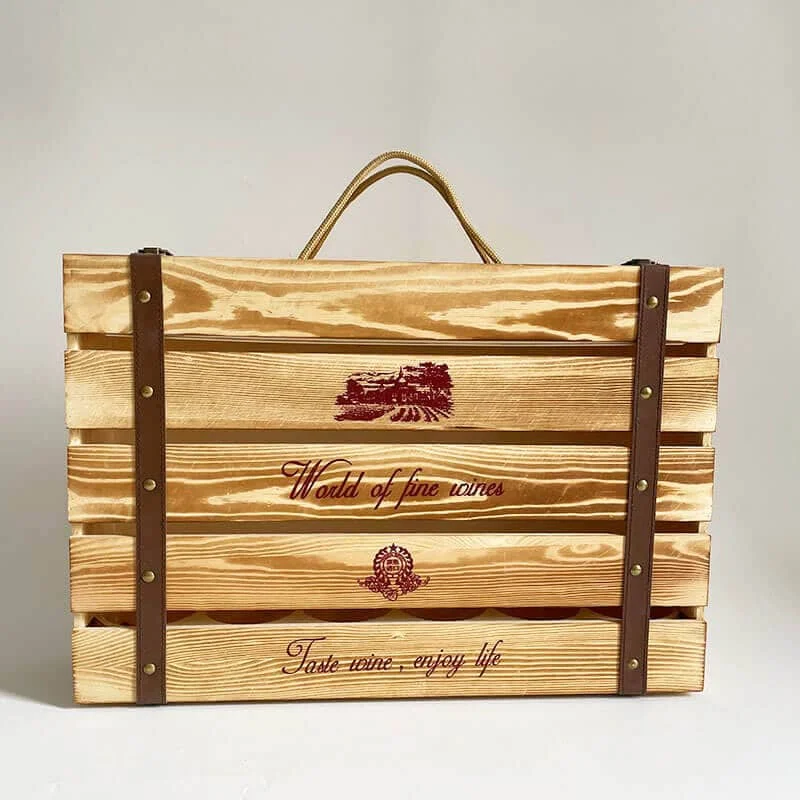
- Open-slat front panel — partial bottle visibility for retail display, air circulation for cellar storage
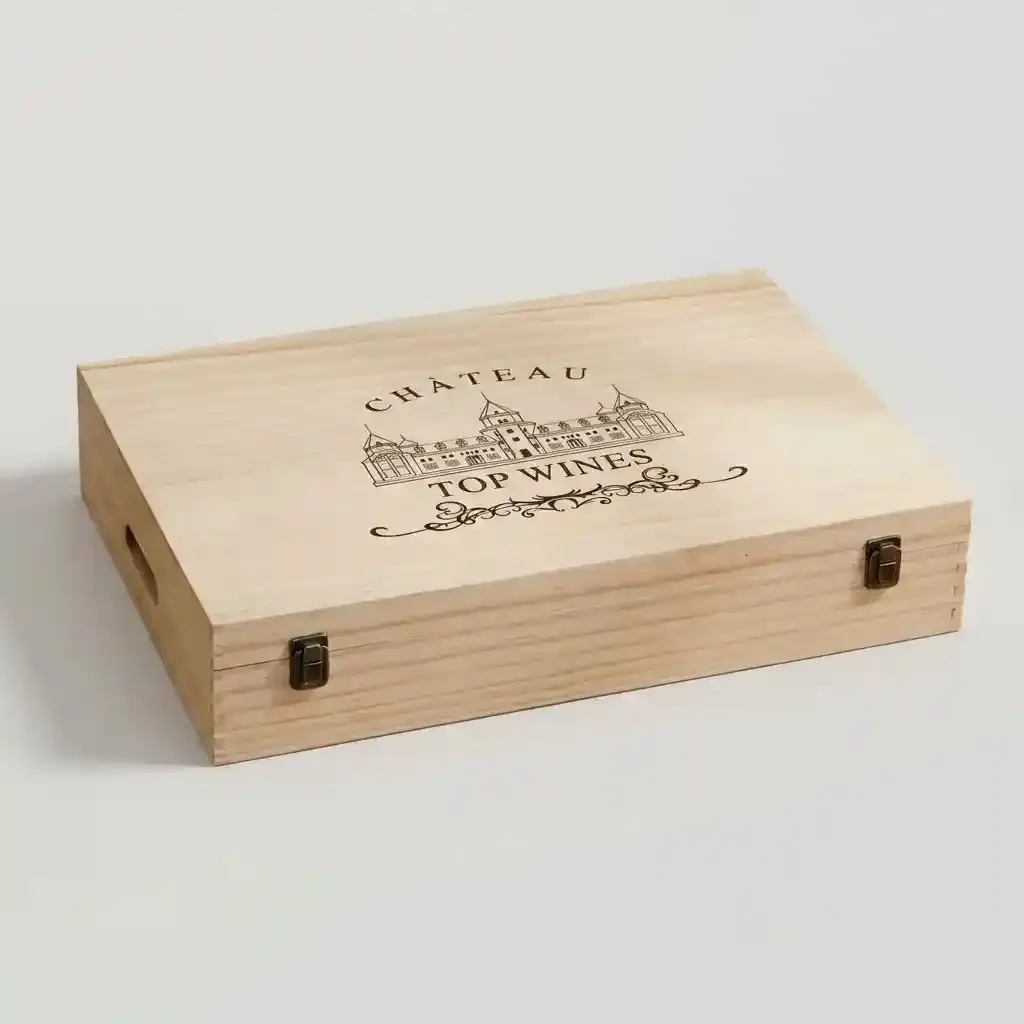
- Hinged lid with dual vintage metal latches — secure closure, ceremonial opening, hardware visible as design element
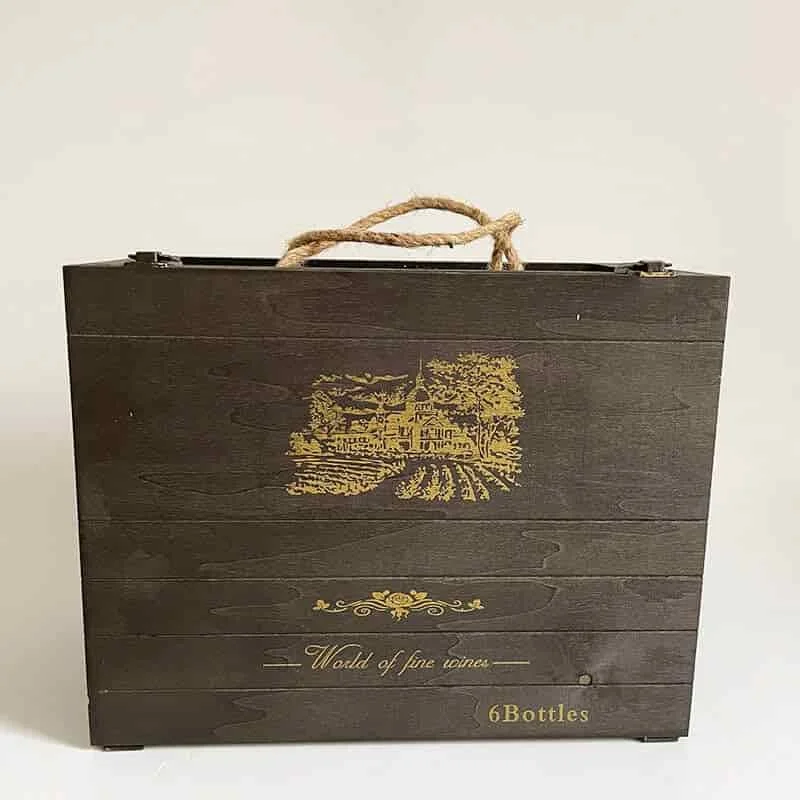
- Woven rope handle through reinforced top panel — balanced carry for 4–6 full bottles
- Solid wood frame with individually fastened horizontal slats — lighter than a solid-panel box of the same volume
- Vintage stained finish with screen-printed vineyard graphics — fully replaceable with your brand artwork
$2.50 - $5.50 / piece
Prices vary based on order quantity, dimensions, material selection, and logo printing method. Send an inquiry.
Specifications
- Wood Type
- Pine wood (customizable to other wood types)
- Capacity
- Multi-bottle (typically 4-6 bottles)
- Dimension
- Custom dimensions available upon request
- Design
- Slatted crate style with top lid and handle
- Surface Finish
- Vintage stained finish with custom graphics
- Usage
- Wine packaging, corporate gifting, retail display
- Customization
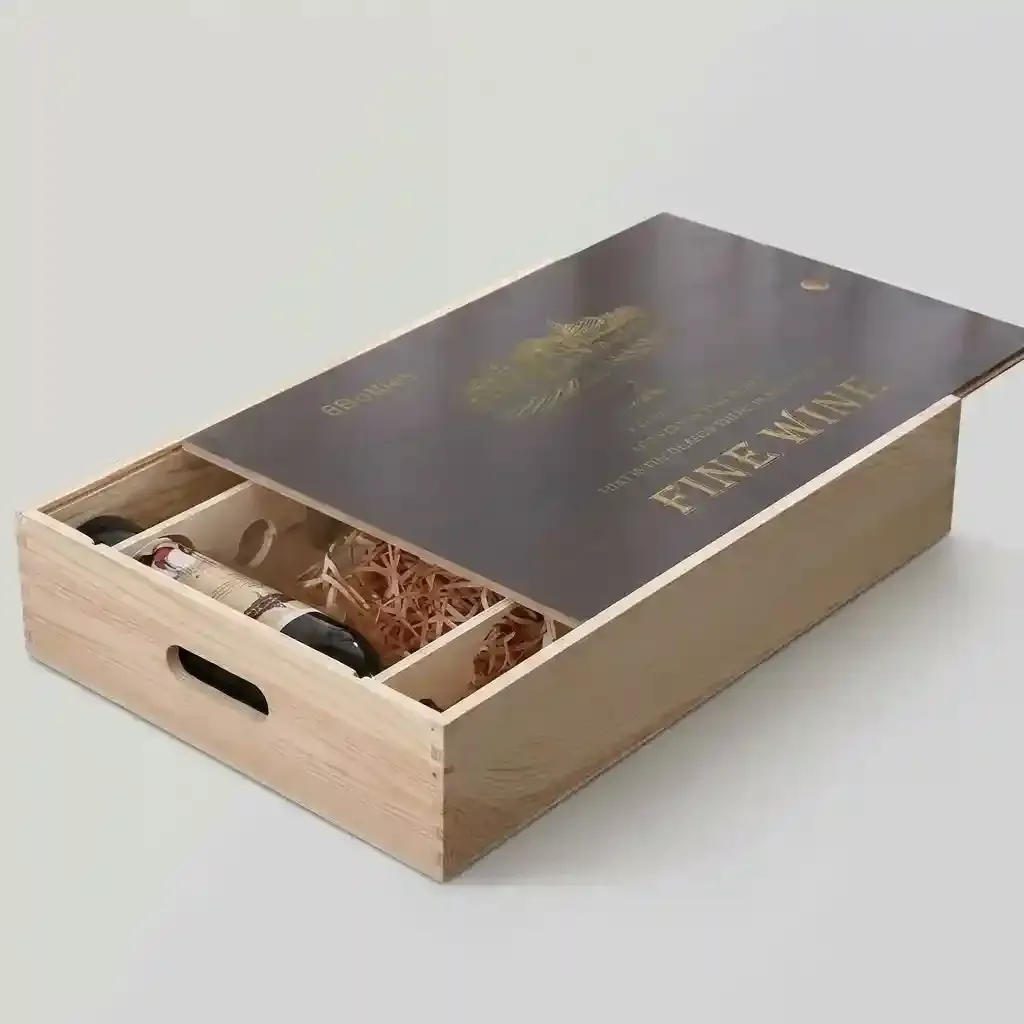
- OEM/ODM, custom logos, sizes, and internal dividers
Applications
Retail shelf display
The slatted front lets customers see bottle labels and fill levels without opening the lid — staff don't reposition bottles after every curious shopper. The vintage hardware and stained finish create a cellar-at-the-store signal that solid boxes don't.
Wine club and DTC shipment
4–6 bottle capacity matches club shipment sizes. The hinged lid with latches stays closed through carrier networks without tape or bands. Slatted construction is lighter than solid-panel crates — lower per-unit freight cost on full-container orders.
Corporate gifting with cellar aesthetic
A slatted crate with vintage hardware reads as 'selected from the cellar,' not 'pulled from a warehouse.' For wine brands, financial services, and executive gifting where authenticity matters, the crate look creates a story that a smooth-sided box can't.
Customization Options
Dimensions & Bottle Count. Standard fits 4–6 standard Bordeaux bottles. We adjust width, depth, and internal divider layout for smaller or larger counts — 3-bottle gift sets, 6-bottle club shipments, or custom mixed-format bundles. Changing dimensions affects slat count and spacing, so the visual proportion is recalculated per order to keep the slatted look balanced.
Wood Species. Pine is standard — lightweight, takes stain evenly, slats cut and fasten cleanly. Paulownia for an even lighter crate at higher material cost; softer surface means wider slats are recommended to prevent splitting at fastener points. Birch plywood for the frame rails if maximum screw retention for the hinges is needed. Solid hardwood (oak, walnut) for premium runs — heavier but creates a crate that reads as furniture, not packaging.
Slat Configuration. Standard horizontal slats with 8–12mm gaps for visibility and ventilation. Wider slats (25–30mm) read more rustic; narrower (15–20mm) read more refined. Gap width is the trade-off: wider gaps show more bottle but offer less structural rigidity. We recommend 8–10mm gaps for 4-bottle crates, 10–12mm for 6-bottle crates where structural load is higher.
Stain & Finish. Standard is a medium-dark vintage stain with matte clear coat — the warm aged-wood look that reads as cellar-authentic. Natural pine with clear coat for a lighter, cleaner aesthetic. Distressed or whitewashed finishes available. The slatted surface takes stain differently than a solid panel — each slat catches light independently, so darker stains create more depth and shadow play across the front.
Hardware Finish. Antique bronze latches and hinges are standard — dark, low-luster, complements the vintage stain. Alternatives: matte black (modern rustic), polished brass (traditional), nickel (clean contemporary). Hardware is surface-mounted on the exterior — it's visible, so the finish choice matters more than on a box where hardware is hidden. Latch & hardware configuration →
Branding Method. Screen printing across multiple slats: lowest per-unit cost, but registration across slat gaps requires careful setup — the print bridges the gaps, so slat alignment must be tight. Laser engraving on individual slats: permanent, each slat engraved separately for perfect alignment, but monochrome only. Hot stamping on a single wide slat or the solid top rail: metallic foil for a premium brand mark. The most effective branding on a slatted crate is often understated — a small mark on the top rail or corner reads as cellar provenance, not advertising.
Ready to get a recommendation?
Send us your requirements — we'll respond with material and production recommendations within 24–48 hours.
Why This Design Works
The slatted front solves a retail problem that solid boxes create. A solid box hides the product — customers have to open it to see what's inside, and every open-close cycle in a retail environment risks hardware wear, lid misalignment, and staff time spent repacking. Slats let the bottles sell themselves. The label, the fill level, the bottle shape — all visible through the gaps. For winery tasting rooms, wine shops, and specialty retailers, a crate that displays through its structure converts browsers into buyers without staff intervention.
The slats serve display and ventilation, not significant weight reduction. The open gaps let customers see bottle labels and fill levels without opening the lid — product visibility is the primary function, material savings are incidental. For DTC wine shipping, the crate's weight is dominated by the solid wood frame, bottom panel, and the bottles themselves. The ventilation benefit matters more for cellar storage, where air circulation through the front helps maintain consistent humidity around the bottles. The trade-off: each slat must be individually cut, sanded, finished, and fastened — assembly time is longer than a solid-panel box.
The hinged lid with vintage latches makes the crate a display piece, not disposable packaging. A sliding lid on a slatted crate would read as industrial. The hinged lid with visible hardware reads as intentional — the latches and hinges are part of the aesthetic, not hidden functional components. The lid opens to roughly 100° and stays open, turning the crate into a standing display. After the bottles are gone, the crate becomes household storage — wine tools, table linens, kindling by the fireplace. That second life keeps your brand visible for years.
See our full range of wooden wine crates with hinged lids — slatted, solid, and vintage-style for retail display and cellar storage.
Manufacturing Considerations
Slat spacing consistency is the #1 visual QC checkpoint. If one gap is 8mm and the next is 11mm, the eye catches it immediately — the rhythm of the slats is what makes the crate look intentional rather than slapped together. Each slat is positioned against a spacing jig during assembly, not measured individually. The jig sets the gap, the slat is fastened, the jig moves to the next position. First crate off the line is checked with a gap gauge on every space — any variance over 1mm and the jig is recalibrated.
Each slat is individually fastened — loose slats are the #1 structural QC issue. A solid panel distributes stress across its full area. A slatted front distributes stress across individual attachment points. If a slat is under-fastened, it loosens over time from vibration during shipping and handling. The standard: each slat gets two fasteners per end (into the vertical frame rail), with fastener length at least 2× the slat thickness for adequate pull-out resistance in pine. Every crate is shaken on inspection — any slat rattle and it goes back for re-fastening before finishing.
Finishing slatted surfaces is harder than finishing solid panels. Stain and clear coat must reach the edges of every slat — not just the front faces. If the slat edges are left raw, they absorb moisture differently than the finished faces, and the slat can cup or twist across its width. We finish slats individually before assembly: stain, seal, and clear coat applied to all four long edges and one face, then the slats are fastened to the frame. The assembled crate gets a final clear coat pass that unifies the sheen across all surfaces. This two-stage finishing adds a production step but eliminates the most common durability complaint about slatted wood products: unfinished edges that grey and weather faster than the visible faces.
Watch out for hinge screw retention in the slatted frame rail. The hinge side of the crate uses a solid vertical rail — not slats — to provide a continuous mounting surface for the hinge leaves. If that rail is pine and the crate holds 6 bottles (~16–18 pounds), the hinge screws carry significant load every time the lid is opened. Pilot holes at 75–80% of screw minor diameter with coarse-thread screws are the minimum. For crates expected to see frequent opening — retail display, tasting rooms — we recommend birch plywood for the hinge rail. Cross-laminated plies hold screws regardless of humidity swings and repeated stress cycles.
Have a technical concern about your use case? Our team can walk you through how we'd handle it for your project.
Start with pine, medium-dark vintage stain, horizontal slats with 10mm gaps, antique bronze hardware, and discreet screen-printed branding on the top solid rail or corner. This configuration creates the strongest cellar-authentic impression per dollar — the slatted design and vintage hardware do the visual work, not the wood species. The one upgrade worth paying for: switch to birch plywood for the hinge rail. It's invisible from the outside, adds negligible cost, and eliminates the most common long-term durability issue with hinged pine crates. Skip the temptation to brand across multiple slats — a small, well-placed mark reads as provenance; a large logo spanning 4 slats reads as promotional packaging. For retail display buyers, add a lid stay — it holds the lid open at ~100° so the crate becomes a self-supporting display, and it costs cents per unit.
Start Your Project
Send us your design or reference images — we'll return with a pre-production sample for your approval.
Frequently Asked Questions
Q: Can the bottles be seen clearly through the slatted front?
Q: Is the slatted crate strong enough for international shipping with full bottles?
Q: How do the vintage metal latches hold up to repeated opening in a retail environment?
Q: Can the internal divider configuration be changed for different bottle counts or mixed contents?
Q: Will the finish between the slats hold up over time, or will the edges show wear?
Q: Can the crate be stacked when full of bottles?
Send Us Your Requirements
Send your design, reference images, or product sample. We don't just quote a price — we respond with material recommendations, a feasibility assessment, and professional suggestions grounded in over 20 years of manufacturing experience. Expect a detailed response within 24–48 hours.
- Professional recommendations included
- Small MOQ & trial orders supported
- Worldwide shipping with export documentation