
Custom Square Open Top Wooden Boxes
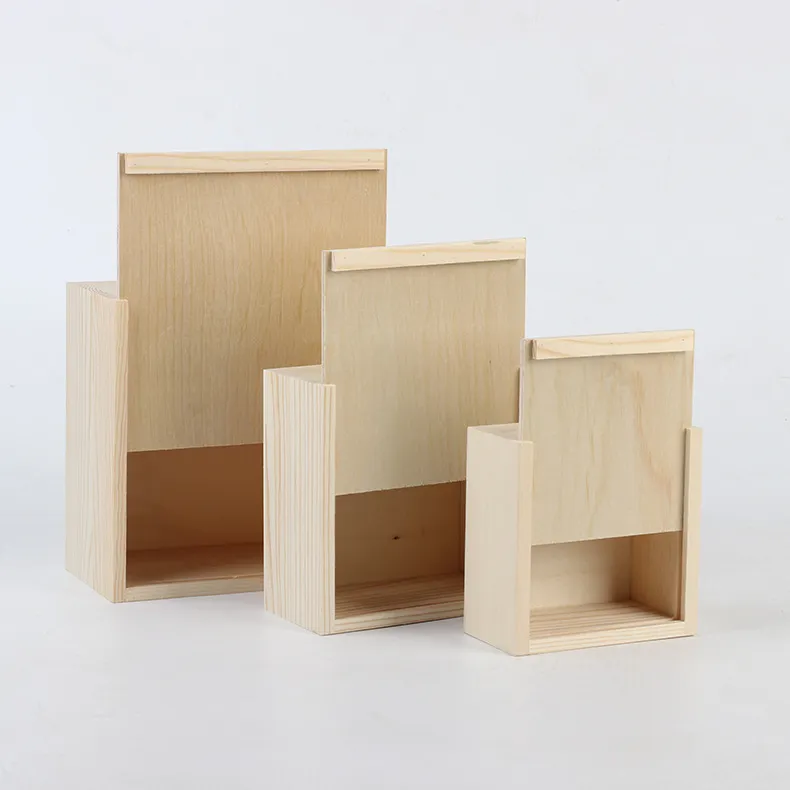
Square open-top pine wood boxes with no lid, suitable for retail product display, shelf organization, and planter-style gift packaging.
Key Features
- Open-top design — no lid, no hinge, no clasp, no opening mechanism at all; the contents are always visible and accessible without any action from the user; for retail display, this means customers see products instantly; for home storage, this means items are grabbed in one motion without opening anything
- Square format with clean geometry — the equal-side square profile stacks uniformly on retail shelves and creates consistent sight lines across multiple units; the square shape is visually stable and balanced, unlike rectangular boxes that look directional and create awkward stack patterns
- Solid pine wood construction — sustainable, lightweight for shipping, and rigid enough to hold its shape when stacked or loaded with product; the natural wood grain provides a warm, organic backdrop that elevates the perceived value of displayed merchandise
- Sanded smooth interior — the inside surfaces receive the same sanding attention as the exterior; no splinters, no rough patches, no unfinished corners that could snag delicate products or catch dust; the smooth interior means the box is product-ready without liners or inserts
- Multi-context versatility — functions as a retail display bin, shelf organizer, planter box, gift hamper base, craft storage container, or DIY customization blank; the open-top format removes any use-case restriction that a lid would impose
$1.20 - $4.50 / piece
Prices vary based on order quantity, dimensions, material selection, and logo printing method. Send an inquiry.
Specifications
- Material
- Solid pine wood (paulownia, bamboo, birch options available)
- Design
- Open-top, no lid — square format
- Finish
- Natural sanded (varnish, stain, paint, charred options available)
- Application
- Retail display, shelf organization, planter-style gift packaging
Applications
Retail product display and merchandising
Where products are displayed in open-top boxes on store shelves — candles, soap bars, packaged snacks, folded textiles — the box frames the merchandise and creates visual order out of loose product; the open top means customers pick up and examine products without navigating a lid.
Home and pantry organization
Where pantry items, craft supplies, or bathroom essentials are organized by category in open-top boxes on shelves — grab what you need in one motion, see inventory levels at a glance, no lids to open when hands are full.
Planter-style gift packaging
Where the box itself is partially filled with excelsior or shredded paper and gifts are arranged on top, resembling a planter or crate presentation — the open top invites the recipient to see everything at once, creating a generous, abundant presentation.
Customization Options
Dimensions: Fully customizable. Standard square sizes: small (8×8×4 cm for small-item display), medium (20×20×8 cm for shelf organization), large (30×30×8 cm for planter-style packaging), extra-large (40×40×8 cm for bulk display). The square format means only one dimension needs to be specified for the footprint — width and depth are equal.
Wood species: Pine (standard) — the best cost-to-quality ratio for open-top boxes where the wood grain is part of the display aesthetic. Paulownia for lightweight shipping. Bamboo for a harder, more moisture-resistant alternative. Birch for a finer, more uniform grain — popular for higher-end retail display where the box itself is part of the store's visual merchandising.
Finish: Natural sanded (standard) — smooth, unfinished pine ready for use as-is or for the buyer to customize. Clear varnish for a finished, retail-ready look. Stained (walnut, mahogany, espresso) for premium retail environments. Painted (white, black, custom Pantone) for brand-matched displays. Charred for a rustic, artisanal aesthetic.
Branding: Laser engraving on the front face or bottom — visible without covering the interior. Screen printing on exterior faces. Branded liner — a printed card insert for the box bottom with brand messaging, visible when the box is partially empty. The open-top format makes the interior branding opportunity more valuable — the customer sees the branded interior every time they reach in.
Planter liner option: A removable plastic liner insert available for boxes used as planters — protects the wood from soil moisture and allows the box to function as a cachepot for potted plants or fresh flowers.
Ready to get a recommendation?
Send us your requirements — we'll respond with material and production recommendations within 24–48 hours.
Why This Design Works
The open-top design is not a cost-cutting omission of a lid — it's a functional choice that prioritizes access speed over dust protection. In a retail environment, a lid is a barrier between the customer and the product — every second of friction reduces the likelihood of a customer picking up the item. In a pantry, a lid is an inconvenience multiplied by the number of times per day someone reaches for a snack or ingredient. In a planter, a lid makes no sense. The open-top box accepts that for many use cases, instant access is more valuable than dust protection. If the items need to be sealed, they go in a lidded box. If they need to be grabbed, they go in an open-top box. This product serves the grab case.
The square format is visually and logistically superior to rectangular for multi-unit retail and shelf use. A grid of square boxes creates uniform gaps and aligned edges regardless of orientation — rotate a square box 90° and it still sits flush with its neighbors. Rectangular boxes create irregular patterns when mixed orientations, looking cluttered even when organized. For a retail buyer ordering 50 boxes for shelf display, the square format means consistent, predictable shelf layouts without spending time arranging boxes for visual alignment.
The open-top box is the least expensive wood box format to manufacture — no lid means no hinge hardware, no lid-to-base alignment, no closure mechanism, and roughly 30% less material and labor. This cost advantage makes it the right choice for volume applications where the box is a display fixture, not a keepsake. For a retailer displaying $15 candles, a $5 open-top pine box adds presentation value without devouring margin. For a pantry organizer company, the open-top format hits a price point ($8–12 retail) that customers accept for a product category where they might buy 4–6 units to organize an entire pantry.
Manufacturing Considerations
Without a lid, the top edge is the most visually prominent surface — any imperfection in the rim is immediately visible. The top edges of all four walls must be perfectly flat, square, and free of router tear-out or sanding unevenness. We cut the walls slightly over-height, assemble the box, then run the assembled box through a wide-belt sander that levels all four top edges simultaneously, guaranteeing they're in the same plane. After sanding, the top edges are hand-broken — a very slight rounding (approximately 0.5mm radius) that removes the sharp arris without creating a visibly rounded edge.
The corner joints on an open-top box take more lateral stress than a lidded box because there's no lid to tie the top edges together. The lid on a lidded box acts as a structural brace — when the lid is closed, it prevents the box walls from splaying outward under lateral load. An open-top box has no such brace. The corner joints must resist splaying on their own. We use box joints (finger joints) for boxes up to 20×20 cm and add a glued corner block (a triangular pine block glued into the interior corner) for boxes larger than 20×20 cm or deeper than 10 cm — the corner block triples the glue surface area and prevents the corner from opening under load.
Have a technical concern about your use case? Our team can walk you through how we'd handle it for your project.
Start with the 20×20×8 cm format in natural sanded pine as the volume SKU. This size fits standard retail shelving (typically 30–45 cm deep) with room for 2 boxes front-to-back, works as a pantry organizer for standard cabinet depths, and is large enough for planter-style gift packaging. The natural pine finish is the most versatile — it reads as intentional in any context from rustic to modern. Offer painted white as the second SKU for bright, clean retail environments and bathroom organization. For eco-positioned brands, bamboo is the upgrade path — harder, more moisture-resistant, and carries the sustainability story. The open-top box's margin advantage makes it the best product in the catalog for volume pricing — offer tiered discounts at 100, 500, and 1,000+ units to capture large retail fixture and pantry organization contracts.
Start Your Project
Send us your design or reference images — we'll return with a pre-production sample for your approval.
Frequently Asked Questions
Q: Do these boxes stack when empty?
Q: Can the box be used as a planter?
Q: Are the corners strong enough for heavy items?
Send Us Your Requirements
Send your design, reference images, or product sample. We don't just quote a price — we respond with material recommendations, a feasibility assessment, and professional suggestions grounded in over 20 years of manufacturing experience. Expect a detailed response within 24–48 hours.
- Professional recommendations included
- Small MOQ & trial orders supported
- Worldwide shipping with export documentation