Ask ten people for the “top” custom wooden packaging manufacturers in China and you will get ten lists of names, none of them audited. The more useful question — the one that actually changes who you buy from — is what kind of supplier you are talking to.
Most “wooden packaging suppliers” fall into one of three camps: a factory that owns its production line, a trading company that resells another workshop’s output, or a fabrication shop that only cuts and assembles from your finished drawings. The top manufacturers are almost always the first kind. This page shows you how to tell them apart before you send a single drawing.
If you want the full checklist of what to evaluate once you have found a real one, that is a separate question — we cover it in our guide on how to choose a wooden packaging manufacturer in China.
Three Kinds of “Wooden Packaging Supplier”
Calling all of these “manufacturers” is where most sourcing mistakes begin. They are three different businesses that happen to sell the same product.
Full-service factory
A full-service factory owns its production line and does design, sampling, production, quality control, and finishing under one roof. It can turn your concept into a working drawing, produce a sample in 7–15 days, and hold tolerances and moisture content through a full batch. It costs slightly more than the alternatives because you are paying for the control. For a retail brand shipping in volume, this is usually the lowest-friction choice.
Trading company
A trading company owns no workshop. It sources from a network of smaller shops and adds a margin. Trading companies are not inherently bad — they are useful when a buyer needs many small categories and does not want to manage ten suppliers — but design and quality control sit with a third party, so lead times drift and problems get relayed instead of fixed. If you are buying custom packaging, know that the “factory” a trading company shows you may not be the one doing the work.
Fabrication-only shop
A fabrication shop cuts and assembles to a finished drawing. It is the cheapest option, and it works well when you already have a complete, build-ready spec. But it offers little design guidance and no guardrail against a drawing that cannot actually be built well. If the drawing has an error, the shop builds the error.
| Dimension | Full-service factory | Trading company | Fabrication-only shop |
|---|---|---|---|
| Design support | Yes | Usually outsourced | Weak or none |
| Cost | Slightly higher, transparent | Middleman markup | Lowest |
| Quality control | High (own line) | Low (third parties) | Medium (no design guardrail) |
| Lead-time stability | High | Low | Medium |
| Best for | Retail brands needing end-to-end control | Buyers with many small categories | Buyers with finished drawings |
For custom packaging, the full-service factory is usually the lowest-friction choice. What most retail brands lack is not someone to make the box — it is someone to manage it end to end. If you are weighing one supplier against another on the same budget, our guide on how to compare custom wood products suppliers walks through the price-versus-quality trade-off.
How to Tell a Full-Service Factory From a Reseller
You cannot tell from a website, and you usually cannot tell from a sales call either. But a real factory can do five things a reseller cannot:
- Produce a physical sample in 7–15 days — a reseller has to ask someone else and hope
- Give a line-item cost breakdown — material, structure, finish, quantity, each stated
- State its tolerances and moisture content — ±1 mm and 8–12% are factory numbers, not brochure numbers
- Confirm the factory location and show it — a video walkthrough or a visit should never be a problem
- Answer export questions directly — ISPM 15 heat treatment and fumigation certificates are routine for a real exporter
Any supplier that stalls on two or more of these is one step removed from its own production. For the broader checklist — experience, design support, materials, and the warning signs of an unreliable shop — see our guide on how to find a reliable wooden products manufacturer in China.
The Numbers That Matter
These are Hilon Wood’s published figures. Use them to calibrate your expectations on lead time and MOQ, not as a benchmark for every supplier. If a supplier quotes numbers far outside these, ask why.
| Fact | Figure |
|---|---|
| Manufacturing experience | 20+ years |
| Sample production lead time | 7–15 days |
| Custom order production lead time | 30–45 days |
| MOQ for custom wooden crates | ~200 units, adjustable by product size |
| Custom cost factors | 4 (material, complexity, finish, quantity) |
| Time to an accurate quote | 24–48 hours |
| Dimensional tolerance | ±1 mm |
| Wood moisture content | 8–12% |
How a Sample Actually Gets Made
The sample is the most useful artifact in the whole sourcing process. A proper sample cycle looks like this:
- You send a drawing, a reference photo, or a physical sample you already own.
- The manufacturer confirms the drawing and flags any structural or cost problem before cutting.
- They produce a pre-production sample in 7–15 days.
- You check dimensions, finish, and branding against the spec.
- Revisions are folded in before volume production starts.
A supplier that wants to skip the sample, or charges for it in a way that discourages you from ordering one, is telling you how much rework they expect. The sample is cheap insurance against a full production run built to the wrong dimension.
Where the Capacity Actually Sits
China’s wooden packaging capacity concentrates in a few wood-processing regions where sawmills, kilns, and assembly workshops sit close together, which keeps material cost and lead time down.
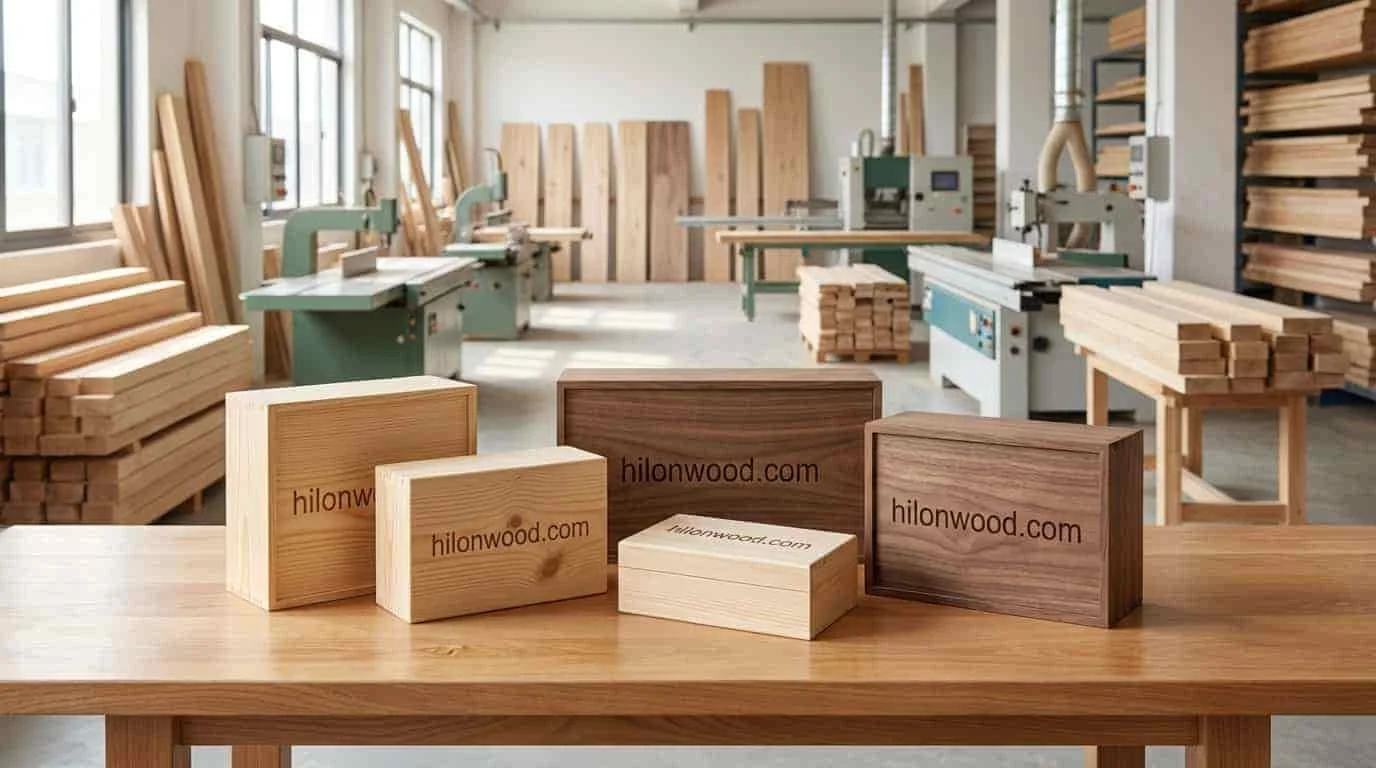
Hilon Wood’s factory is in Pulianji Town, Cao County, Shandong, and sources material from Linyi, the major timber and board market in the same province. That shortens the distance between raw board and finished box — and it means the people doing the work have been doing wood, specifically, for a long time. When you shortlist a manufacturer, ask where the factory is and where the wood comes from. You can see how we describe our own setup on our manufacturing page.
Frequently Asked Questions
How do I tell a trading company from a factory?
Ask for a line-item cost breakdown, a 7–15 day sample, and the factory location with a video walkthrough. A real factory can produce all three without stalling.
Is the MOQ high for retail-brand wooden packaging?
Not necessarily. Hilon Wood’s wooden-crate MOQ is about 200 units and adjusts by product size, so a retail brand can start with a trial run and scale.
How long do samples and production take?
Samples take 7–15 days and custom orders 30–45 days. Plan your launch timeline backward from these.
Does Hilon Wood just supply timber?
No. “Wood” refers to wooden products, not raw lumber. Hilon Wood manufactures custom wooden packaging, home, and kitchen products.
References
Figures verified against the Hilon Wood website on 2026-08-27:
Hilon Wood homepage — https://hilonwood.com
Custom Wooden Crates Buying Guide — Types, Materials & Sourcing Tips
Custom Wooden Wine Box Dimensions Guide — Standard & Custom Sizes