
Custom Wooden Double Bottle Wine Box with Sliding Lid
Wholesale custom wooden double-bottle wine box with sliding lid and rope handle, built for portable gift presentation and winery tasting room retail.
Key Features
- Sliding wood-on-wood lid — no metal hardware to loosen, rust, or fail during transit or daily handling
- Top-mounted woven rope handle — knotted through the box body, balanced one-hand carry for two full bottles
- Finger joint corner construction — mechanical interlock distributes bottle weight across the full joint height
- Screen-printed front panel with classic wine motif — pre-applied and fully replaceable with your brand artwork
- Compact two-bottle footprint — the right size for personal gifting, event favors, and tasting room carry-out
$1.00 - $2.50 / piece
Prices vary based on order quantity, dimensions, material selection, and logo printing method. Send an inquiry.
Specifications
- Wood Type
- Natural pine wood
- Capacity
- Holds up to two standard wine bottles
- Dimension
- Customizable based on client requirements
- Design
- Rectangular with sliding lid and top rope handle
- Surface Finish
- Smooth sanded with custom print options
- Usage
- Wine packaging, corporate gifting, retail display
- Customization
- Available for size, logo printing, and wood stain
Applications
Wedding and event favors
A two-bottle format is the right gift scale — couple's presents, table favors, bridal party gifts. The rope handle makes it grab-and-go from the event table, and the pre-printed front panel means no assembly step at the venue.
Winery tasting room retail
Tasting room visitors buy 1–2 bottles, not 6. A compact two-bottle carrier with a carry handle converts a tasting into a retail sale. The sliding lid opens and closes smoothly through a full day of customer handling.
Corporate appreciation gifts
Six bottles signals bulk. Two bottles signals selection — chosen for the recipient, not pulled from a pallet. For executive gifts and client appreciation, the smaller format reads as curation, not inventory clearance.
Customization Options
Dimensions. Standard fits two 750ml Bordeaux bottles. We adjust for Champagne (wider diameter, ~8.8cm vs ~7.5cm), Burgundy (broader shoulder), or any custom bottle profile. Changing dimensions affects material panel yield — we optimize for boxes per sheet to keep per-unit cost down.
Wood Species. Pine is standard — lightweight, takes stain and print well, finger joints cut cleanly. Paulownia is lighter but softer, requiring larger knot holes to prevent rope pull-through. Birch plywood offers the best dimensional stability across humidity swings and superior screw retention if you add hardware. Solid oak or walnut at 2–3× pine material cost for premium runs.
Stain & Finish. Natural pine with clear coat (standard), or any custom stain tone. Medium to dark stains hide handling marks better on a box that gets carried. Matte or satin clear coat for scuff resistance. For the printed front panel, a lighter base stain creates more contrast with dark ink.
Handle Type. Woven cotton rope is standard — durable, natural feel, low cost. Leather strap upgrade adds a premium tactile signal — it's the first thing the recipient touches. Metal handle for industrial or modern aesthetic. All handle types are tested to 2× the loaded box weight on every sample.
Branding Method. Screen printing: lowest per-unit cost for single-color or simple multicolor designs, applies cleanly to the flat front panel. Laser engraving: permanent textured mark, monochrome, reads as furniture-grade branding. UV full-color printing: photos and gradients on the front panel or lid. Hot stamping: metallic foil for a premium brand mark. Screen printing & branding methods →
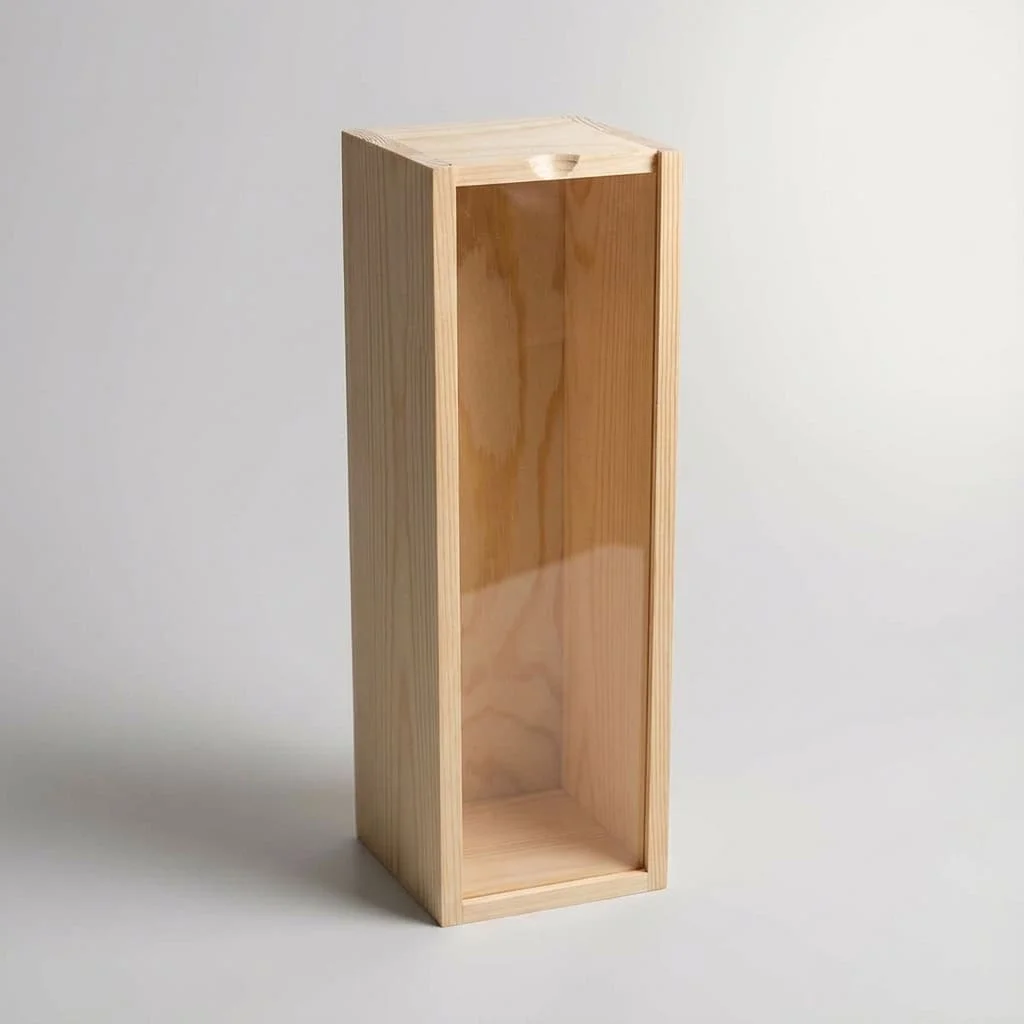
Lid Options. Solid wood sliding lid is standard. Clear acrylic sliding lid available — lets bottle labels sell the product without opening the box. Trade-off: acrylic reads as more modern but adds cost and undercuts the all-natural material story. Worth considering only when retail display visibility is the primary buying decision.
Ready to get a recommendation?
Send us your requirements — we'll respond with material and production recommendations within 24–48 hours.
Why This Design Works
The sliding lid on a two-bottle box has no failure points — and one inherent advantage over six-bottle formats. A sliding lid is a wood-on-wood track milled directly into the side panels. No hinges to loosen, no latches to go out of alignment, nothing to rust. At the shorter track span of a two-bottle box (~35cm), there's less cumulative expansion differential across humidity swings than on a six-bottle box (~51cm). The lid tolerance is naturally more forgiving — the same 0.5mm clearance handles a wider humidity range before binding or rattling becomes noticeable.
The rope handle is mounted through the box body, not the lid. The load path is straight down through the top panel — the knot bears against the interior face, and the woven rope distributes tension across its full diameter. For two filled bottles (approximately 5–6 pounds), a centered top handle balances in one hand. This is the difference between a box you carry like a small case and a crate you need two hands for. Side cutout handles, which work on six-bottle crates, don't make ergonomic sense at this scale — the box is too narrow for two-handed side carry, and offset handles tilt the load.
The printed front panel makes the box shelf-ready without secondary packaging. A flat vertical surface with no hardware, no lid track, no handle — just clean pine with your graphic. The buyer opens the master carton and the box is already branded. No insert card to print separately, no sleeve to source, no hang tag to attach. For event distribution and retail display where staff time matters, a pre-branded box eliminates an entire assembly step at the point of distribution.
See our full range of two-bottle wooden wine carriers — portable gift crates with rope handles for winery retail and event favors.
Manufacturing Considerations
Rope handle attachment is the #1 structural QC checkpoint on this product. The rope passes through two holes in the top panel and is knotted on the interior. Three things can go wrong: the knot is undersized relative to the hole and pulls through under load; the hole edges are sharp and abrade the rope with each carry cycle; or the knot loosens over time from repeated lifting. The fixes: chamfered hole edges (broken with a countersink bit to eliminate the sharp rim), knots sized to at least 2.5× the hole diameter, and a pull-test on every sample — load the box to 2× its rated weight, lift and lower 20 times, inspect for rope movement or fiber shedding at the entry holes. If the rope shifts by more than 1mm or shows visible fiber damage, the hole prep or knot method gets adjusted before production.
Screen print grain telegraphing is the #1 appearance QC issue on natural pine. Pine has alternating earlywood (soft, absorbent) and latewood (hard, less absorbent) bands. Ink soaks into earlywood and sits on top of latewood — the result is a subtle stripe pattern visible through the print. Some buyers accept this as natural character; most want it minimized. The fix: sand the print surface to 180–220 grit to even out the absorption profile, then apply a thin pre-print sealer to create a uniform base. After curing, the print is checked under raking light — any visible grain telegraphing means the sealer coat needs adjustment. This step adds one production pass but eliminates the most common cause of print rejection on pine.
Sliding track precision on a short box is easier to hold than on a long one — but not automatic. The tracks are milled into both side panels after the box is assembled, ensuring both grooves are parallel and at identical height. A 0.5mm variance in groove width between left and right tracks creates uneven friction, and the lid drags on one side. The track is cut 0.5–1mm wider than the lid thickness to allow for humidity expansion. First piece check: slide the lid open and closed 20 times, feeling for any change in resistance or any catch point. If the lid glides smoothly on the 20th slide, the track setup is confirmed for the production run.
Watch out for the lid sliding open during transit. A two-bottle box has a shorter, lighter lid than a six-bottle crate — less contact area in the track, less self-weight creating friction. If the box is inverted during shipping, the lid can work its way open. The fix costs nothing: a small friction bump milled into the track that the lid snaps past when fully closed. Invisible from the outside, no hardware, no added assembly step. Each box shipped with the lid secured by this detent, then individually poly-bagged with a foam pad over the printed front panel.
Have a technical concern about your use case? Our team can walk you through how we'd handle it for your project.
Start with natural pine, a sliding wood lid, the standard rope handle, and a custom screen-printed front panel with your brand design. This configuration delivers the strongest gift impression per dollar of any wooden wine packaging format — lower cost than any hinged box (no hardware to buy, no mortising to machine), lighter than any six-bottle crate, and the rope handle creates a tactile unboxing signal that costs pennies. The one upgrade worth paying for: swap the rope handle for leather. It's the first thing the recipient touches, and leather communicates "gift" in a way woven cotton rope doesn't. Skip the acrylic lid — it adds cost, the plastic-on-wood look undercuts the natural material story, and the only scenario where it earns its keep is retail display where the bottle labels must sell the product through a closed box. For 90% of buyers, a solid wood lid with your branding on the front panel is the better product and the better value.
Start Your Project
Send us your design or reference images — we'll return with a pre-production sample for your approval.
Frequently Asked Questions
Q: Will the sliding lid bind or loosen in humid climates?
Q: Can the rope handle support two full bottles during regular use?
Q: Does this box fit champagne or Burgundy bottles?
Q: Can I order the box blank — without the pre-printed wine motif?
Q: How does the two-bottle format handle international shipping compared to six-bottle crates?
Q: Can the interior be configured for bottles plus accessories instead of two bottles?
Send Us Your Requirements
Send your design, reference images, or product sample. We don't just quote a price — we respond with material recommendations, a feasibility assessment, and professional suggestions grounded in over 20 years of manufacturing experience. Expect a detailed response within 24–48 hours.
- Professional recommendations included
- Small MOQ & trial orders supported
- Worldwide shipping with export documentation