A serving tray is the cheapest way into a wooden product range and the easiest piece to get wrong. It is a flat panel with a lip, so it looks simple; it is also the piece most likely to cup, split at the handle, or come back from the customer because the finish failed after three washes.
Most of that risk is settled before production, in four decisions: what the tray has to do, which species carries that, how thick the panel needs to be, and what finish the customer will actually put it through. Handles, edges, branding and packing are cost and logistics after those four are settled.

Start With the Job, Not the Look
Three jobs cover most of the tray market, and they pull the specification in different directions.
Serving at the table. A tray that goes from kitchen to table with food on it needs a lip deep enough to stop a glass sliding — 10–15 mm — a surface that tolerates a hot plate, and a weight one hand can still carry when the tray is full. A 40 × 30 cm acacia tray at 20 mm is already heavy enough that a full load makes people use both hands.
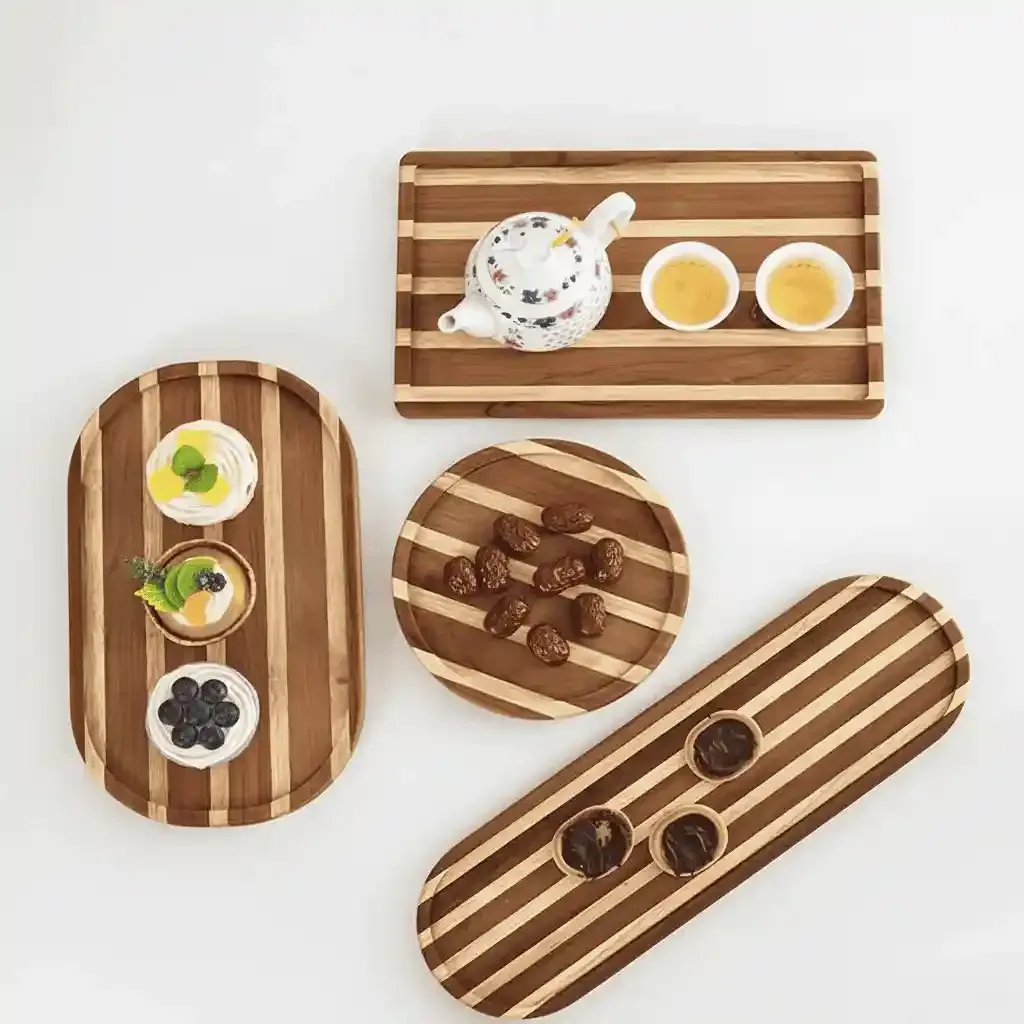
Display and merchandising. Retail trays sit still and get photographed. The grain has to run the length of the tray, the lip has to be consistent enough to look deliberate from three feet away, and the piece has to stack six high in a carton without the one underneath taking the load of the whole stack on its face.
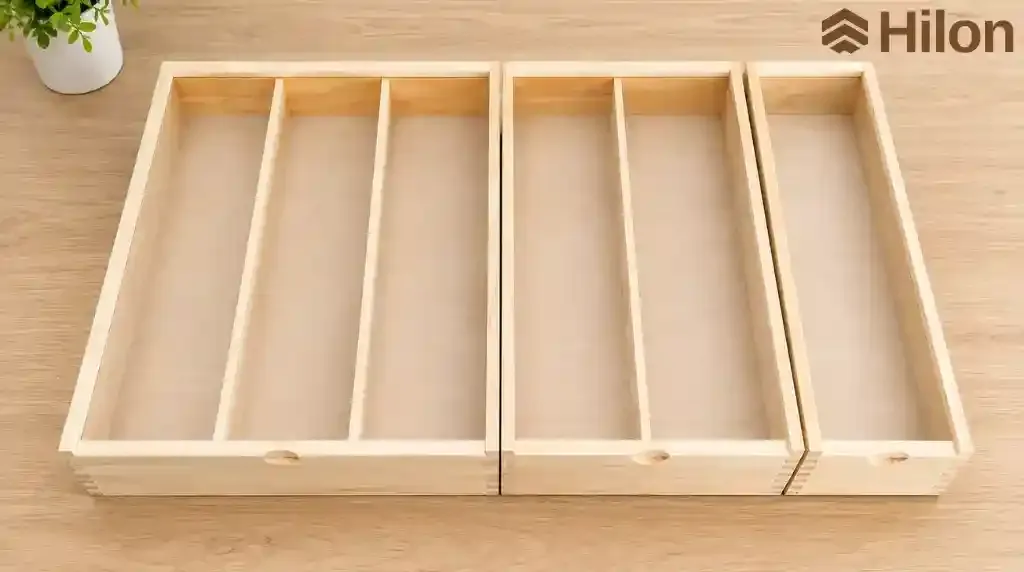
Storage and organisation. A tray used as a drawer insert or shelf organiser wants the opposite: 12–15 mm thick, little or no lip, and a footprint that matches standard cabinet depth. Handles are a liability here, because anything protruding stops it sliding in.
One SKU that tries to do all three usually ends up too heavy for the shelf and too shallow for service.
Species: Buy for the Finish You Plan to Sell
The species question is usually asked the wrong way round. Buyers ask which wood is best for trays, when the useful question is which wood is best for the finish and price point on the plan. A pale, even species is the right answer for a painted set and the wrong one for a natural-grain set, because one disappears under colour and the other is the reason a customer picks the tray up.
Density still matters. It decides how a tray feels when lifted and whether the face survives a commercial dishwasher. A soft species dents under a point load, and once the finish has cured around the dent it is permanent.
| Wood | Density and hardness | Grain and colour | Price | Where it fits |
|---|---|---|---|---|
| Acacia | 650–800 kg/m³ depending on species; hard, tight grain | Warm brown with golden highlights; strong contrast between growth rings | Mid to upper | Serving and charcuterie trays where the grain is the product |
| Birch | 690 kg/m³, 1,260 lbf Janka; T/R 1.3 | Pale, even, fine texture; stains and paints without blotching | Low to mid | Painted, stained and white-label trays |
| Beech | 720 kg/m³, 1,450 lbf | Pale, fine and even; takes stain and steam-bending cleanly | Low to mid | Colour-matched collections, restaurant service |
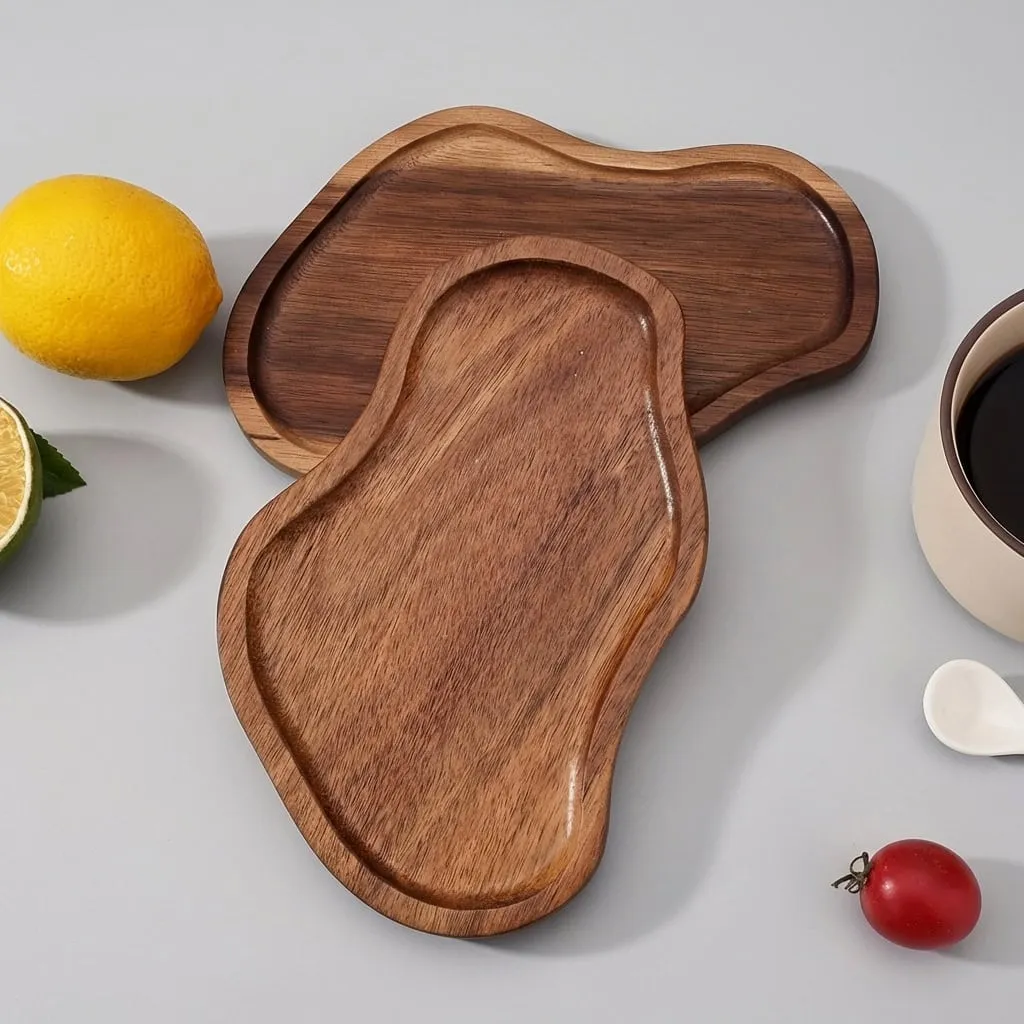
| Black walnut | 610 kg/m³, 1,010 lbf; T/R 1.4, the most stable here | Chocolate-brown heartwood, straight grain, occasional dark stripes | Highest | Premium serving trays and cheese boards |
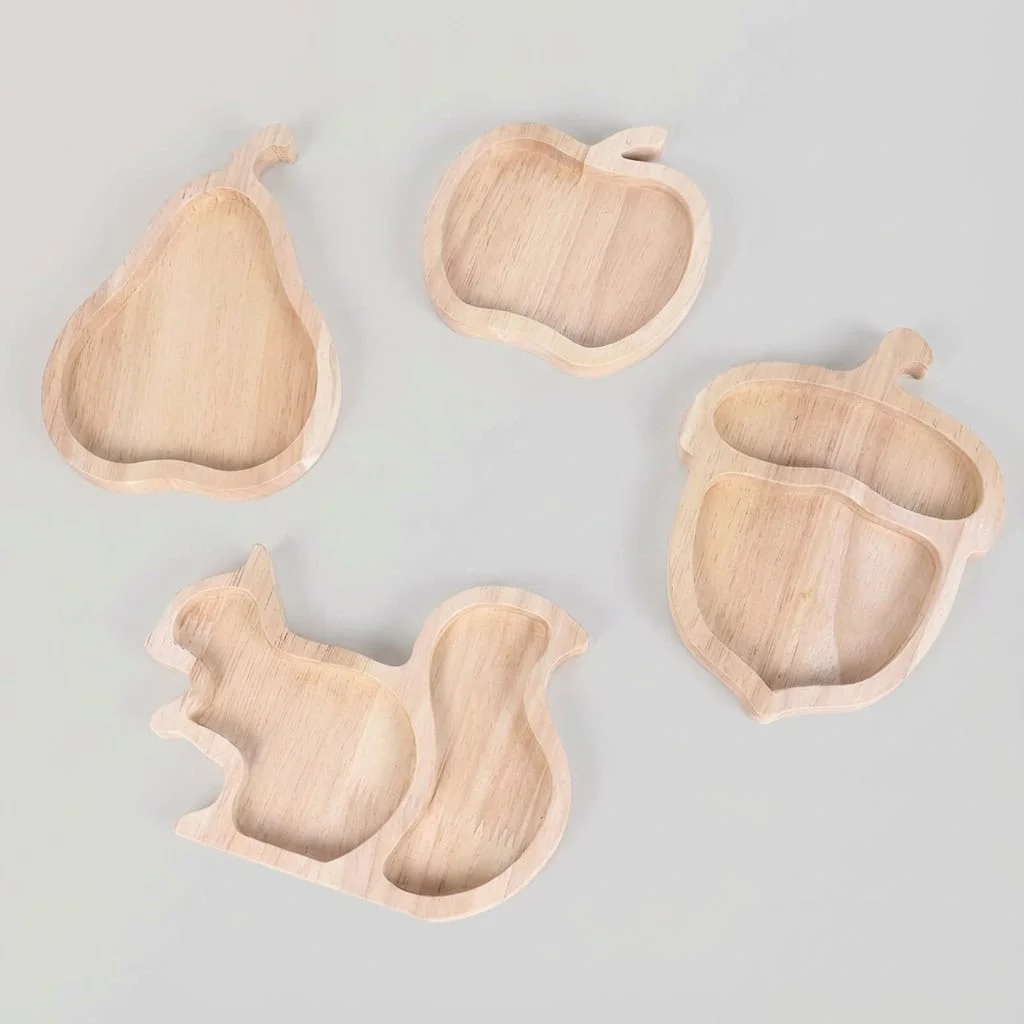
| Rubberwood | Softer than beech at roughly 960 lbf | Consistent pale tone with little variation board to board | Lowest | Volume promotional and department-store lines |
| Bamboo | Strand-woven board 1,000–1,200 kg/m³ and 2,500–3,000 lbf | Straight grain with visible nodes; carbonized for a darker tone | Low at volume | Eco-positioned lines and lightweight serving trays |
| Pine | Janka ~400; the softest wood on this list | Light, warm, knotty; rustic by nature | Lowest | Farmhouse finishes where dents read as character |
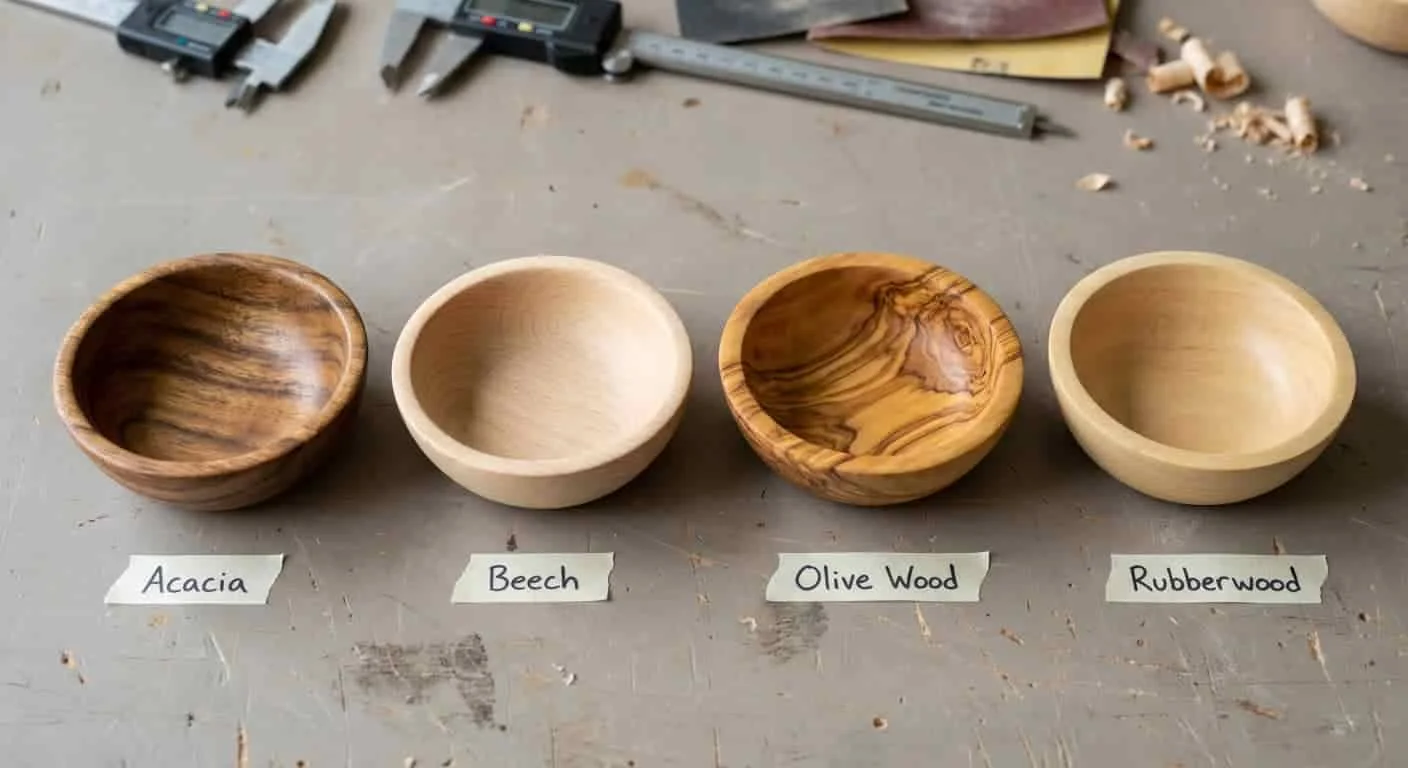
Two of these are specification problems wearing the costume of a material choice. Acacia is a genus with dozens of commercial species, and the density range above is not a rounding error — it is a different tray. Olive wood runs from pale to dark-striped within a single board, so a matched set is not achievable at volume; it works for one-off and gift pieces.
Birch is the one buyers underestimate. At 690 kg/m³ and 1,260 lbf it is harder than most beech and close to oak, it machines and sands cleanly, and its T/R of 1.3 makes it one of the calmer species on the list. What it does not do is resist decay, which matters for a bathroom or plant tray and not at all for a serving tray.
If the range includes a painted line, specify birch or beech and approve the colour sample on that species. Paint on acacia reads differently from paint on birch at the same RAL number, because the grain underneath is doing different things.

Thickness, Span and Why Trays Cup
Trays run 12–25 mm thick, and the choice is a span decision rather than a style one. Under 12 mm, a tray spanning more than about 300 mm between supports feels springy and will cup when the humidity swings. Over 25 mm it has become a serving board with a lip, and freight per unit climbs without the customer seeing what they paid for.
Blank construction matters as much as thickness. A one-piece solid blank cut from a wide board is the most expensive option and the most dimensionally honest — every tray is what the board was. Edge-glued blanks, with strips jointed in alternating grain direction, cost less and resist cupping better than a single wide board of the same thickness, which is why most production trays over 25 cm are built that way. Plywood cores are the flattest option and the right choice for painted surfaces where any movement shows through the paint.
Wood moves across the grain as humidity changes. The ratio between radial and tangential shrinkage — T/R — predicts how hard a species will fight a flat panel. Birch at 1.3 and walnut at 1.4 are calm; species with a high T/R twist and cup, and need either a thicker section or a narrower span.
None of it helps if the blank is dried to the wrong moisture content. Trays are kiln-dried to the equilibrium content of the destination: 6–10% for the United States, 8–12% for northern Europe, 6–9% for southern Europe. A tray dried for a humid warehouse and delivered to a heated apartment cups in its first winter, and the finish will not stop it.
Sizes and Formats That Sell
Size follows the job, and the sizes that repeat across orders are narrower than most new buyers expect.
| Format | Typical size | Where it sells |
|---|---|---|
| Small snack / tapas tray | 20–26 × 12–16 cm | Gift sets, café service, multipacks |
| Breakfast tray | 30–35 × 20–25 cm | Hospitality, room service, home retail |
| Serving tray | 40–45 × 28–32 cm | Dining, restaurant service, core retail SKU |
| Ottoman / coffee table tray | 45–50 × 30–35 cm | Home décor, styled photography |
| Long oval | 26–38 × 12–18 cm | Bread, olives, charcuterie, candle displays |
Depth matters as much as footprint. A tray with a 10 mm lip holds a rounded object in place; a 25 mm lip contains a spill. Buyers who specify a size without a lip height get one chosen for them, and it is usually the cheap one.
Food-Safe Finishes on a Flat Surface
A tray takes more abrasion than a bowl. It gets cut on, stacked, wiped with a cloth and slid across a counter, which changes which finishes make sense.
Penetrating finishes — food-grade mineral oil, a beeswax blend, hardwax oil — soak into the wood instead of coating it. A scratch does not open a film, and the end user can re-oil a dry patch at home without the surface going patchy. This is the right family for cutting and serving trays.
Film finishes — lacquer, water-based clear coat — sit on the surface and give a harder, more even sheen. They suit display and merchandising trays that never see a knife, and they are the wrong choice anywhere the customer will cut.
Compliance is where first orders stall. Food-contact finishes are supplied against FDA 21 CFR 175.300 (coating migration ≤10 mg/in², lead ≤90 ppm) and German LFGB (overall migration ≤60 mg/kg, formaldehyde ≤15 mg/kg, lead ≤1.0 and cadmium ≤0.5 mg/kg, plus the odor and taste tests LFGB requires). Laminated or edge-glued blanks use adhesives compliant with 21 CFR 175.105. We supply material declarations and coating specification sheets, and submit production samples to an ISO 17025 lab when the destination market needs a report in the buyer's name.
One detail decides how a tray ages: seal both faces and all edges, not just the top. A tray coated on one side only absorbs moisture unevenly and cups toward the dry face, and no specification prevents that if the finishing line coats only the show side.

Unfinished Trays and the DIY Channel
Unfinished is the fastest-growing request from craft, DIY and private-label channels, and it is also the specification most often described too loosely. A bare tray is not simply a tray that skipped the finishing line.
Three things have to be true. Sanding: unfinished trays go through 180, 220 and 240 grit, with every routed edge broken by hand so a buyer does not catch a splinter from a corner. Moisture: the blank is dried to the destination's equilibrium content, for the reason above — sanding does not stop a panel from moving. Cleanliness: no burnished patches from a dull cutter and no glue squeeze-out on the show face, because the buyer's first coat of oil will go on unevenly and there is no fixing it afterwards.
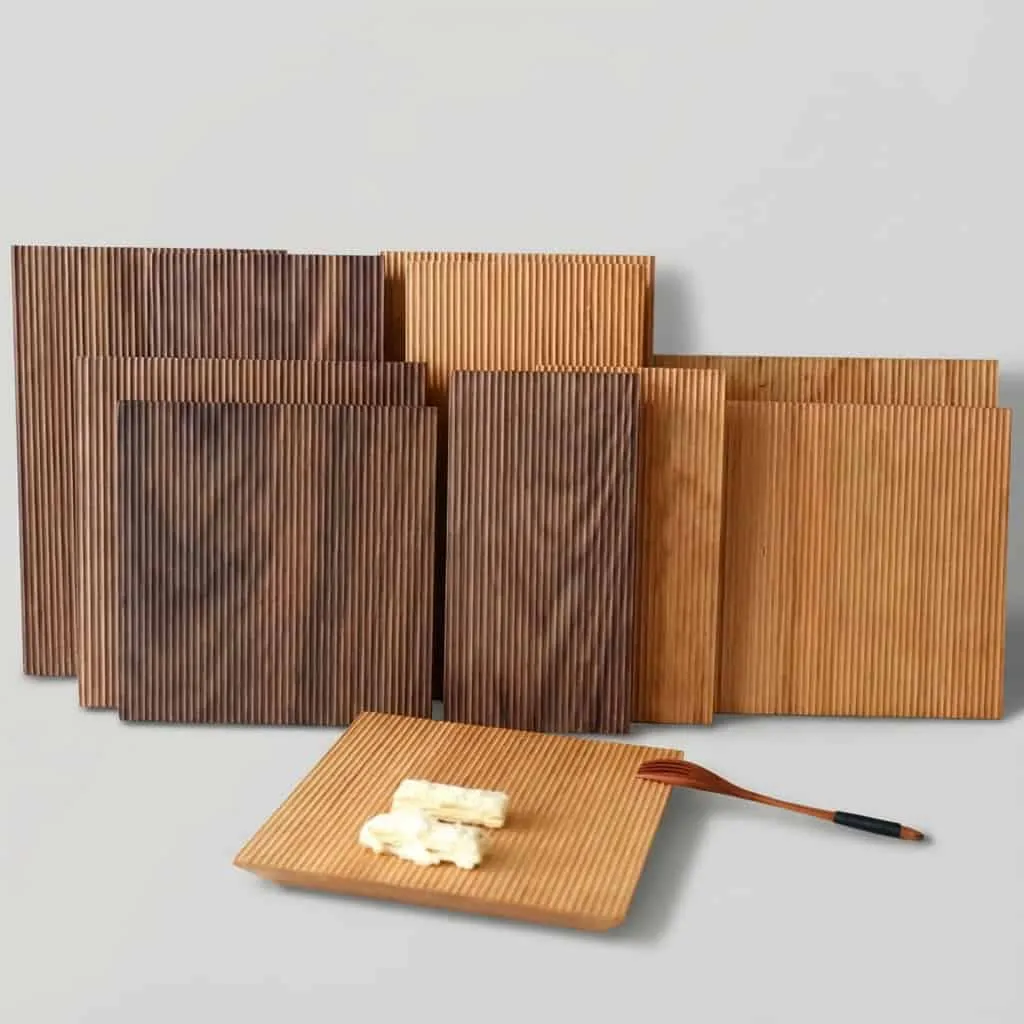
What gets applied in market depends on the species. Birch and beech take hardwax oil or water-based lacquer evenly. Acacia and walnut want an oil that deepens the grain rather than flattening it. Pine needs a sealer first, or the knots bleed through a light stain.
Handles, Edges and the Cost of Complexity
Handle options, roughly in order of cost:
- Routed finger groove — machined into the underside, invisible from above, no hardware. The cheapest way to add grip.
- Cut-out side grips — a routed opening at each end. Still no hardware, but every opening is a stress point and the wall behind it has to be thick enough not to split.
- Metal bar handles — bolted through the sides. The strongest option and the only one that survives a heavy load, but the drilling adds a step and the hardware adds a part number to the bill of materials.
- Rope or leather loops — threaded through drilled holes. Cheap to add, and the one option that introduces a material you do not control.
Edge profiles follow the same logic. A 6–10 mm rounded edge is fast to produce and comfortable in the hand; a bullnose or a chamfer takes more passes. Every extra operation on a tray adds cost and a place where the finish can pool or the sanding can miss.
What Actually Moves the Price
Material is the largest line on a wooden tray's cost sheet, and it is the line buyers negotiate hardest and control least. What a buyer can control is complexity. One outline with four species, three finishes and two edge profiles is a single production run. Five outlines is five setups, five jigs and five approvals, at the same total quantity.
MOQ on a standard tray design runs 100–300 pieces. Mixed containers are what make a first order workable: several designs, species and finishes consolidated into one shipment, so a buyer can test a range without committing a container to a single SKU.
Two costs surprise first-time buyers. Sampling runs 7–15 days and is usually credited against the bulk order, but it is not free up front. And finishing is labour rather than machine time — it scales with the number of faces that have to be sanded, sealed and sanded again, which is why an unfinished tray can cost a third less than the same tray in a hardwax oil.
Packing and Freight for Flat Goods
Trays are the easiest product in a wooden range to ship and the easiest to damage in transit, for the same reason: flat, wide, and unsupported in the middle. A dropped carton lands on a corner, and the corner takes the panel with it.
Production trays ship with corner protectors and a divider between every piece, stacked no more than six high in a carton sized to the tray so nothing shifts. Mixed containers are standard, each SKU labelled and palletized separately so receiving does not have to unpack a container to find one line.
A 40HQ holds about 68 m³, and because trays are light, a container runs out of space long before it reaches its weight limit. Freight per piece is decided almost entirely by how tightly the cartons stack. The corollary is worth repeating to anyone choosing a size: shaving 3 cm off a tray's length can cut landed cost more than switching to a cheaper finish.

How to Vet a Tray Supplier
Seven questions separate a supplier who can run a tray programme from one who can cut rectangles:
- Which species, by botanical name, and can you send a sealed colour sample taken from the production lot?
- What moisture content will you dry to for my market?
- How is the blank built — one piece, edge-glued or plywood core — and what is the T/R of the species?
- Which finish, against which standard, and can I have the coating specification sheet before I order?
- Can I approve a packing drawing before production starts?
- What does your inline QC check, and at which production stage?
- Will I get a photo set of the packed cartons before the container is sealed?
A supplier who answers from memory is describing a system they run. One who has to check with the factory for all seven is brokering your order to somebody else, and the margin is going somewhere other than the product.
Building a Tray Range Alongside Other Wooden Products
Trays sit at the intersection of three product groups, and a range that crosses them sells better than one built from a single category.
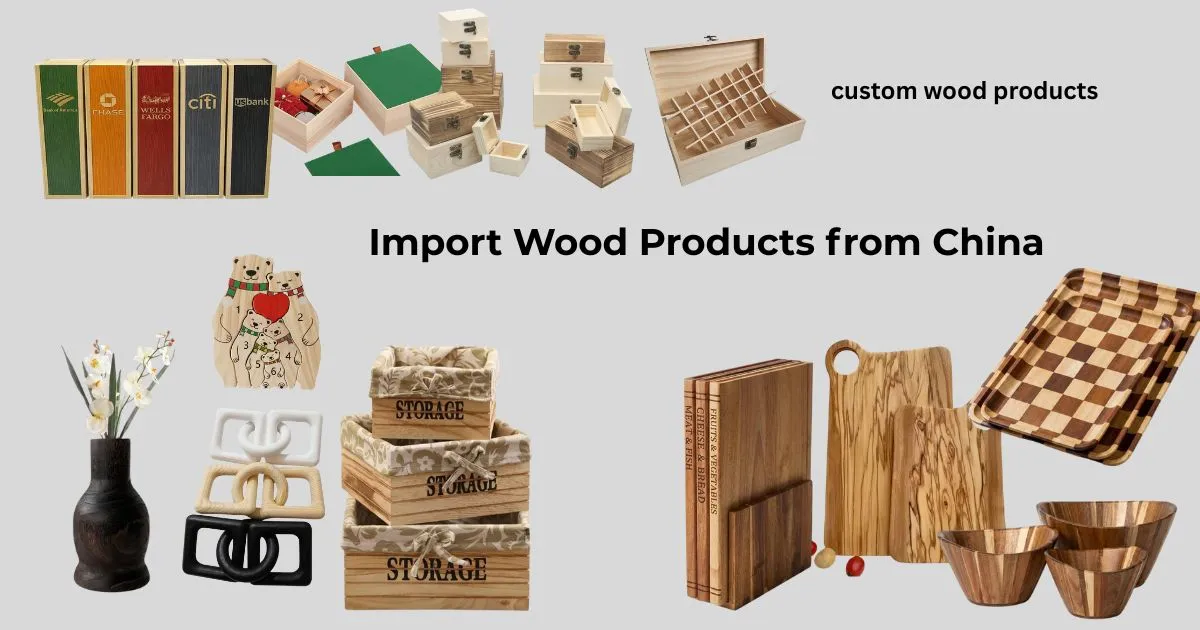
With serving boards, a tray becomes the second SKU in a charcuterie set — same species, same finish, half the tooling, because the blank construction is identical. With cutting boards, the tray takes the same food-safe finish and the same moisture specification, so one compliance file covers both. With wooden bowls, the species list can be shared exactly, and a matched table service in acacia reads as one collection rather than three separate purchases.
The tray range we manufacture is at custom wooden trays, and the kitchen side of it at wooden kitchen products.
Where to Start
If this is a first tray order, the shortest path is one outline, one species, one finish, at 100–300 pieces, packed to the carton dimension you actually want to ship in. Test that SKU, then add species and finishes to the same outline rather than outlines to the same species. The second order costs less than the first, and the third is usually where a tray range turns into a category.